Before It Was Empty, It Was Everything
What a depot reveals about the system it served
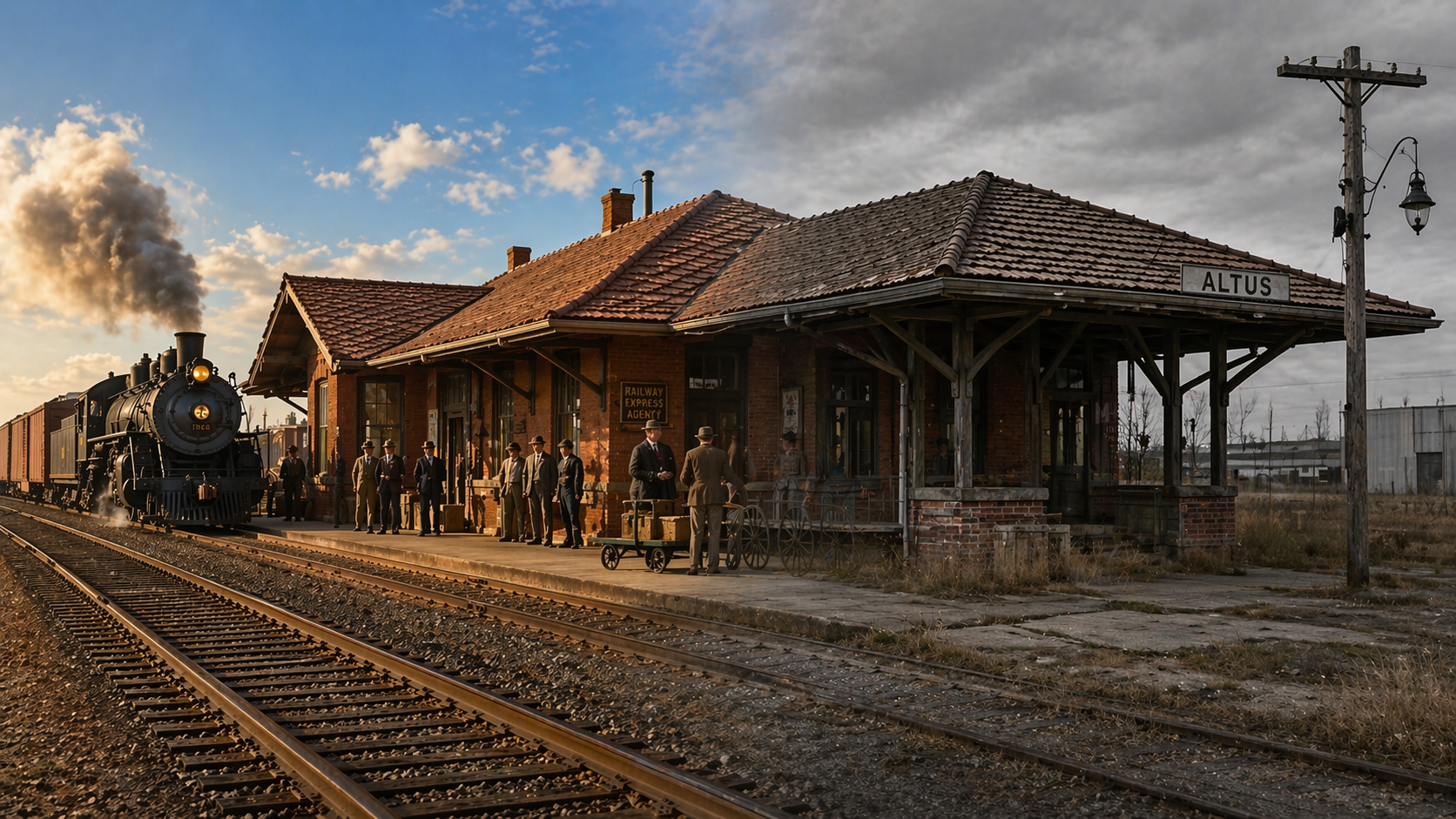
A photo of the old Katy depot in Altus showed up in a Facebook group this week. The comments were predictable.
It should be a bar.
It would make a great restaurant.
Someone should do something with it.
That’s usually how these things go. An empty building gets treated like a blank canvas.
This one isn’t blank.
“Katy” is the Missouri–Kansas–Texas Railroad. Not the Santa Fe. Altus had both at different points, which is probably where the confusion comes from.
The line that ran past that depot moved through western Oklahoma’s agricultural belt. Cotton, grain, livestock. Not glamorous, but steady. The kind of work that keeps a place viable.
The depot wasn’t built to be admired. It was built to keep things moving.
Railroads did something subtle to towns like Altus. They introduced timing where there hadn’t been much need for it.
A train doesn’t wait. Everything around it adjusts instead.
Inside that building, someone was tracking freight, passing messages, making sure the right things ended up on the right cars at the right time. Outside, the platform handled whatever showed up next.
It looks small because it had a narrow job. It mattered because the job connected outward.
By the time I noticed it, most of that had already thinned out.
If you stood on Bradford, you could still see the green and yellow MKT engines moving through. They weren’t in a hurry. Fewer cars than you’d expect. Sometimes long stretches with nothing at all.
The trains were still there. The reason for them felt quieter.
It didn’t register as a decline at the time. Just how things were.
The shift came in pieces.
Trucks took over the short runs. Highways handled what rail used to carry locally. Passenger service disappeared first, then the rest started to follow.
The Katy didn’t collapse so much as get folded into something bigger. Different priorities. Fewer reasons to stop in places like Altus.
The depot stayed put. Its job didn’t.
Turning it into a bar or a restaurant isn’t a bad idea. It’s just answering a different question.
You can fill a space without understanding it.
A lot of these buildings end up that way. The structure stays. The story gets reduced to atmosphere.
Exposed brick. Good lighting. Maybe a framed photo of a train on the wall, just to nod at what used to be there.
Before it was empty, that building was doing real work.
It connected a small town to places most people there would never see. It gave shape to movement that otherwise wouldn’t have had one.
Take the system away and you’re left with something harder to read.
We do this a lot. We inherit the physical remains of systems and skip straight to what they could become next.
Fair enough. Towns change. Needs change.
Still, it’s worth pausing long enough to get the first part right.
The depot doesn’t need a new idea.
It needs a clear memory of what it was.
Not a building.
Something that made other things possible.

Subscribe to Amid the Noise
Amid the Noise is an ongoing body of work on signal, systems, governance, AI, and the structures that shape human judgment under pressure.
Subscribe to receive new essays as they are published.