Copy, Paste, and the Myth of the Inventor
Most things arrive carrying more people than history remembers.
Most people know copy and paste.
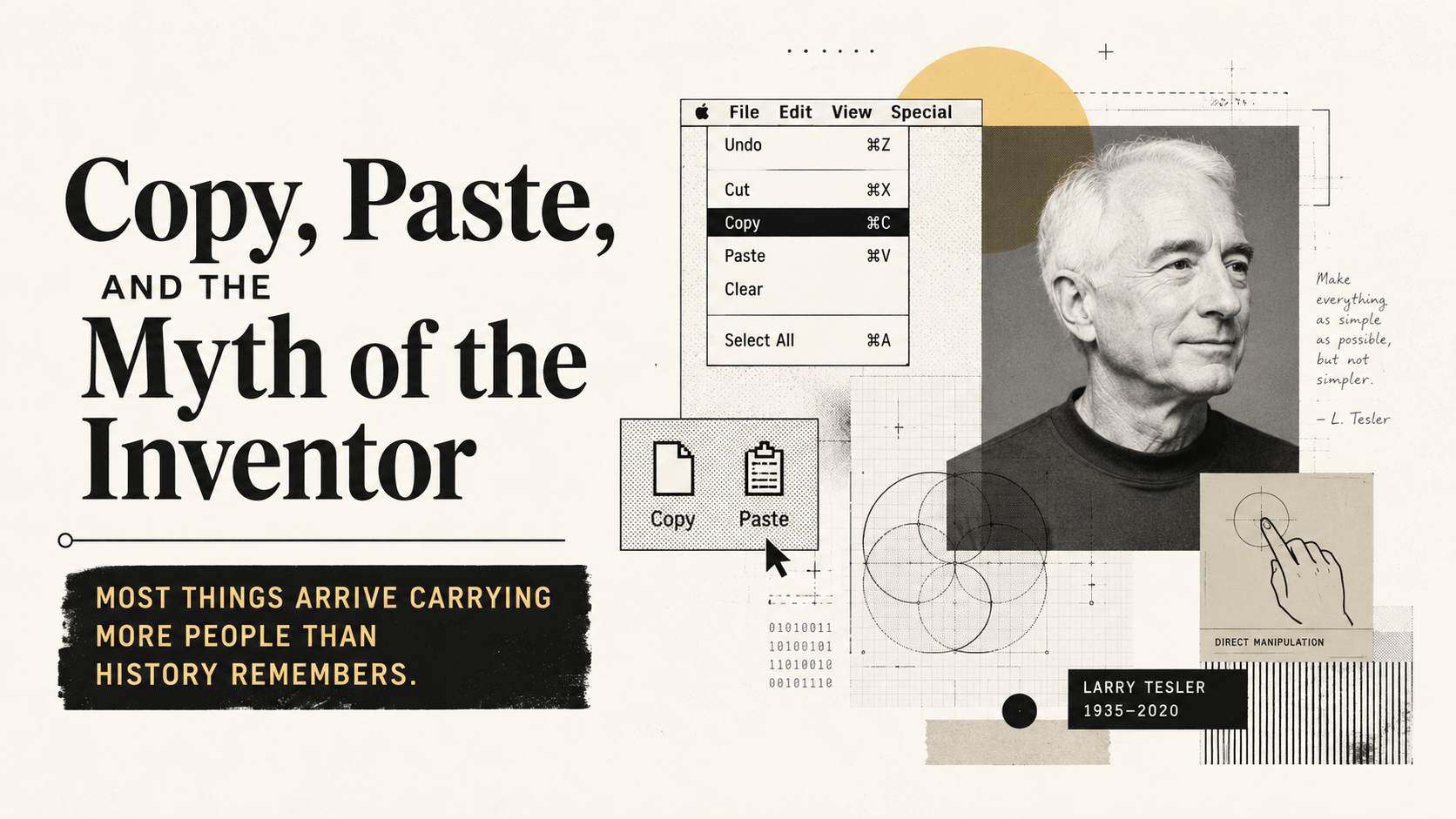
Very few know Larry Tesler.
I knew Larry at Yahoo. Years later, he nearly hired me at 23andMe before the company became the kind of place people casually reference in documentaries about Silicon Valley. At the time, none of that felt historic. It felt like work. Conference rooms. Product conversations. Smart people arguing over details most users would never consciously notice.
Larry just happened to be one of the people in those rooms.
Only later did I fully appreciate how much of modern computing quietly carried his fingerprints.
Tesler belonged to a generation of computing pioneers whose ideas became so successful they effectively disappeared into normal life. Most people do not think about where copy and paste came from any more than they think about who invented the stoplight. Once infrastructure becomes ordinary, the names attached to it begin to evaporate.
Meanwhile, culture prefers inventors with stage presence.
That version of innovation is easier to package. Easier to market. Easier to remember.
One person. One breakthrough. One moment where the future suddenly arrives fully formed.
Real technology rarely works that way.
The farther I moved into design and systems work, the harder it became to believe in the lone genius version of history. Most meaningful breakthroughs seemed to emerge from layers of prior thinking. Someone develops an underlying concept. Years later, someone else figures out how ordinary people might actually live with it. Another team refines the interface. Another company scales the distribution. Eventually the public compresses the entire story into a single recognizable face.
Steve Jobs became that face for a generation of consumer technology.
That is not an insult. Apple changed the trajectory of modern computing. Jobs had extraordinary instincts around integration, taste, simplification, and emotional resonance. He understood that technology is not experienced as engineering. It is experienced as friction, clarity, confusion, delight, intimidation, momentum.
That understanding mattered.
At the same time, many of the ideas associated with Apple existed long before Apple refined them into mass adoption. The graphical interface. The mouse. Portable computing. Touch interaction. Even the smartphone itself existed in rougher forms before the iPhone arrived and reorganized the category around usability and coherence.
History tends to flatten that distinction because refinement is difficult to dramatize. A keynote is easier to narrate than twenty years of accumulated interface thinking.
Larry understood interface thinking deeply.
One of the things I remember most about that era was how much attention serious designers and technologists paid to reducing unnecessary friction. Not adding complexity. Removing it. The work often felt less like inventing something from nothing and more like slowly uncovering the shape something should have had all along.
That kind of contribution rarely photographs well.
You can see the same pattern all over technology. The public remembers the founder, the product launch, the breakthrough moment. Meanwhile entire generations of researchers, designers, engineers, operations teams, and mentors quietly disappear into the background once their ideas become ordinary enough to stop looking innovative.
I think about that more now than I used to.
Especially after Larry passed in 2020.
Most people using computers today have benefited from ideas he helped normalize without ever hearing his name. There is something strangely beautiful about that. A little sad too. The work became infrastructure. Invisible in the way successful infrastructure usually does.
Maybe that is the real shape of innovation.
Not lightning.
Accumulation.
Not a single inventor standing alone at the edge of history, but thousands of people handing incomplete ideas to each other across decades until something finally becomes simple enough for the rest of us to use without thinking about it.
Most things arrive carrying more people than history remembers.

Subscribe to Amid the Noise
Amid the Noise is an ongoing body of work on signal, systems, governance, AI, and the structures that shape human judgment under pressure.
Subscribe to receive new essays as they are published.