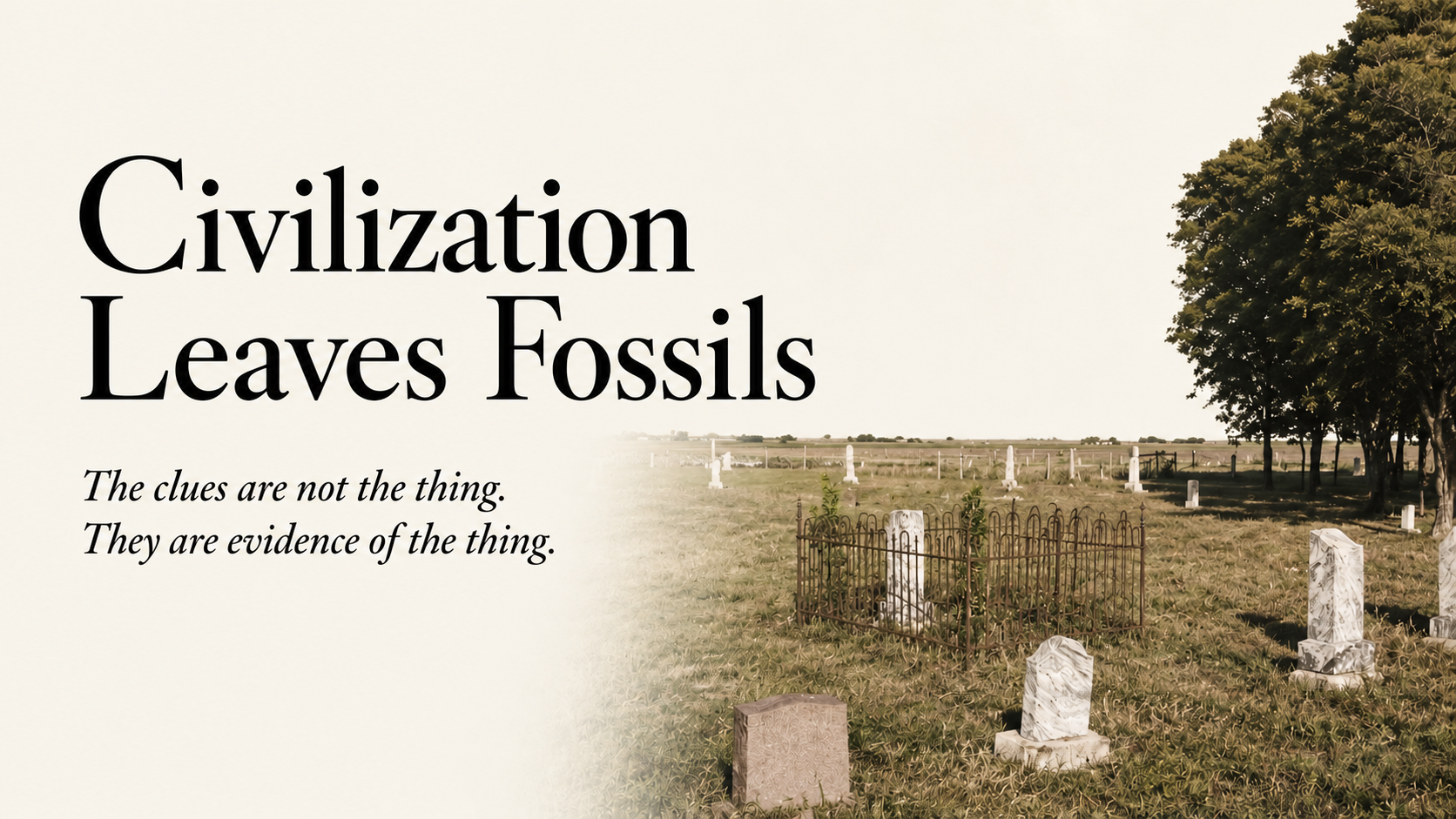
Civilization Leaves Fossils
The clues are not the thing. They are evidence of the thing.
A glass door on California Avenue in Palo Alto still bears the word Mayfield.
Most people walk past it without a second thought. There is no particular reason they should do otherwise. Mayfield ceased to exist as an independent town a century ago. Palo Alto absorbed it, the maps were redrawn, and life moved on.
Yet there it remains.
A fragment of a previous landscape.
Not the town itself, but evidence that the town once existed.
Around the same time, I found myself thinking about Frazier, Oklahoma.
Growing up in Altus, I was told that Frazier was the region’s first serious attempt at settlement. The town was established near the Red River, where repeated flooding eventually made permanence difficult. The settlement disappeared. Altus emerged on higher ground. Today, one of the most visible remnants of Frazier is a cemetery standing where a community once stood.
The town is gone.
The cemetery remains.
Standing in that cemetery, I do not think much about the flood itself. I think about the people who believed they were building something permanent. Families buried their dead there. Children grew up there. Businesses opened there. Arguments were settled there. Then, in 1891, the river reminded everyone that permanence is often an illusion. The town disappeared. The post office was dragged to higher ground, where Altus stands today. What remains is not simply evidence of a vanished settlement. It is evidence of people adapting to circumstances they could not control.
At first glance, a cemetery in Oklahoma and a name on a glass door in California appear to have little in common. Yet I have become increasingly convinced they represent the same phenomenon.
They are low-information artifacts.
A paleontologist does not excavate an entire dinosaur. They recover a tooth, a vertebra, a footprint, or a fragment of bone. The organism itself has vanished. What remains is enough evidence to reconstruct the larger structure that produced it.
Civilization leaves behind similar traces.
A cemetery is evidence of a settlement.
A road that curves unexpectedly is evidence of an earlier transportation route, a property boundary, or a geographic constraint that no longer exists.
A city boundary is evidence of a political compromise that nobody remembers making.
A law is evidence of a social condition that has long since disappeared.
A symbol is evidence of a belief system whose original context has been forgotten.
The artifact survives. The system that produced it often does not.
Or at least, that is how it first appears.
The deeper realization is that these artifacts are not interesting simply because they tell us what once existed. They are interesting because they reveal forces that continue to shape the present. The cemetery at Frazier is evidence of why Altus exists where it does. The word Mayfield survives because Palo Alto grew around an earlier settlement rather than emerging from nothing. The residue remains because the underlying history still exerts influence long after the original circumstances have faded from memory.
Once I started looking for these artifacts, I realized they were not confined to the physical world. Cities preserve them. Institutions preserve them. Symbols preserve them. Entire societies carry traces of earlier conditions long after the original circumstances have vanished.
East Palo Alto, for example, cannot be understood solely by looking at East Palo Alto today. The city contains traces of lending practices, migration patterns, municipal decisions, economic incentives, and political boundaries accumulated over generations. The present-day city is not those decisions, but it bears their imprint.
The same is true of institutions.
Millions of Americans interact with Social Security without spending much time thinking about the Great Depression. Millions interact with Medicare without considering the political and social conditions that produced it. Yet both are artifacts of particular historical moments. They are not history books. They are historical residue embedded in everyday life, reminders that previous generations encountered problems significant enough to permanently alter the structure of governance.
Even symbols behave this way.
An ancient symbol survives because generation after generation found some reason to preserve it. The original meaning may have shifted. New interpretations may have accumulated. Entire mythologies may have formed around it. Yet the symbol itself persists as evidence that a previous generation considered it important.
This realization has changed the way I walk through cities.
A street name becomes a clue.
A monument becomes a clue.
An abandoned rail line becomes a clue.
A parcel boundary becomes a clue.
A family name attached to a building becomes a clue.
The question is no longer, “What is this?”
The question becomes, “What produced this?”
Perhaps that is why I find myself increasingly fascinated by governance, urban design, history, symbols, and even fictional worlds. They all reward the same habit of mind.
Observe the residue.
Reverse-engineer the system.
Reconstruct the world that produced it.
An archaeologist does this with fragments of pottery.
A paleontologist does it with fossilized bone.
A historian does it with documents.
A data scientist does it with observations.
A xenoanthropologist, if such a profession ever exists, would do the same thing with an alien civilization.
The process is fundamentally identical.
History is often presented as a sequence of events. Battles. Elections. Foundings. Disasters. Celebrations.
Yet most of us do not encounter history as events.
We encounter it as landscape.
The road beneath our tires.
The neighborhood boundary on a map.
The century-old law nobody remembers passing.
The cemetery in a field.
The word Mayfield on a glass door.
Civilization leaves fossils.
The challenge is learning how to recognize them.

Subscribe to Amid the Noise
Amid the Noise is an ongoing body of work on signal, systems, governance, AI, and the structures that shape human judgment under pressure.
Subscribe to receive new essays as they are published.