Between Perception and Perspective
How obedience disguises itself as clarity
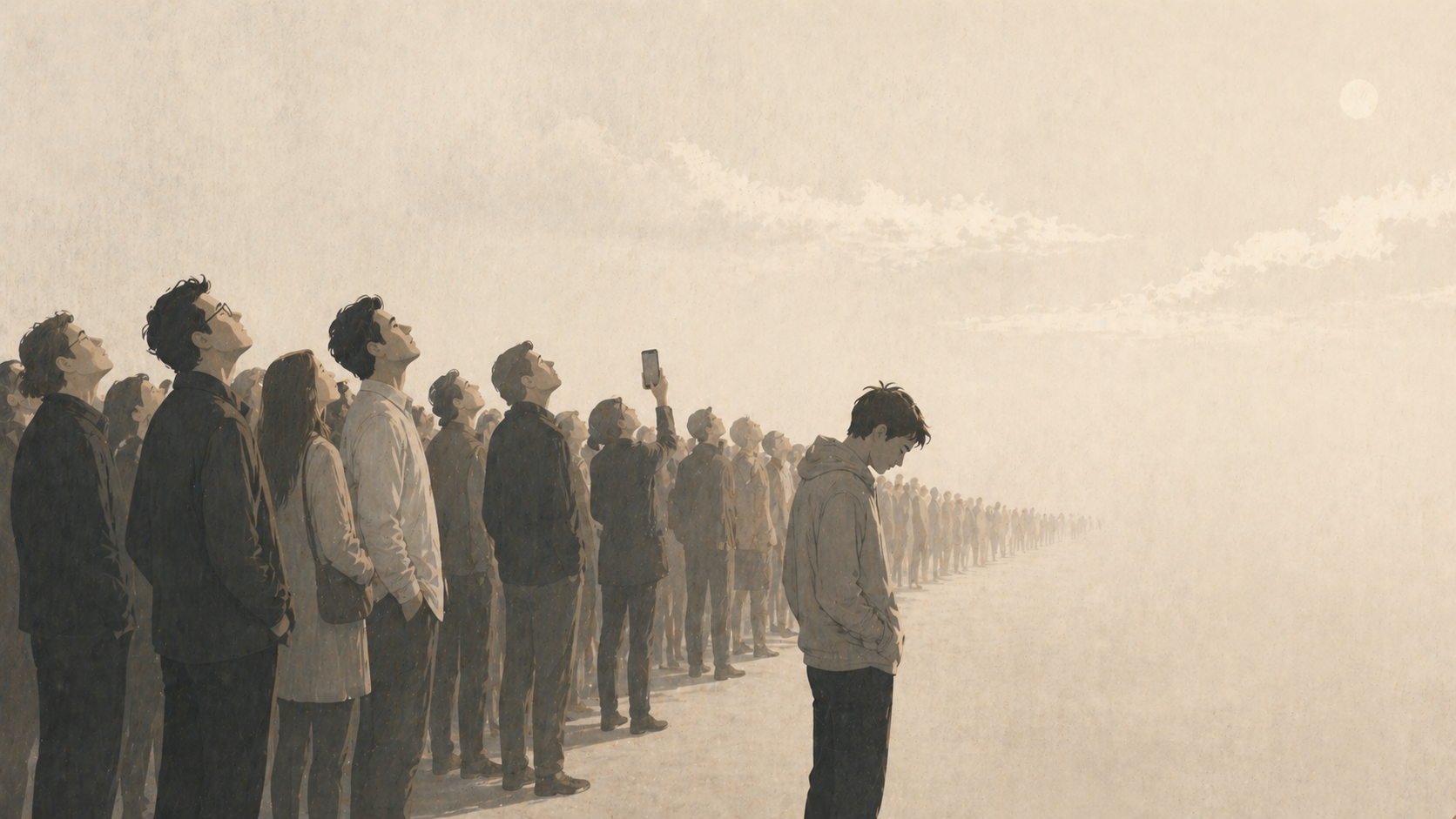
You are in a line. A long, weary line that stretches past the corner and keeps going—farther than you can see. At first, it is only the man in front of you who tilts his head upward. Then the woman beside him. Soon, like a ripple through water, dozens of faces turn skyward. A shared pause. A silent agreement.
So you look up too.
The sky offers little: a few thin clouds, the indifferent sun. Yet you keep staring. Not because there is something to see, but because others are seeing. One man even lifts his phone to record the absence, capturing the miracle of nothing at all.
In that instant, you are no longer yourself. You are a function of the line.
This is how obedience feels. It isn’t shackles or decrees, but a quiet surrender of perspective. We confuse perception—the raw fact of eyes turning upward—with perspective: the meaning we layer on top, the story we accept as truth.
Perception: heads are lifting.
Perspective: there must be something worth seeing.
That is the sleight of hand at the center of our age.
We are not short on intelligence; we are drowning in it. Our pockets hold more information than entire civilizations ever dreamed. The tragedy is not ignorance but our willingness to rent perspective from others rather than build one of our own.
Real thinking is not comfortable. It asks you to tear down the house you have lived in, belief by belief, until you are standing at the studs. It asks you to face the possibility that what you were certain of yesterday was propaganda, projection, or simply habit. It asks you to live with the grief of discarding not just ideas, but former versions of yourself.
That grief is the cost of freedom.
The line will always be there—stretching down the block, craning upward. Breaking from it is not dramatic; it is subtle. It begins in the smallest split second: the moment between perception and perspective. Between the fact and the story. Between the stimulus and the meaning you assign.
The revolution will not arrive as headlines or hashtags. It arrives in that pause. In the willingness to say, quietly but firmly:
“What, exactly, am I looking at?”
Then, when the answer is nothing, lower your gaze and walk on.
The choice is binary. Either you think for yourself, or you remain a thought in someone else’s system.
Subscribe to Amid the Noise
Amid the Noise is an ongoing body of work on signal, systems, governance, AI, and the structures that shape human judgment under pressure.
Subscribe to receive new essays as they are published.