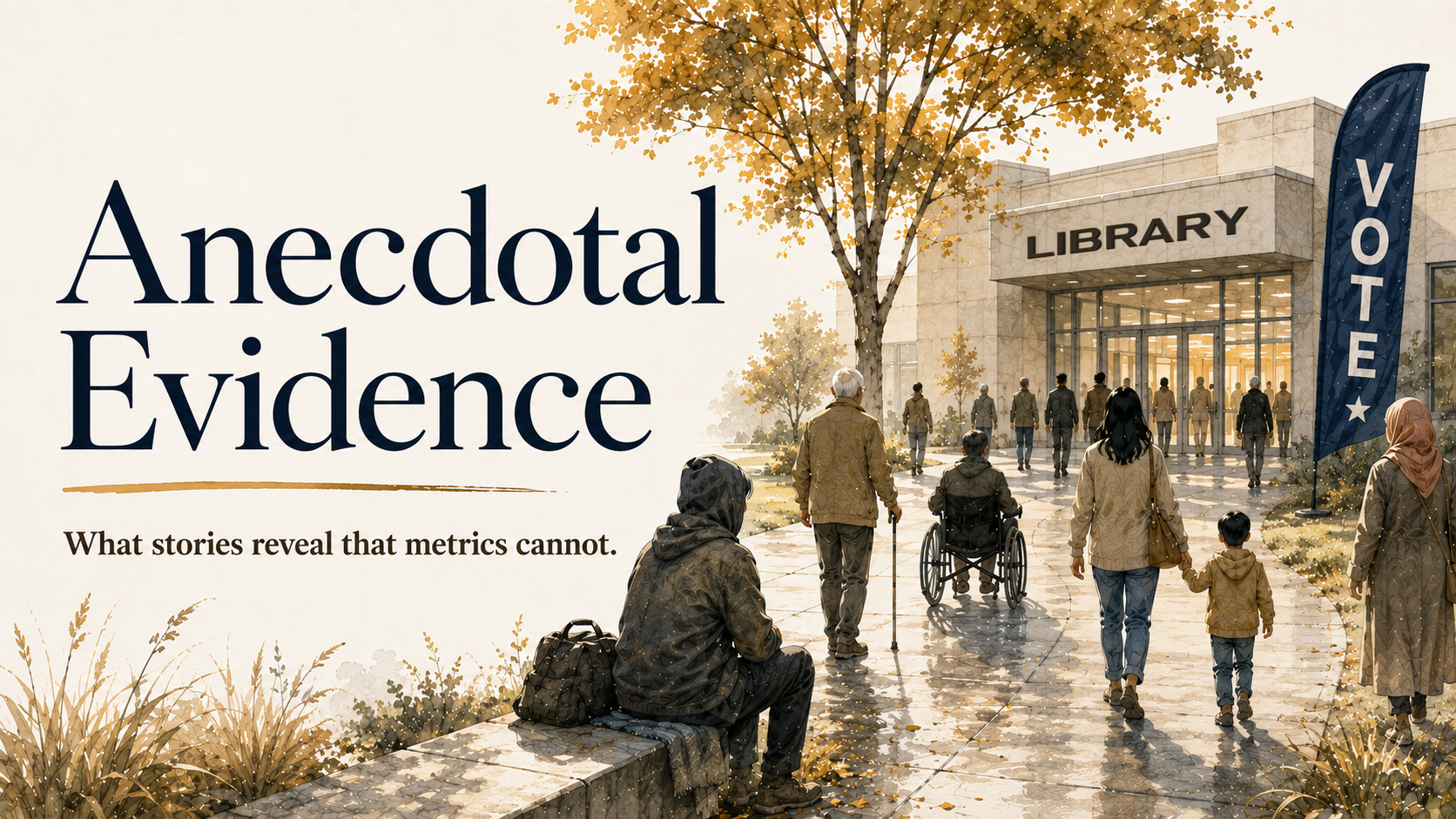
Anecdotal Evidence
What stories reveal that metrics cannot.
A year ago, two election observers visited our vote center.
By the time they reached us, they had already visited four others.
I expected questions about procedures.
Instead, they asked about people.
What accessibility resources had we used?
How were voters interacting with the equipment?
What challenges had we encountered?
What stories stood out?
The conversation lasted nearly thirty minutes.
At one point, I found myself fighting back tears.
Not because we were discussing voting machines, ballot accounting, or election procedures.
We were discussing people.
I told them about an elderly Vietnamese woman who arrived concerned about voter fraud. One of our native-speaking aides spent time with her, answered her questions, and helped her navigate the process.
She left smiling ear to ear.
Months later, when she saw me in the neighborhood, she still waved.
I told them about seniors who needed chairs at our touchscreen stations because standing for an extended period was difficult.
I told them about magnifying glasses, larger font sizes, inverse display modes, facsimile ballots, pocket translators, and adjustable touchscreen stations.
I told them about our unhoused voters.
One observer paused.
They told us they had not heard anyone at the other vote centers mention unhoused voters.
That surprised me.
Not because unhoused people had voted at our center.
Because it had never occurred to us that they were unusual.
They were simply voters.
Some needed help.
Some had questions.
Some needed more time.
Some needed reassurance.
Like everyone else who walked through the door.
The observers continued asking questions.
We talked about language access. We had eight languages represented through native-speaking aides.
We talked about accessibility. We used every tool available to make voting easier for people with different needs.
We talked about patience.
From the beginning, our philosophy had been simple:
It takes however long it takes to vote.
We rushed no one.
Eventually, one of the observers said something that has stayed with me ever since.
We had the strongest anecdotal evidence of any vote center they had visited.
At first, I wasn’t sure what to make of that.
In research, anecdotal evidence is often treated as a lesser form of evidence. It lacks statistical rigor. It does not establish causation. It cannot tell us whether an observation is representative.
Yet election observers do not spend their evenings traveling from vote center to vote center because spreadsheets can answer every question.
A report can tell you how many voters were processed.
A report can tell you how many accessibility devices were available.
A report can tell you how many languages were supported.
A report can tell you how many ballots were cast.
A report cannot easily tell you whether voters felt welcome.
It cannot tell you whether someone who arrived anxious left reassured.
It cannot tell you whether a senior felt rushed.
It cannot tell you whether a person who needed help felt comfortable asking for it.
It cannot tell you whether an unhoused voter felt like they belonged.
The stories revealed something the metrics alone could not.
The conversation also reminded me of a decision our team made during our very first huddle while setting up the vote center.
Before the doors opened, before the first ballot was cast, we agreed on a simple principle.
We would be a dignity-first vote center.
That did not mean relaxing procedures.
It did not mean ignoring security.
It did not mean changing eligibility requirements.
Santa Clara County’s election process is remarkably well designed. The training, safeguards, accessibility resources, and procedures are extensive.
The process itself was never the issue.
What changed was our posture.
When someone entered our vote center, our first instinct was not to screen them.
Our first instinct was to welcome them.
Eye contact.
A greeting.
An offer to help.
Patience.
Questions answered without hurry.
Time given freely.
The procedures remained exactly the same.
The experience did not.
A year later, that may be the lesson I remember most clearly.
The voting machines were the same.
The laws were the same.
The accessibility tools were the same.
The difference was a decision made during our first huddle.
Everyone who walks through that door gets eye contact.
Everyone who walks through that door gets welcomed.
Everyone who walks through that door gets the time they need.
We often talk about institutions as collections of rules, policies, and procedures.
Perhaps they are also collections of small decisions.
A greeting.
A chair.
A translated ballot.
A few extra minutes.
A willingness to meet people where they are.
The systems matter.
The rules matter.
The metrics matter.
Yet the stories people carry home matter too.
A year later, I am beginning to wonder if some of our most important institutions succeed or fail on decisions that small.

Subscribe to Amid the Noise
Amid the Noise is an ongoing body of work on signal, systems, governance, AI, and the structures that shape human judgment under pressure.
Subscribe to receive new essays as they are published.