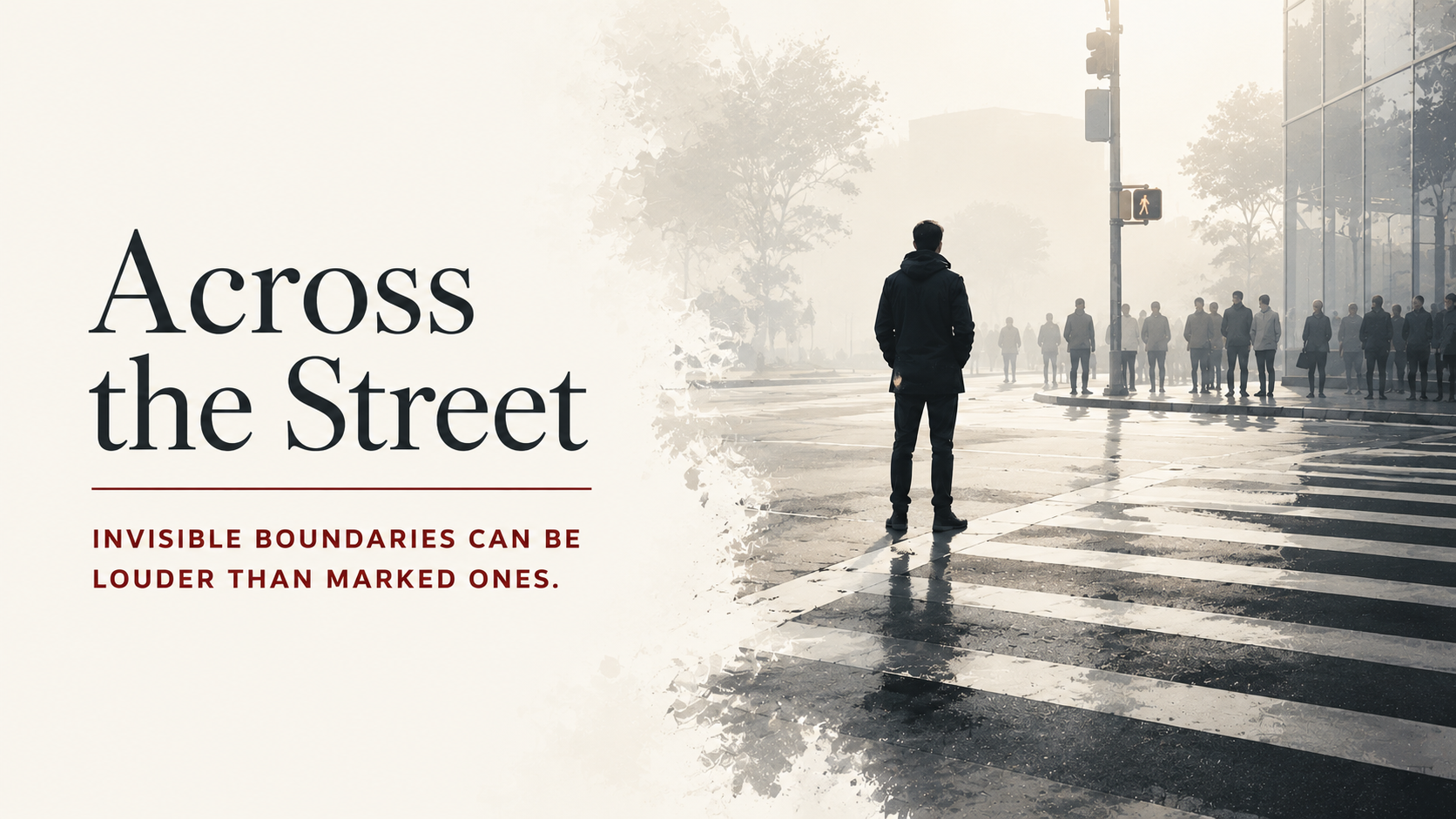
Across the Street
Invisible boundaries can be louder than marked ones.
Recently, a man put his arm through the front window of a vote center.
The glass exploded inward. By the time we reached the sidewalk, there was already a trail of blood leading away from the building.
The police were called. Reports were taken. Someone found a broom.
A few of us crossed the street.
The man had headed toward a nearby Recovery Café. We were not looking for a suspect. We were worried he might be seriously injured.
What happened next has stayed with me far longer than the broken window.
Nobody threatened us.
Nobody told us to leave.
Nobody raised a voice.
Yet the atmosphere changed the moment we stepped across the street.
Conversations slowed.
People watched.
Faces hardened.
The message was unmistakable.
We did not belong there.
Later that evening, I found myself thinking about how ordinary the street looked.
A few lanes of traffic.
A painted crosswalk.
The sort of road most people cross without a second thought.
Yet for a few minutes it felt much wider than it was.
What separated the two sides was not distance.
It was trust.
The longer I sat with that thought, the more uncomfortable it became.
The man who broke the window was clearly in distress.
The people outside the Recovery Café were protecting one of their own.
The election workers were concerned enough to follow a trail of blood.
Nobody involved appeared particularly surprised by the situation.
That may have been the most revealing part of the entire day.
The boundary existed long before the window broke.
The broken glass simply made it visible.
What stayed with me was how quickly people became roles.
Election workers.
Police officers.
People in recovery.
Residents.
Service providers.
Each label described something real.
None of them described a whole person.
That realization has stayed with me.
The strange part was that nothing about either side felt unfamiliar.
The election workers understood the boundary.
The people gathered outside the Recovery Café understood it.
The police appeared to understand it.
Nobody discussed it.
Nobody needed to.
The border was invisible.
Everyone knew where it was.
The man who broke the window disappeared before I learned what became of him.
I hope someone found him.
I hope he received medical attention.
I hope he is doing better today than he was that afternoon.
What remains with me is not the broken glass.
It is the realization that everyone knew where the boundary was.
Nobody discussed it.
Nobody had to.
The boundary existed long before the window broke.
The broken glass simply made it visible.
A few lanes of pavement separated the two sides.
The distance felt much larger.
I still find myself thinking about that street.

Subscribe to Amid the Noise
Amid the Noise is an ongoing body of work on signal, systems, governance, AI, and the structures that shape human judgment under pressure.
Subscribe to receive new essays as they are published.