Seeing Like a State
A foundational text for thinking about legibility, administrative simplification, and the gap between institutional models and lived reality.
The intellectual bedrock. A curated body of sources, references, and further reading that informs the research.
Works that shape the language of institutions, public systems, legitimacy, civic trust, and the design of durable structures under pressure.
A foundational text for thinking about legibility, administrative simplification, and the gap between institutional models and lived reality.
An essential influence on observing cities as living systems rather than abstract plans imposed from above.
A systems-thinking reference point for learning organizations, feedback loops, and the habits that allow institutions to perceive themselves more accurately.
A useful framework for understanding how tightly coupled, complex systems fail in ways no single actor fully controls.
References that inform the site’s approach to AI, decision systems, interpretability, governance, and human accountability.
Important background for thinking about alignment, human preference, and the limits of technical capability without governance.
A core design text for understanding affordance, feedback, error, and the ways systems teach people how to act.
A practical reminder that models become political when they affect people at scale while hiding assumptions behind technical authority.
A key influence for thinking about search, classification, bias, and the social consequences of computational systems.
Writers and observers whose work models compression, moral clarity, cultural reading, and the discipline of making complex systems visible.
A recurring influence on moral perception, clarity under pressure, and the refusal to let public language evade human consequence.
An influence on observational method, compression, irony, and the ability to make systems legible through ordinary speech.
A model for using speculative premises to expose civic, institutional, and moral structures that ordinary realism can miss.
A durable reference for language, power, institutional truth, and the fragility of shared reality under political pressure.
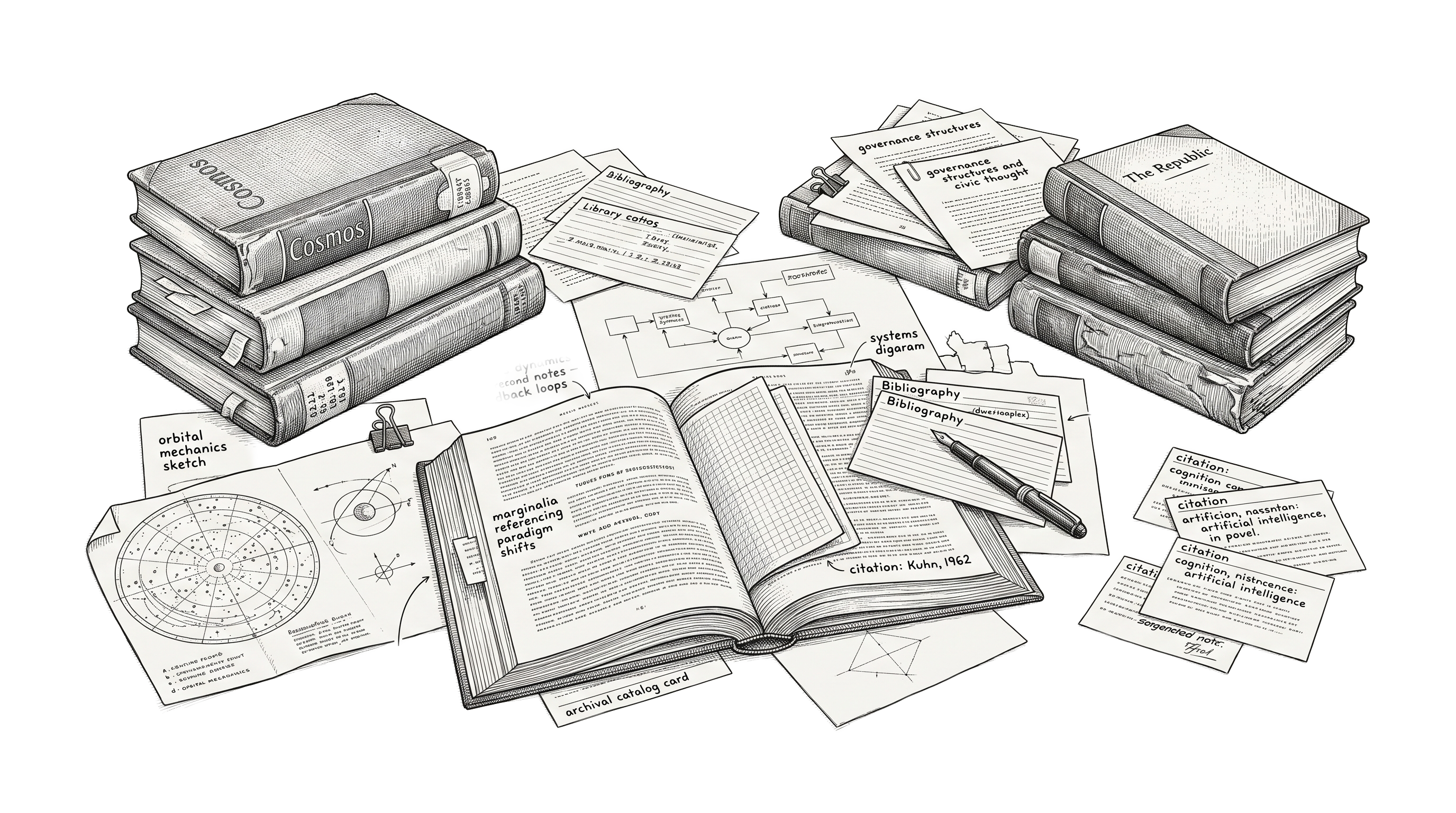
Sources that shape the site’s habit of using astronomy, science fiction, physics, and world-building as laboratories for civic thought.
A historical anchor for the discipline of honoring observed reality when inherited models fail to explain what the world is doing.
A recurring reference point for intelligence, tools, human evolution, and the unease that appears when systems exceed familiar understanding.
A long-running civic thought experiment about institutions, exploration, governance, pluralism, and life inside designed systems.
A major influence on thinking about ancillas, augmented intelligence, human-machine partnership, governance across civilizations, and the relationship between memory, identity, and decision-making.
A recurring influence on legitimacy under crisis, institutional continuity, scarcity, civilian governance, and the moral burden of leadership when every decision carries existential consequence.
A useful modern reference for infrastructure, scarcity, political legitimacy, and the consequences of human systems expanding beyond their original scale.