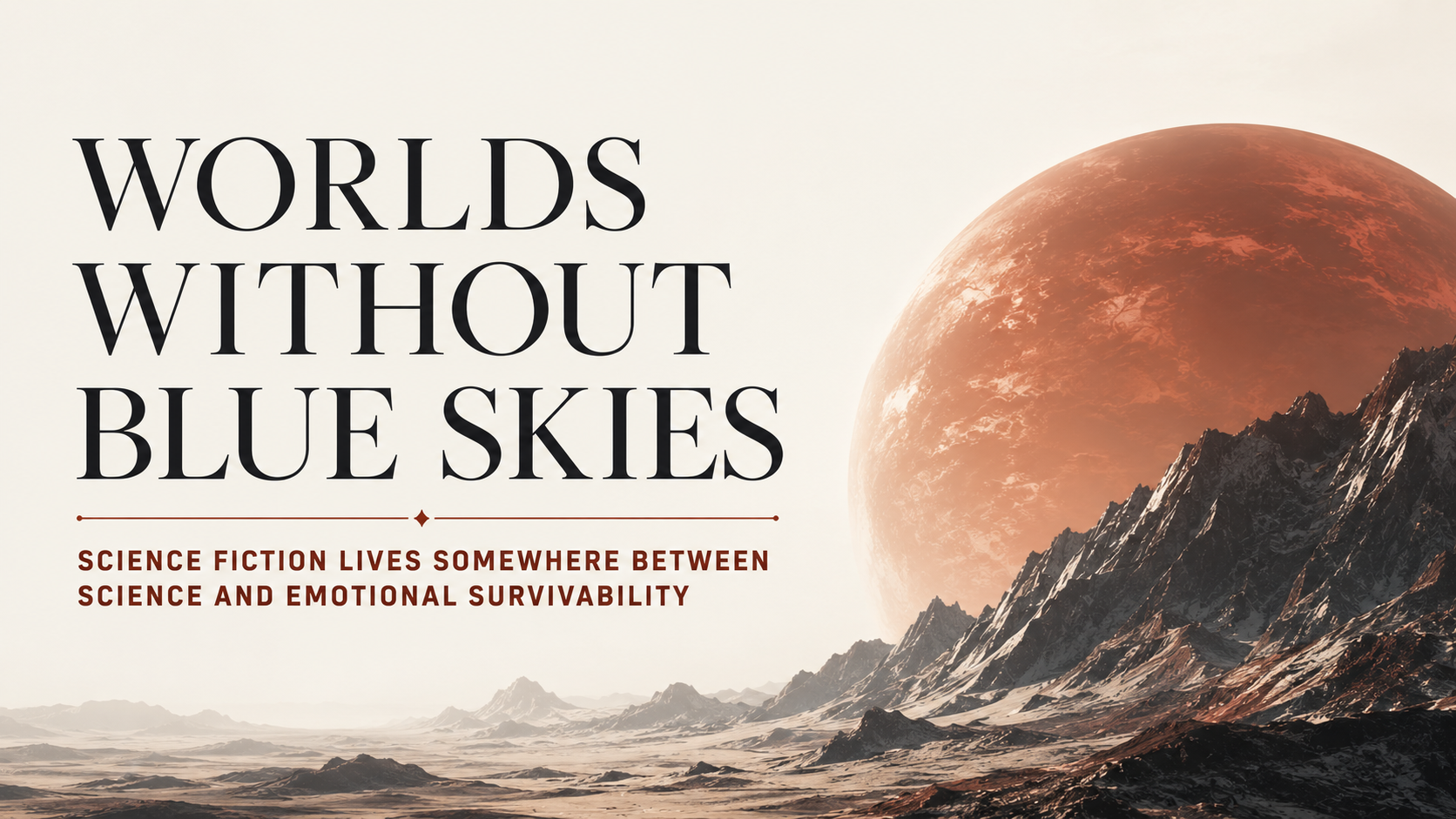
Worlds Without Blue Skies
Science fiction lives somewhere between science and emotional survivability
David Gerrold said something recently that I have not been able to stop thinking about.
He said there are no truly Earth-like planets in science fiction.
At first that sounded exaggerated. Then I started mentally flipping through decades of science fiction films and realized how often alien worlds still feel emotionally familiar. Blue skies. Recognizable weather. Gravity close enough that nobody moves differently. Forests, deserts, oceans, mountains. Even distant planets usually preserve enough of Earth that audiences instinctively know how to feel inside them.
Science fiction sits in an unusual place because it has to balance two competing forces.
Science pushes outward toward reality. Fiction pulls back toward emotional comprehension.
The genre lives somewhere in the middle.
That compromise shows up everywhere once you notice it. Alien planets are often filmed in California deserts, Icelandic lava fields, quarries, forests outside Vancouver. Tilt the rocks a little differently, add a second moon, maybe some atmospheric haze, and suddenly Earth becomes another galaxy.
There is something charming about that honestly. Human beings keep trying to imagine the universe using landscapes we already understand emotionally.
Then once in a while a film allows itself to become genuinely strange.
The Harkonnen homeworld sequence in Dune: Part Two did that for me in a way very little modern science fiction has.
The environment feels wrong before the mind fully understands why.
The blackened daylight. The inverted tones. Those strange fireworks blooming overhead like chemical reactions instead of celebration. Even the architecture feels hostile to ordinary human instinct.
Nothing in the sequence reassures the viewer emotionally. The world does not merely look different. It feels like human consciousness evolved somewhere else entirely.
That may actually be closer to reality than most science fiction prepares us for.
A truly alien planet would not simply have unusual geology. The environment itself could reshape perception, culture, mythology, emotion, even language. Human beings evolved beneath blue skies and familiar stars. Our metaphors grew from Earth conditions. Dawn means something to us because dawn has always existed for us.
Remove those reference points and even ordinary experience might begin to drift.
Imagine standing beneath a dim red dwarf where daylight never turns blue. Imagine a world with permanent cloud cover so dense nobody has ever seen stars clearly. Imagine a tidally locked civilization where one half of the planet never experiences sunrise.
What would hope look like there? What would darkness mean? What emotional weight would color carry?
Science fiction often softens these possibilities because stories still require orientation. Audiences need enough familiarity to stay emotionally grounded while the narrative unfolds.
Reality has no such obligation.
I suspect humanity’s first true landing on a world outside our solar system would feel less like science fiction becoming real and more like realizing how provincial our imagination has been all along.
Human beings evolved here.
That may turn out to be one of the strangest truths we ever confront.

Subscribe to Amid the Noise
Amid the Noise is an ongoing body of work on signal, systems, governance, AI, and the structures that shape human judgment under pressure.
Subscribe to receive new essays as they are published.