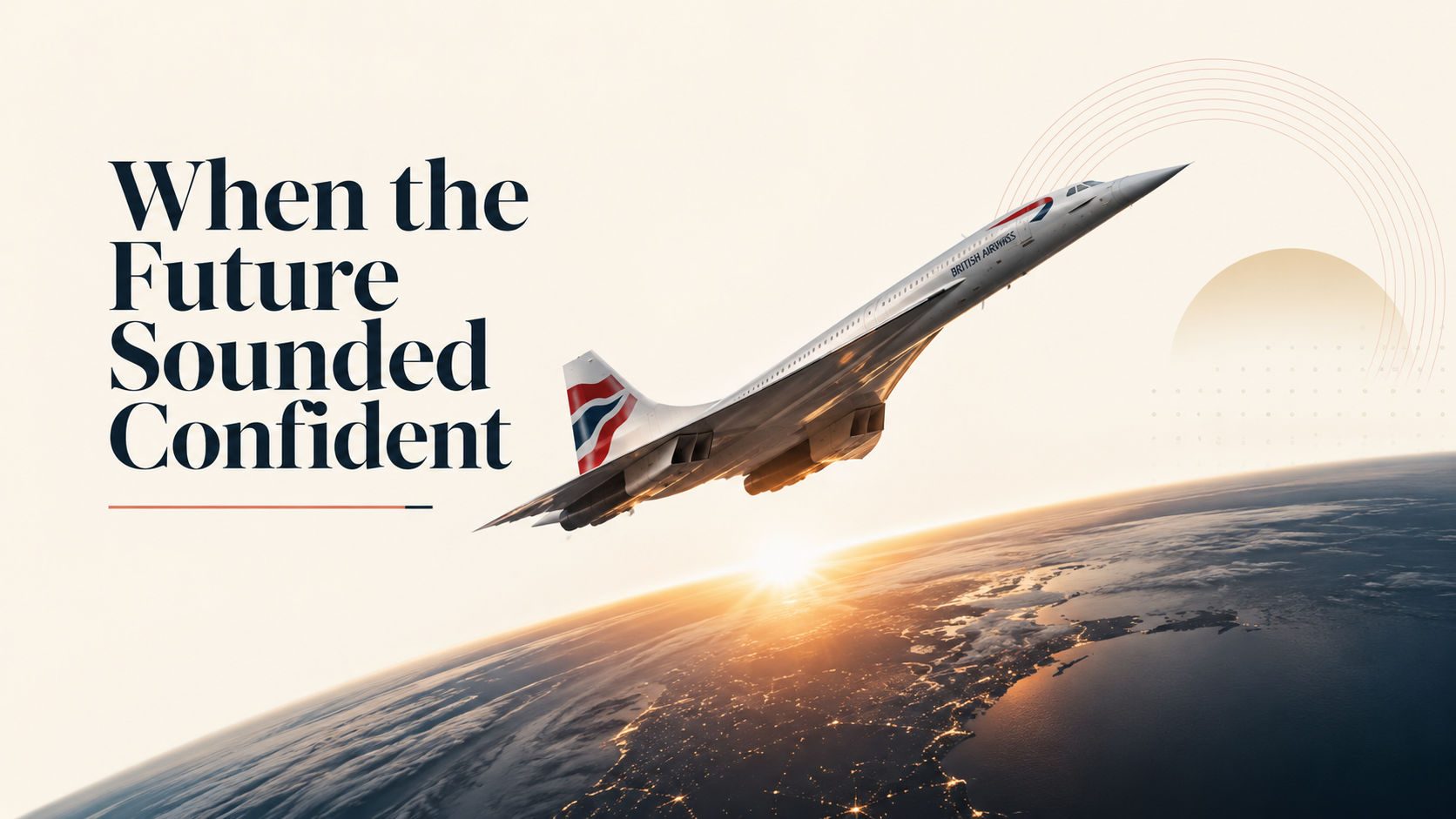
When the Future Sounded Confident
A reflection on Concorde, ambition, and the shrinking horizon of modern imagination.
I once owned a framed painting of Concorde climbing into dawn over the Atlantic.
Gunmetal frame. Triple matting in British Airways colors.
The kind of object you buy because it reminds you the future once sounded confident.
I lost it in the fire years later.
Strange thing is, I never really mourned the painting itself.
I mourned what Concorde represented.
Concorde belonged to an era when the future still carried theatricality. Not fantasy. Conviction.
The aircraft looked impossible even standing still. Needle nose angled toward the horizon. White fuselage stretched tight as a mathematical proof. Four Olympus engines engineered less like transportation and more like a declaration that speed itself still mattered. The thing crossed oceans faster than the Earth seemed prepared to allow.
Even people who never boarded one understood the signal.
Human beings were still willing to build beautiful problems.
That feels increasingly rare now.
Somewhere along the line, the culture shifted from ambition to optimization. We stopped asking what civilization might become and started asking what could scale safely, cheaply, and indefinitely. Concorde disappeared for practical reasons. Fuel costs. Sonic booms. Maintenance complexity. Risk. All valid. All rational.
Rationality has a way of sanding the edges off entire civilizations.
Today the future arrives mostly as software updates, subscription services, battery optimization, and faster delivery windows. Useful things, certainly. Efficient things. Yet very little of it feels transcendent. Very little feels like humanity standing at the edge of possibility simply because possibility exists.
Concorde did.
That may be why the painting stayed with me long after it disappeared.
Not because it was expensive. Not because it was rare.
Because somewhere inside that frame was evidence that people once believed the future should feel extraordinary.
Maybe that belief was unsustainable.
Or maybe we simply became afraid of maintaining ambitious things once they stopped being easy.
Either way, Concorde is gone now.
Sometimes I think the real loss was not the aircraft itself, but the kind of civilization willing to build it.

Subscribe to Amid the Noise
Amid the Noise is an ongoing body of work on signal, systems, governance, AI, and the structures that shape human judgment under pressure.
Subscribe to receive new essays as they are published.