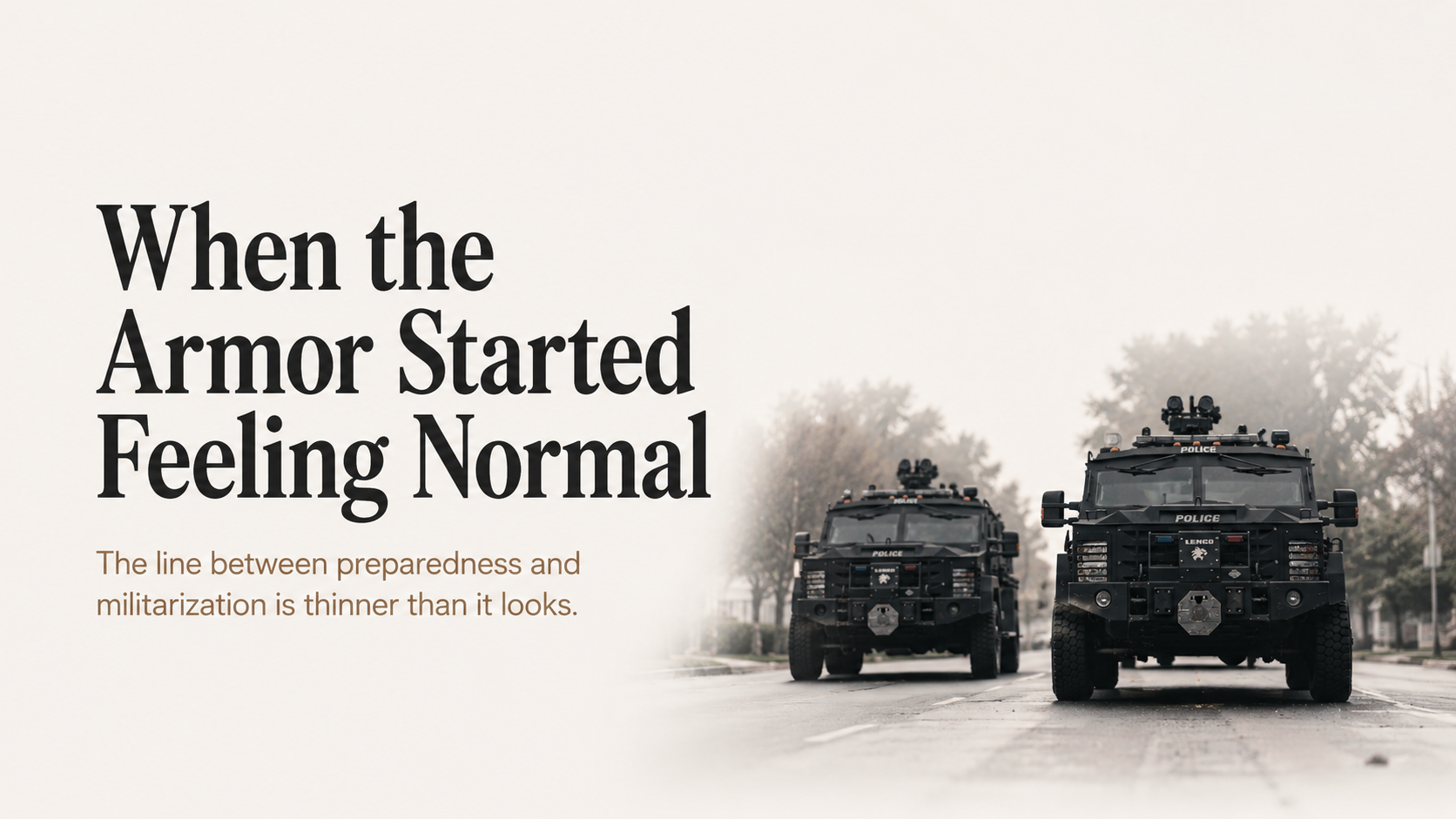
When the Armor Started Feeling Normal
The line between preparedness and militarization is thinner than it looks.
There was a period where I thought military surplus going to local police departments made sense.
The logic felt straightforward enough. The government had already purchased the equipment. If specialized vehicles or hardened systems could help officers respond to dangerous situations, why let them sit unused somewhere?
At the time, it felt pragmatic.
Then I moved to Fremont.
My apartment sat directly beside two hospitals and a BART station. The area felt less like a neighborhood and more like a junction point for civic infrastructure. Ambulances moved through at all hours. Trains arrived and departed in waves. Nurses crossed intersections carrying coffee at sunrise. Patients stood outside hospital entrances smoking quietly beneath fluorescent lights at 02h00.
Life moved through that corridor continuously.
Every so often, a massive armored police vehicle would come rumbling through the middle of it all.
Not during riots.
Not during some catastrophic emergency.
Just there.
Heavy.
Angular.
Built for a completely different psychological environment than the one surrounding it.
I remember watching it pass apartment buildings, hospital signage, and commuters walking toward the station while California sunlight reflected off the armor plating. Nobody really reacted anymore. Traffic continued moving. People crossed intersections. The city absorbed it without resistance, almost as if the vehicle had always belonged there.
That was the moment the question changed for me.
Not whether police should have tools to protect themselves.
Of course they should.
Police work can become dangerous very quickly. Active shooters exist. Hostage situations exist. There are moments where ordinary patrol equipment is not enough, and pretending otherwise feels detached from reality.
The discomfort started somewhere else.
An armored personnel carrier is not just protective equipment. It carries an entire visual language with it. The phrase itself comes from military doctrine. Its purpose is protected movement through hostile territory.
That wording matters.
Once vehicles designed for conflict zones begin appearing routinely inside ordinary civic environments, the atmosphere subtly changes. Hospitals, transit stations, apartment complexes, and grocery stores start sharing visual space with machinery built around battlefield assumptions.
The city begins speaking two languages simultaneously: care and control.
Neither side fully cancels the other out.
That tension is what stayed with me.
I still do not know exactly where the line should be. Part of me is relieved those vehicles exist if the worst happens. Part of me wonders what it means for a society when equipment designed for war starts feeling visually ordinary beside public transit and emergency rooms.
The older I get, the more I think the real danger in civic systems is not sudden authoritarianism.
It is acclimation.
Most structural change arrives quietly enough that people adjust before they fully process what changed. The language shifts first. Then the posture. Then eventually the imagery stops registering at all.
One day an armored tactical vehicle rolls past a hospital and nobody even looks up anymore.
That realization unsettled me far more than the vehicle itself.

Subscribe to Amid the Noise
Amid the Noise is an ongoing body of work on signal, systems, governance, AI, and the structures that shape human judgment under pressure.
Subscribe to receive new essays as they are published.