When Systems Still Had Accents
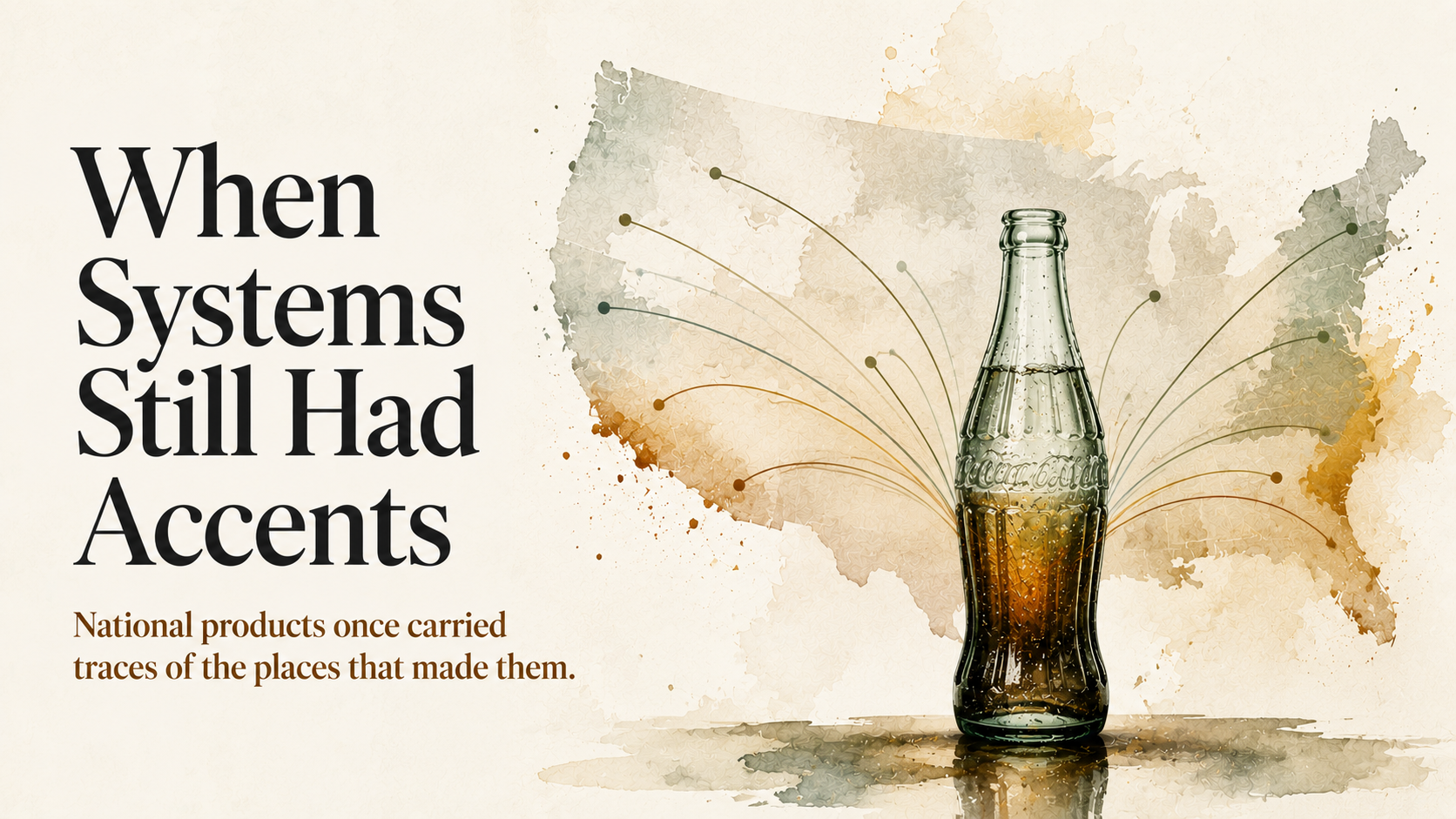
National products once carried traces of the places that made them.
When I was a kid in Altus, Oklahoma, we had an RC bottling plant.
That probably sounds smaller than it really was.
In my memory, the place felt important. It was a modest brick building, but it carried a strange kind of gravity because it meant the town participated in something larger than itself. Bottles arrived empty and left full. Trucks moved constantly. The machinery mattered. People worked there. The town produced something.
An hour away in Lawton, there was a Coca-Cola bottling plant.
Back then, one of the things we always checked was the bottom of the green glass bottles.
Every bottle told you where it came from.
We had favorites.
Albuquerque Coke tasted incredible. Amarillo Coke honestly tasted terrible.
A lot of that probably came down to the water itself. Amarillo has some of the harshest tap water I can remember, and back then local bottling still carried traces of local infrastructure directly into the final product.
At the time, I did not understand what we were actually experiencing.
Regional systems still had accents.
Different water chemistry. Different facilities. Different bottling equipment. Different distribution paths. Different environmental conditions.
Products were standardized, but not fully homogenized.
The system still allowed small amounts of geography to survive inside mass production.
That world has mostly disappeared.
Modern logistics optimize toward consistency, compression, and centralized distribution. Variation increasingly gets treated as inefficiency rather than texture. National brands no longer want products tasting slightly different depending on where you bought them. Supply chains now aim to eliminate regional irregularities before customers ever notice them.
In some ways, that makes perfect sense.
The modern world is astonishingly good at producing reliability.
But something else disappeared alongside it.
Small towns once existed as operational nodes rather than purely consumption endpoints. They bottled soda. Maintained rail depots. Processed grain. Repaired equipment. Manufactured parts. Participated materially in the larger system surrounding them.
The infrastructure gave places identity.
That may be part of why older industrial buildings still affect people emotionally even after their original purpose disappears. They remind us that communities once occupied more visible positions inside the operational life of the country.
Now many systems feel increasingly abstracted away from physical geography entirely.
Cloud infrastructure replaced local switching offices. Centralized fulfillment replaced regional warehousing. National logistics replaced smaller distribution ecosystems. Digital systems compressed local variation into platform uniformity.
The products became smoother.
The systems became quieter.
The world became more consistent and somehow less distinct at the same time.
Maybe that is why I still think about Nehi sometimes.
Orange. Grape. Root beer.
Not simply because I miss the taste.
I miss what the bottles represented: a world where infrastructure still allowed places to leave fingerprints on the things people carried home.

Subscribe to Amid the Noise
Amid the Noise is an ongoing body of work on signal, systems, governance, AI, and the structures that shape human judgment under pressure.
Subscribe to receive new essays as they are published.