What Lingers at Preston Castle
When systems leave a trace
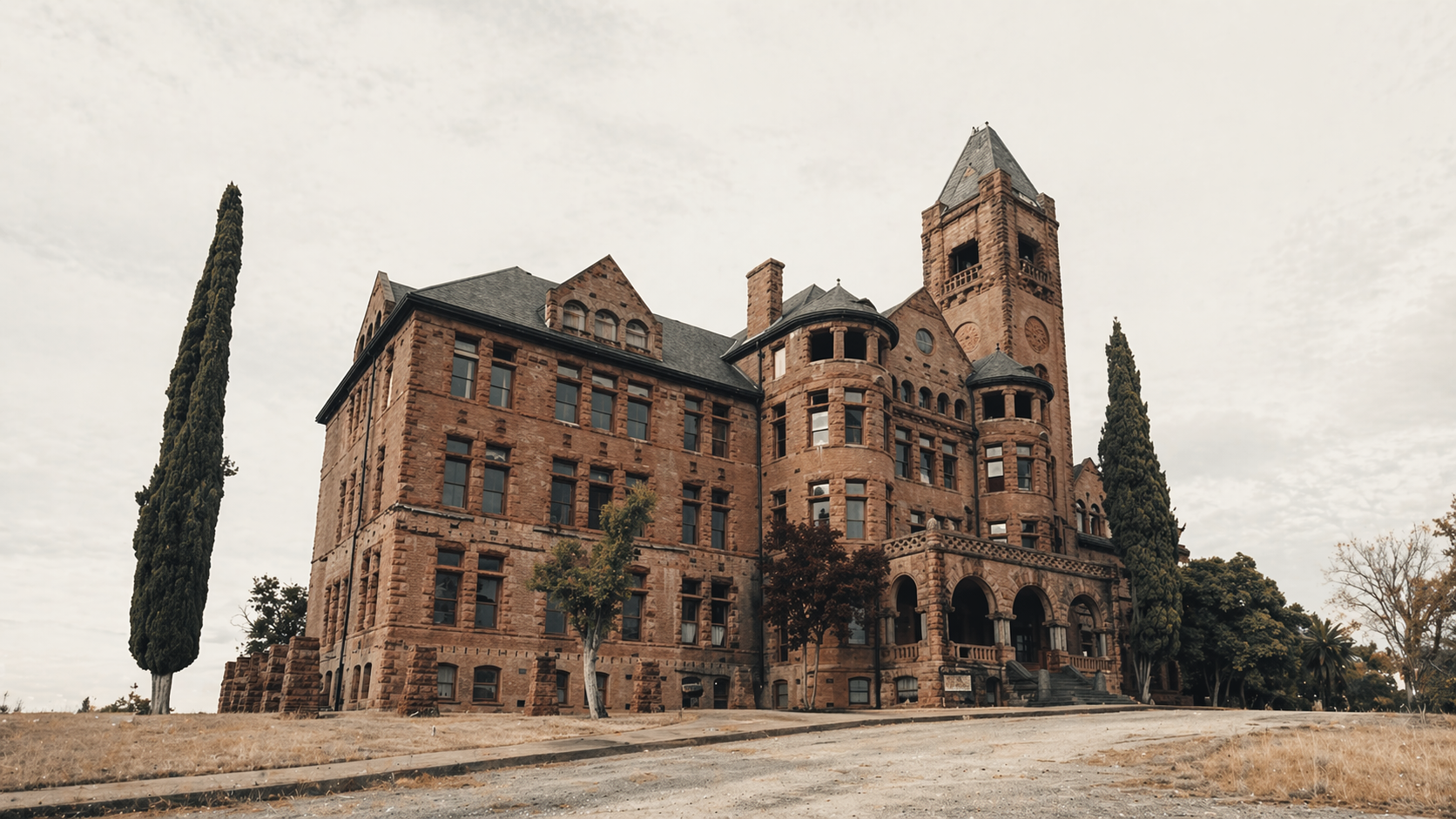
The road into Ione is lonely, even a little desolate, and once you know you are getting close, your attention shifts without asking permission. You start scanning the horizon for Preston Castle, not because it’s hidden, but because it feels like something you could miss if you look away at the wrong moment.
And then you see it, almost casually.
It sits off to the side of everything else, steady and self-contained, like it has outlived the need to explain itself. The symmetry is deliberate, almost formal, but there’s something unresolved in the way it holds together, as if the building never quite finished saying what it was built to say.
Before anyone called it haunted, it had a purpose, and that purpose matters more than the stories layered on top of it.
Preston Castle opened in 1894 as the Preston School of Industry, a reform school for boys, which sounds measured when you say it out loud, almost hopeful, until you sit with what reform tends to mean in practice. The building reflects that reality without subtlety. Long corridors that control movement, sightlines that eliminate privacy, a structure that doesn’t just house a system but quietly enforces it at every turn.
Over time, places like that don’t hinge on a single moment. They accumulate. Voices raised and lowered, instructions repeated until they stop sounding like instructions, resistance met with consequence, and compliance learned because it becomes the only stable option. None of it needs to be dramatic to leave a mark. Repetition does that work far more effectively.
Eventually, the system moved on, as systems tend to do, and the doors closed without ceremony. The function dissolved. The building remained, holding whatever it had already absorbed.
That’s where the language shifts.
People talk about footsteps in empty corridors, doors that seem to move on their own, cold pockets of air that feel too precise to ignore, and a kind of presence that doesn’t reveal itself directly but still manages to register in a way that’s hard to dismiss once you’ve felt it.
There’s a version of this story where all of that is taken at face value, where the explanation sits outside of us and the conclusion is easy.
There’s another version where none of it is necessary, where old buildings carry sound in strange ways, where air moves unevenly through spaces that were never meant to be sealed, and where light bends just enough to make depth unreliable. Human perception fills in the rest, especially when history has already done half the work.
Both explanations make sense, and neither one feels complete.
Because a place like Preston Castle isn’t just something you look at. It’s something you read, and what you read depends on what you believe a place is capable of holding after its original purpose has ended.
If you believe in ghosts, this is the kind of place that would keep them.
If you don’t, you’re still left with something that doesn’t resolve into emptiness.
Call it residue, or imprint, or the afterimage of a system that ran long enough to leave something behind that doesn’t simply disappear when the activity stops. We like to believe that closure follows shutdown, that when an institution ends, whatever it contained ends with it, but that belief is cleaner than reality tends to be.
Systems distribute impact, whether they mean to or not. They leave it in people, in memory, and sometimes in place.
Preston Castle doesn’t need to be haunted to feel inhabited.
Stand there long enough and what settles in isn’t the sense that something is moving through the halls, but that something never fully left them, a kind of weight that lingers without announcing itself, steady and unresolved.
It doesn’t ask you to believe in ghosts.
It asks something quieter and more difficult, which is whether you’re willing to sit with the idea that some structures outlast their purpose in ways that aren’t architectural.
You can walk through and catalog what remains, trace the lines, understand the design, or you can stay just a moment longer and notice the difference between a place that is empty and a place that still holds something you can’t quite name.
They are not the same.
Some places don’t need ghosts. They only need time, memory, and someone willing to stand still long enough to feel what remains.

Subscribe to Amid the Noise
Amid the Noise is an ongoing body of work on signal, systems, governance, AI, and the structures that shape human judgment under pressure.
Subscribe to receive new essays as they are published.