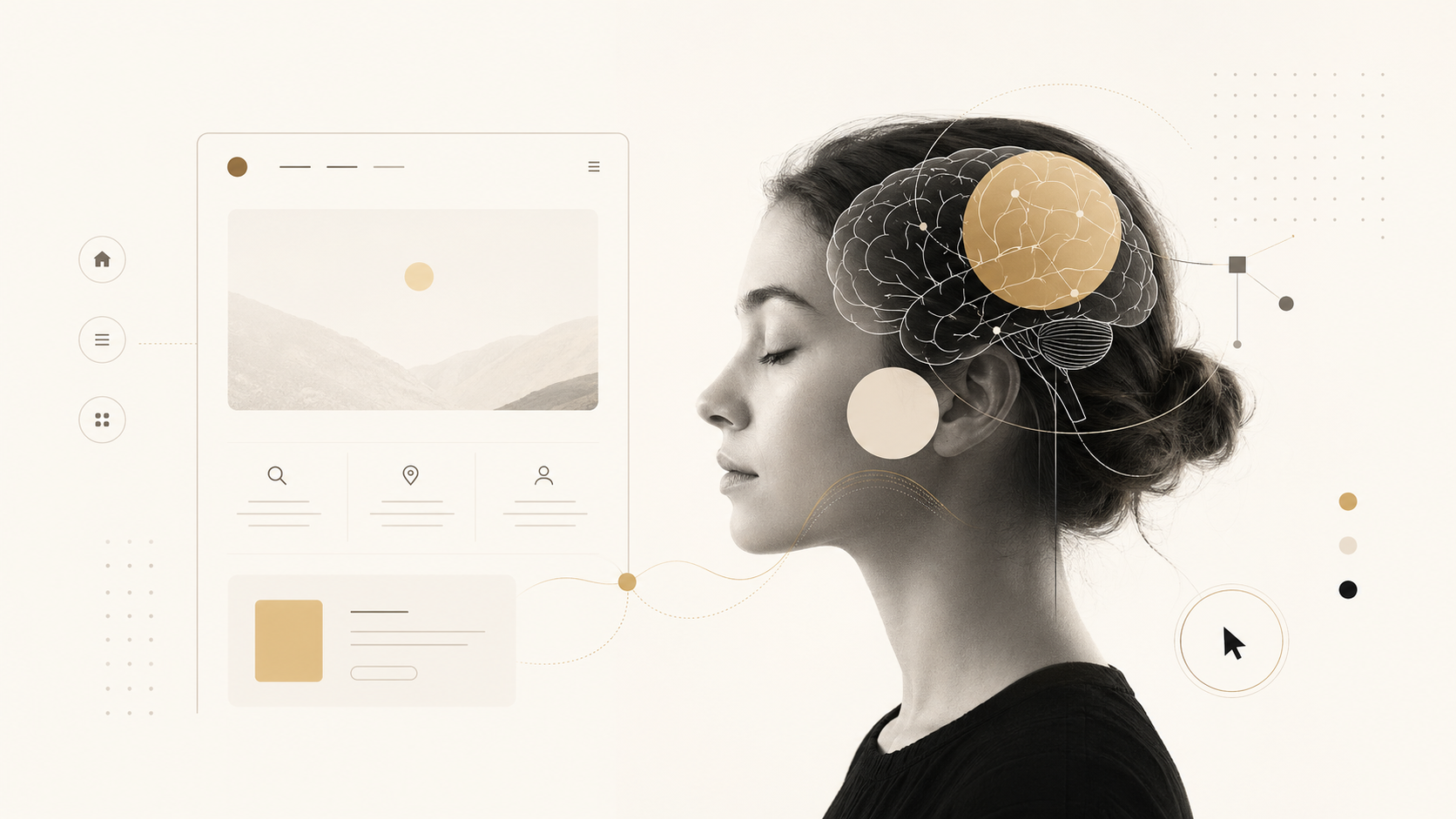
UX and the Human Experience
Fluency over novelty
Unconscious thought drives most human behavior. Interaction rarely begins with intent. It begins with recognition.
People do not approach systems as blank slates. They arrive with expectations shaped by years of exposure to other systems, other interfaces, other decisions. Much of what feels like “intuition” is memory doing its work quietly in the background.
Design either aligns with that memory or fights it.
Familiarity Is Not a Constraint
It is easy to confuse innovation with difference. In practice, most systems fail not because they lack originality, but because they violate expectation without offering clarity in return.
Familiarity reduces cognitive load. The mind is constantly scanning for patterns it already understands. When it finds them, it relaxes. When it does not, it slows down.
That slowdown is friction.
Design patterns exist because they encode shared experience. Navigation at the top of a page. Buttons that look clickable. Inputs that behave consistently. None of these are accidents. They are agreements.
Breaking those agreements is not inherently wrong. It simply creates a debt that must be repaid through guidance.
Mental Models Shape Behavior
A mental model is a user’s internal explanation of how something works. It is rarely precise, often incomplete, and almost always good enough.
Usability is not measured by how a system actually works. It is measured by how closely it matches what a user believes will happen next.
When those two align, interaction feels effortless. When they diverge, the user hesitates, retries, or leaves.
This becomes more pronounced as systems grow more abstract. Data platforms, AI systems, and automation workflows often introduce behaviors that have no direct real-world analogue. There is no inherited model to rely on.
In those cases, design must teach.
Not through documentation, but through interaction. Through feedback, constraint, and progression. A system that introduces something new must also provide the scaffolding to understand it.
The Cost of Interaction
Every action carries a cost. Not just physical effort, but cognitive effort.
Users optimize for the path of least resistance. They scan, not read. They infer, not analyze. They move forward with partial understanding as long as the system rewards that movement.
Design that requires sustained interpretation is design that will be abandoned.
Reducing interaction cost does not mean removing capability. It means structuring complexity so that it reveals itself only when needed.
When to Break Convention
Innovation still matters. The question is not whether to break convention, but when.
Breaking convention is justified when it creates a better mental model, not just a different one. It should reduce long-term friction even if it introduces short-term learning.
The risk is front-loaded confusion. The responsibility is to guide the user through it.
Good systems do this through progressive disclosure, clear feedback, and repetition. They make the unfamiliar feel inevitable over time.
From Interface to Experience
User experience is often treated as a layer. A surface. A set of screens.
In reality, it is the system as it is felt.
Emotion plays a role earlier than most teams expect. First impressions shape trust. Aesthetic coherence signals quality. Even when functionality is identical, people believe that better-looking systems perform better.
This is not irrational. It is a heuristic.
At the same time, visual polish cannot compensate for structural confusion. A system that looks good but behaves unpredictably erodes trust faster than one that is plainly designed but reliable.
Designing for a Changing Interface
The definition of “interface” continues to expand.
Natural language systems, voice interaction, and AI-assisted workflows shift the burden away from explicit commands and toward interpretation. The system is no longer just responding. It is inferring.
This changes the role of design.
Predictability now includes not just what a system does, but how it explains itself. Users need to understand not only outcomes, but confidence, ambiguity, and limits.
The question is no longer “can the user complete the task?”
It is “does the user understand what just happened?”
UX Is Human Experience
User experience is not separate from human experience. It is an extension of it.
We are not designing screens. We are shaping how people move through decisions, how they resolve uncertainty, and how they build trust in the tools around them.
The goal is not novelty. It is fluency.
A well-designed system feels less like something to learn and more like something the user already knew.

Subscribe to Amid the Noise
Amid the Noise is an ongoing body of work on signal, systems, governance, AI, and the structures that shape human judgment under pressure.
Subscribe to receive new essays as they are published.