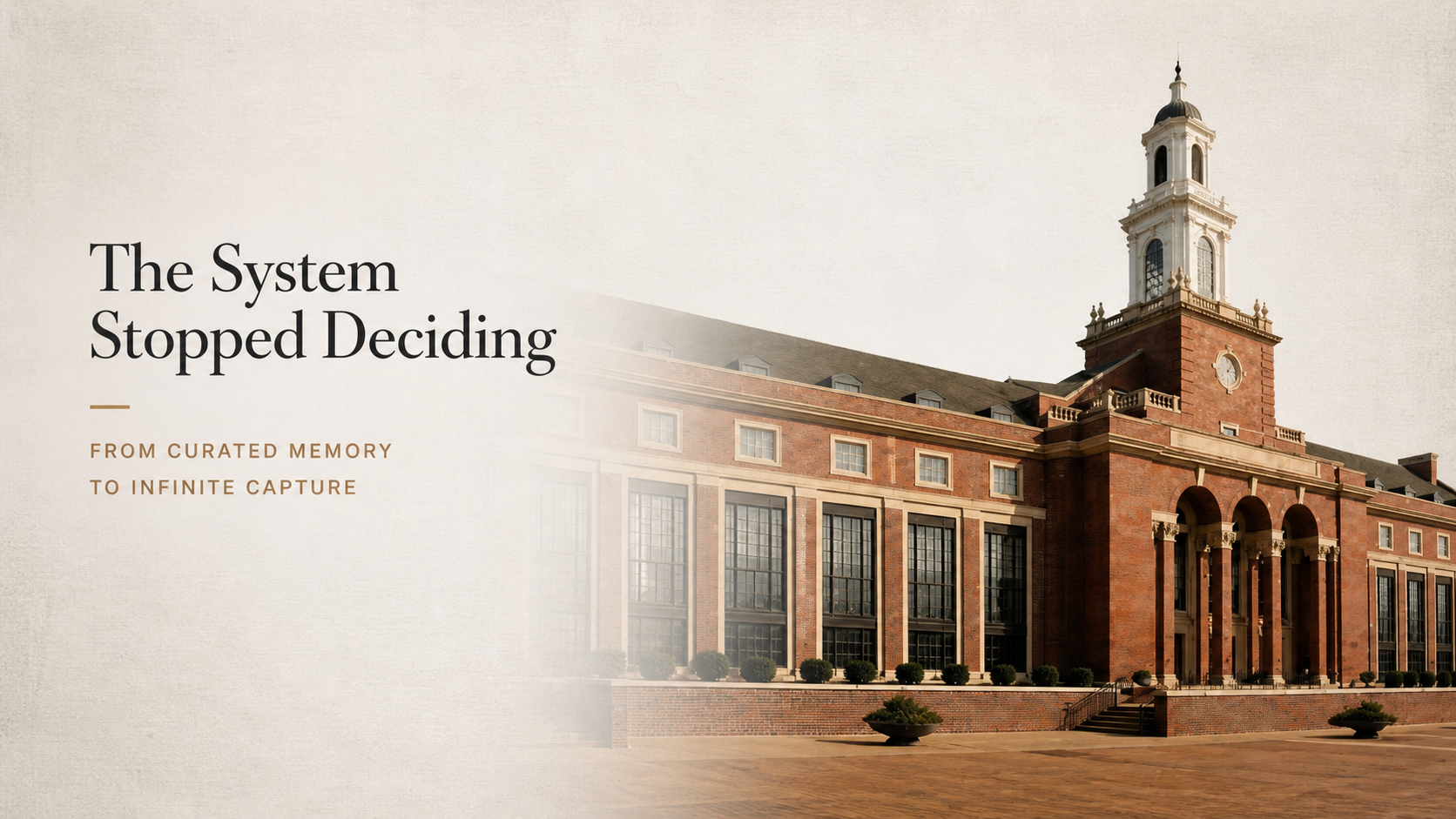
The System Stopped Deciding
From curated memory to infinite capture
My freshman year at Oklahoma State, I worked in the archives at Edmon Low Library.
At the time, it felt like a job.
Looking back, it feels like the last version of a system that still made decisions before you ever touched it.
It was on an upper floor most people never saw. Sloped ceilings. Dormer windows. The kind of quiet that comes from things being stored, not displayed.
I worked on a floor where the blueprints, theses, and records lived.
The pieces the university chose to keep.
One of my jobs was to take a handwritten Civil War diary and enter it into a computer.
It wasn’t written by an officer. It came from someone in the field. The handwriting shifted across the page. You could see when the day had been long.
My job was to make it readable without changing it.
At the time, it felt like typing. It wasn’t. It was carrying something forward without getting in the way of it.
This was 1992.
Before everything flattened into glass walls and terminals. Before search boxes replaced systems you had to learn how to move through.
The card catalog alone filled a room. Drawer after drawer. You didn’t browse it. You worked it.
Edmon Low had one of the largest stacks in the country. You felt that in your body. Rows that kept going. Depth you had to walk to understand.
Memory wasn’t abstract. It had structure. It had limits. It took up space.
Even the systems that felt neutral weren’t.
The Dewey Decimal system looked objective. Numbers, order, structure.
But it wasn’t just organizing knowledge. It was deciding how much space each part of it deserved.
Some subjects expanded. Others were compressed.
The bias wasn’t visible at the surface. It was built into the structure itself.
On that same floor sat the earlier version of the university.
Blueprints. Drafts. Revisions.
Not the campus people moved through every day, but the decisions that made it possible.
Somewhere in that same building, I used Mosaic for the first time.
Same infrastructure. Different direction.
Upstairs, we were working with what had been chosen and preserved.
A few rooms away, we were stepping into a system that would keep almost everything.
That shift doesn’t get talked about enough.
Before the internet, memory had friction. Someone had to write it down. Someone had to keep it. Someone had to decide it was worth the space it would take.
Most things didn’t make it.
What survived carried weight because it had passed through a set of decisions.
Now we live inside a different system.
Storage is cheap. Capture is constant. The default is to keep it.
We didn’t remove the gate. We removed the shape of the gate.
The archive decided before you arrived.
Most modern systems don’t. They present options and call it empowerment.
In practice, it’s deferral. The system avoids the decision and hands it to the user.
I didn’t have language for any of this at eighteen.
I knew how to handle the documents. I knew not to impose myself on what I was typing.
The meaning came later.
Back then, you didn’t just access information.
You moved through the system that decided how it could be found.
Now the system moves around you.
When everything is preserved, importance stops being a property of the system.
It becomes a burden placed on the person.
And the work is deciding what to trust.

Subscribe to Amid the Noise
Amid the Noise is an ongoing body of work on signal, systems, governance, AI, and the structures that shape human judgment under pressure.
Subscribe to receive new essays as they are published.