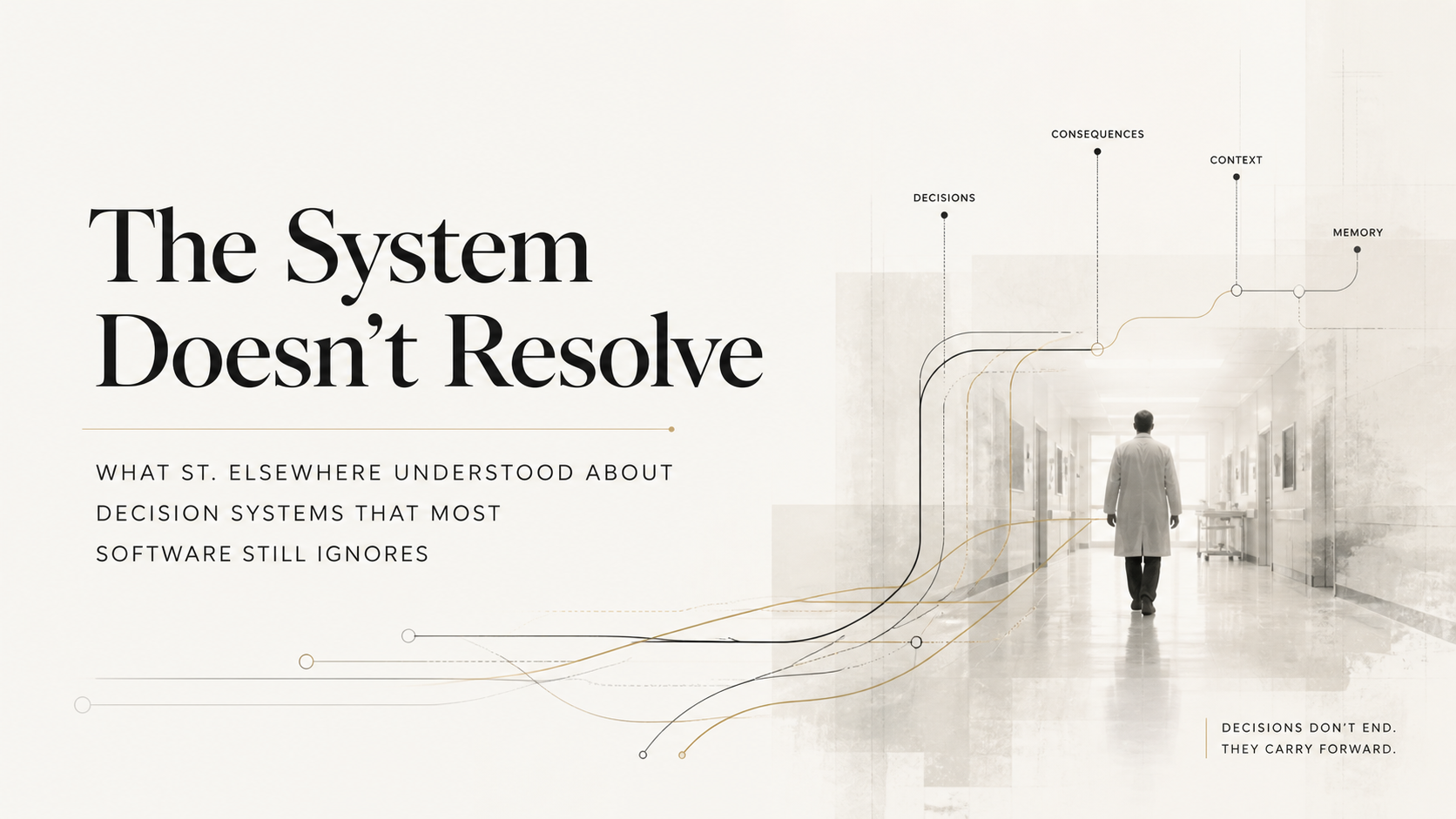
The System Doesn’t Resolve
What St. Elsewhere understood about decision systems that most software still ignores
As a kid, I remember watching St. Elsewhere and feeling something I didn’t have language for. Episodes would end without anything fully resolved. Not cleanly, not conclusively, not in the way television had trained me to expect. The tension didn’t break. It lingered.
At the time, it felt incomplete. Now it reads as something else entirely. It reads as truth.
St. Elsewhere wasn’t failing to resolve its stories. It was refusing to pretend that resolution was the natural state of the system it portrayed. A hospital does not reset at the end of an episode. Decisions carry forward, mistakes linger, and outcomes bleed into whatever comes next. The system holds its state, whether anyone wants it to or not.
Most software is built on the opposite assumption. It presents a world where actions conclude, records close, and workflows complete. The interface returns to neutral, as if nothing remains. That model is convenient. It is also false.
Real decision systems do not resolve. They accumulate. Every decision alters the system’s state, introducing new context that cannot be undone. The next decision is never made from zero. It is made from whatever remains, whether visible or not.
Hospitals work this way. Courts work this way. Financial systems work this way. Human relationships work this way. Memory is not optional in these systems. It is the system.
The tension that lingered in St. Elsewhere wasn’t stylistic. It was structural. There was no reset button, and the absence of one made everything feel heavier, more real. Unresolved tension wasn’t a flaw. It was evidence that the system was telling the truth.
Modern design often does the opposite. It prioritizes completion over continuity and smoothness over memory. Flows are optimized to end cleanly, even when the underlying reality does not. Over time, that decision introduces a quiet failure.
The burden shifts to the human. People carry the context the system chose to discard. They reconcile contradictions that should have been visible. They remember what the interface chose to forget. In doing so, they become the system of record.
That is not design. It is deflection.
There is a limit worth acknowledging. Not every system can carry infinite state, and not every user can operate inside constant tension. Abstraction has a role. Closure has a role. Without them, systems become unusable.
The question is not whether to resolve. It is what must remain.
A well-designed system resolves what can be resolved and preserves what cannot. It exposes decision lineage, makes consequences legible over time, and allows the system to carry its own memory instead of outsourcing it to the user.
St. Elsewhere understood this decades ago. It let the tension remain because the tension was the point.
The most dangerous systems are not the ones that fail. They are the ones that tell you everything is resolved when nothing is.

Subscribe to Amid the Noise
Amid the Noise is an ongoing body of work on signal, systems, governance, AI, and the structures that shape human judgment under pressure.
Subscribe to receive new essays as they are published.