The Roundhouse That Isn't There
Most people in Altus drive past it without knowing it ever existed.
A few weeks ago, I found an aerial photograph of Altus from 1938.
There, in plain view, was the railroad roundhouse my parents used to tell me about.
For most of my life, the roundhouse existed only as a story.
My parents would point toward an unremarkable part of town and explain that locomotives had once been serviced there.
By the time I was old enough to remember the site, the building was already gone.
The story remained.
The photographs were the first proof I had ever seen.
The first aerial image was taken in 1938.
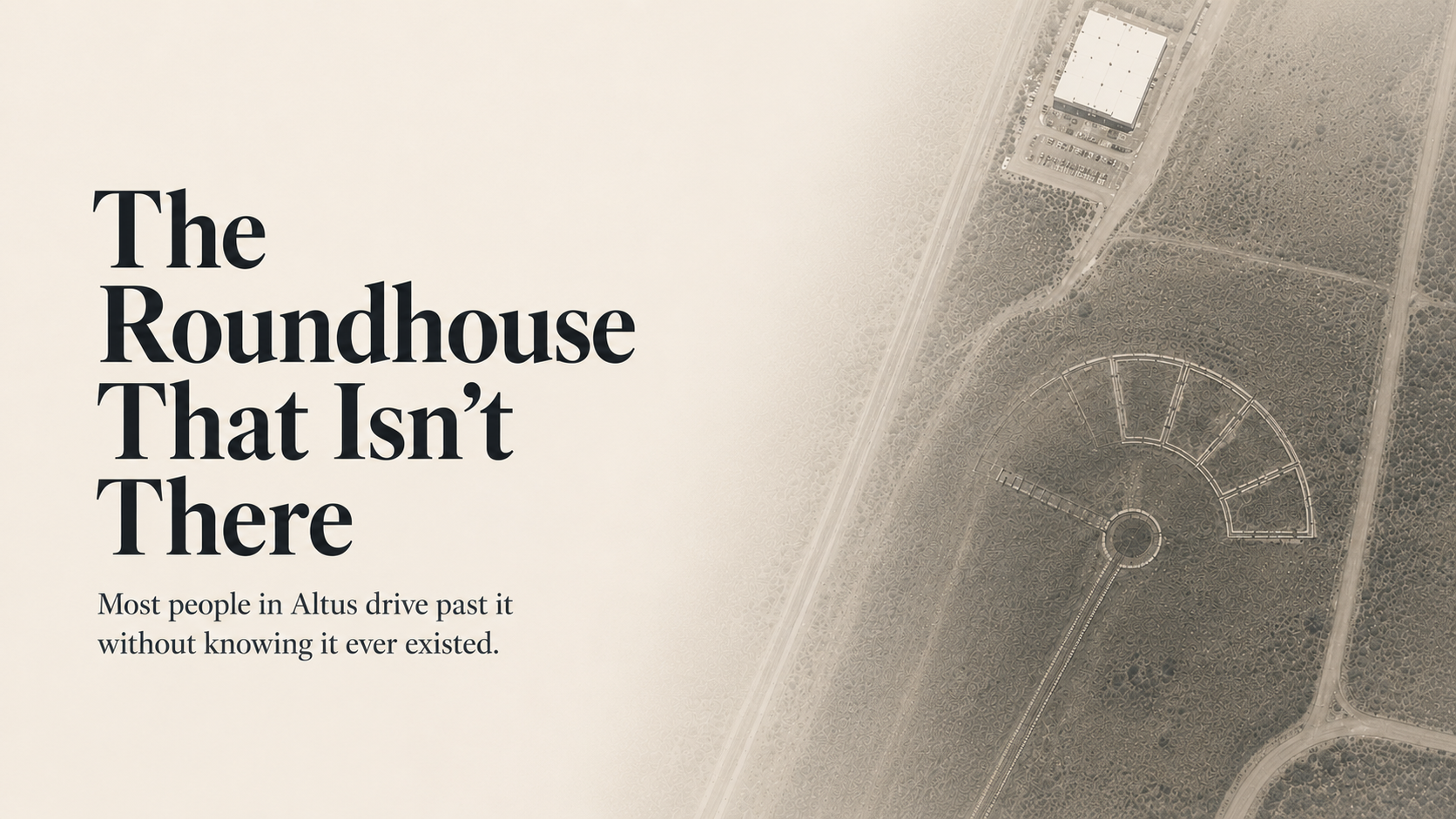
The roundhouse stood beside the tracks in plain view. The turntable sat at the center of a compact arc of service bays. It was not the massive semicircular structure people often imagine when they hear the word roundhouse. It was smaller, practical, and unmistakably real.
The 1957 image showed the facility still standing.
By 1960, the site was changing. The building remained, but the scene felt quieter. The sprawling geometry that dominated the 1938 image no longer seemed permanent.
By 1983, the structure had disappeared.
Only traces remained.
The final image, taken in 2023, revealed something remarkable.
The land still remembers.
What fascinated me was not the railroad itself.
It was how completely a place can disappear from public memory.
This was not a small structure hidden behind a warehouse or tucked away in an alley.
It was a substantial piece of industrial infrastructure. Railroad workers knew it. Families knew it. Children growing up nearby knew it.
Today, I suspect most people in Altus have no idea it was ever there.
That realization stayed with me.
The photographs document more than a building.
They document the gradual disappearance of local knowledge.
Every town contains places like this.
A vacant lot.
An abandoned foundation.
A strange curve in a road.
A field that once held something important.
The landscape carries stories that have been written over, but never entirely erased.
Infrastructure rarely disappears cleanly.
It leaves fingerprints.
Sometimes it leaves scars.
Occasionally it leaves an entire skeleton hidden in plain sight.
The roundhouse is one of those skeletons.
For years, I knew it only as a story my parents told me.
The aerial photographs revealed something else.
The photographs transformed a piece of local folklore into something tangible.
What had survived in memory now had a trace.
Today, almost nothing remains except a few faint curves visible from the sky.
Yet once you know what you’re looking at, you cannot unsee it.
Most people in Altus drive past the site without a second thought.
I probably would too.
Instead, I found myself looking at eighty-five years of photographs and realizing that an entire landmark had vanished within a single lifetime.
Not because anyone deliberately erased it.
Because time did what time does.
The building disappeared.
The story nearly disappeared with it.
Yet the shape remains, faintly visible from the air, waiting for someone to notice.
The land remembers.
Whether we do is another question entirely.

Subscribe to Amid the Noise
Amid the Noise is an ongoing body of work on signal, systems, governance, AI, and the structures that shape human judgment under pressure.
Subscribe to receive new essays as they are published.