The Real AI Race Is Diffusion
Why the future of AI may belong to the systems that quietly increase human capacity.
For the past several years, much of the conversation around artificial intelligence has been framed like a space race.
Who will reach AGI first. Who will build the first system capable of outperforming humans across nearly every intellectual domain. Who will control the next great technological leap.
That framing has shaped policy, venture capital, media coverage, and the behavior of nearly every major AI company in the United States.
But a recent report on renewed AI discussions between the United States and China revealed something far more interesting beneath the geopolitical tension:
The two countries may not actually be running the same race.
According to the report, much of the American AI ecosystem remains focused on frontier models and the pursuit of artificial general intelligence. Larger models. More compute. Recursive self-improvement. The belief that the first company to achieve AGI could trigger an exponential advantage that permanently reshapes global power.
China’s strategy appears different.
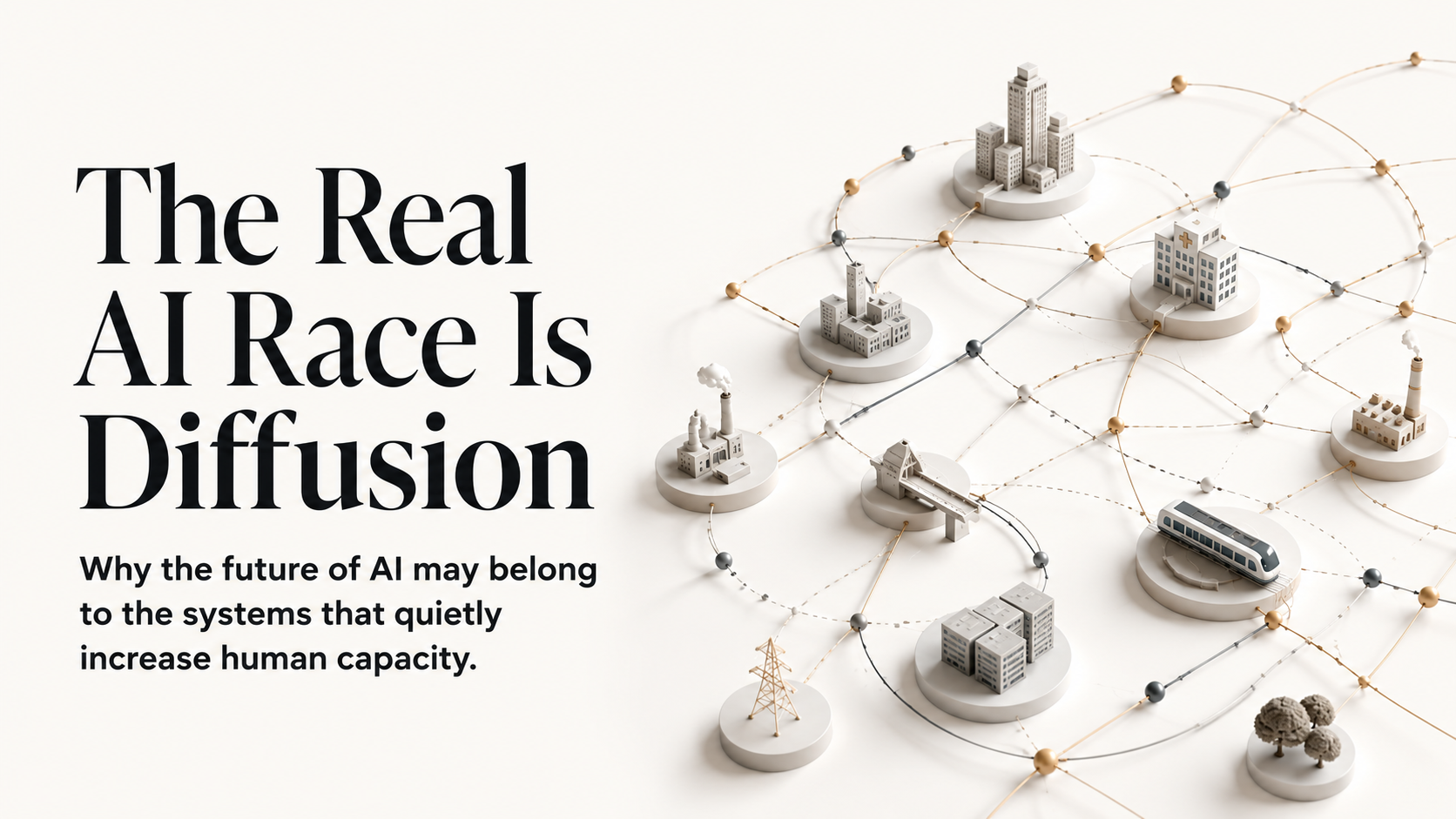
Rather than centering everything around a singular breakthrough model, the Chinese approach has reportedly focused more heavily on diffusion: integrating AI into manufacturing, logistics, robotics, infrastructure, industrial systems, and operational workflows across the broader economy.
That distinction matters enormously.
One approach treats AI as a destination. The other treats it as infrastructure.
Personally, I suspect the infrastructure framing is closer to where the real transformation occurs.
Most institutions do not need an omniscient machine. They need systems that help human beings make better decisions under pressure.
Hospitals need earlier detection. Transit systems need better optimization. Governments need clearer service delivery. Utilities need predictive maintenance. Banks need fraud detection with accountable escalation paths. Emergency response systems need coordination and prioritization.
Most meaningful AI adoption will not arrive as a cinematic moment. It will arrive quietly, embedded into thousands of operational decisions most people never see.
That is also why the governance conversation matters so much.
The central question is no longer whether models are becoming powerful. They clearly are.
The real question is whether societies are building the institutional maturity required to integrate them responsibly.
Who has override authority? How are errors surfaced? What happens when models disagree with humans? Who is accountable when automated systems fail? How do organizations preserve human judgment rather than erode it?
Those are not engineering questions alone. They are civic questions.
The countries and companies that understand AI as cognitive infrastructure, not merely technological spectacle, may ultimately shape the future more profoundly than those chasing the loudest demonstration.

Subscribe to Amid the Noise
Amid the Noise is an ongoing body of work on signal, systems, governance, AI, and the structures that shape human judgment under pressure.
Subscribe to receive new essays as they are published.