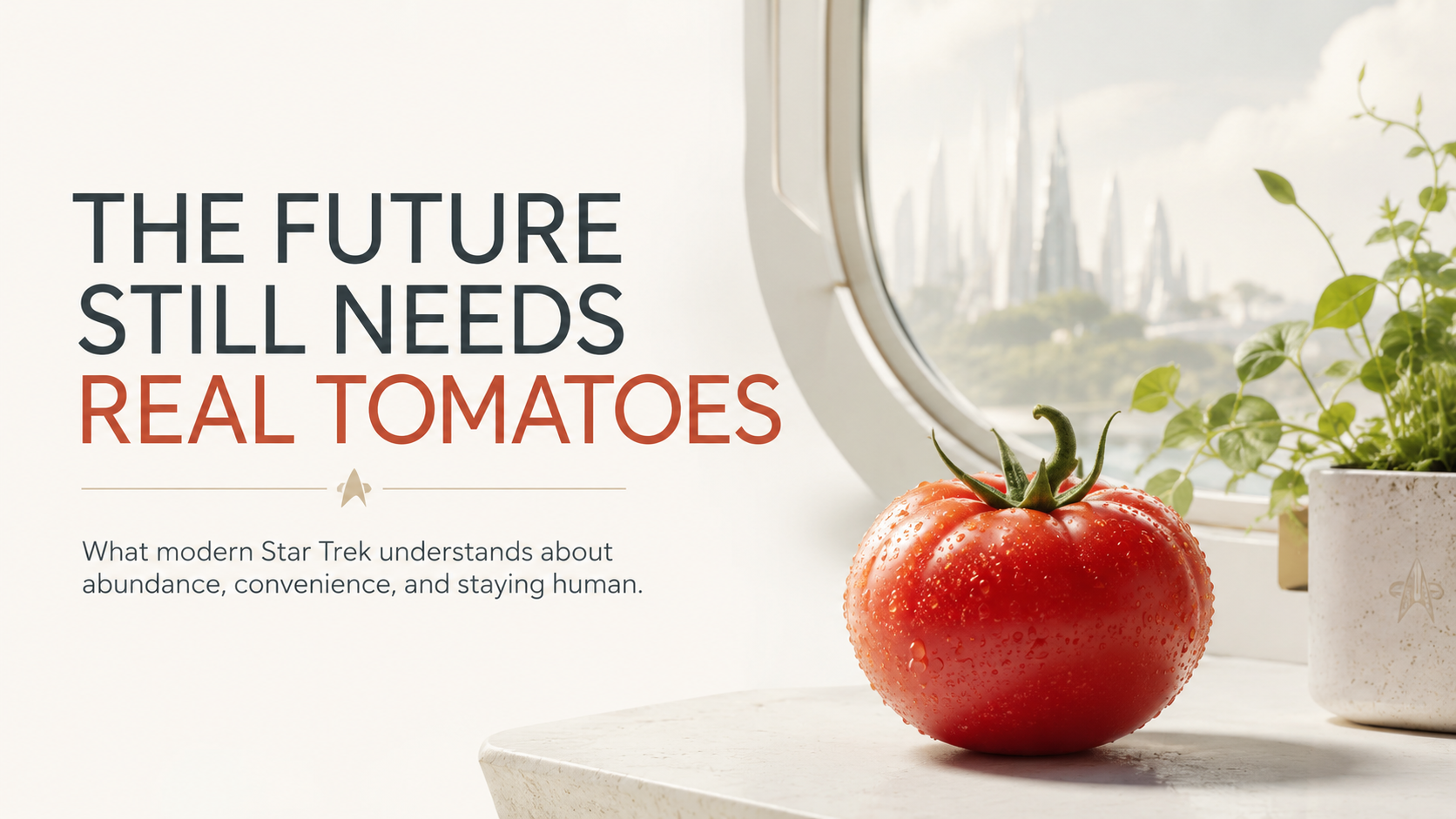
The Future Still Needs Real Tomatoes
What modern Star Trek understands about abundance, convenience, and staying human.
I have always been confused by people who insist modern Star Trek is cynical.
Messier? Absolutely.
More emotional? Definitely.
Occasionally uneven? Of course.
Yet beneath all of it, I still see a future worth reaching for.
The Federation in newer Trek does not feel broken to me.
It feels lived in.
That distinction matters.
For years, critics have argued that Kurtzman-era Trek abandoned optimism. I understand where some of that reaction comes from. Earlier Trek often framed the future through institutional confidence. The bridge crew was composed, the systems worked, and humanity appeared to have largely resolved its contradictions.
Modern Trek asks a different question.
What happens after humanity solves survival?
That is a far more uncomfortable problem.
In Star Trek: Picard, there is a small moment that has stayed with me far longer than any battle sequence or speech. An android woman remarks that she has never tasted a real tomato before.
Not replicated.
Not synthesized.
Real.
Some viewers saw dystopia in that scene. I saw recognition.
Replicators solved hunger. They solved scarcity. They likely prevented wars, ecological collapse, and mass suffering on a scale difficult for us to comprehend.
Yet somewhere along the way, humanity also drifted slightly further from the physical world itself.
The future became optimized.
Efficient.
Safe.
Scalable.
A tomato still existed.
Just not this tomato.
Not sun-warmed from soil.
Not imperfect.
Not grown by a person whose hands still smelled faintly of earth.
That scene worked because the future was still beautiful despite the loss.
Honestly, that feels more truthful to me than a frictionless utopia ever could.
Every civilization is a negotiation between convenience and intimacy.
Modern life already reflects this tension everywhere:
- infinite entertainment paired with loneliness
- algorithmic feeds replacing local community
- synthetic convenience replacing physical ritual
- AI-generated fluency replacing slow-earned craft
- abundance systems that keep people alive while quietly starving them of texture
We solved access.
Now we are rediscovering meaning.
That is why so much Kurtzman-era Trek resonates with me.
Star Trek: Lower Decks understands that institutions are held together by ordinary people still choosing to care.
Star Trek: Prodigy understands that greatness can emerge from forgotten children, broken systems, and people who were never expected to belong anywhere at all.
Star Trek: Strange New Worlds remembers that curiosity is still sacred.
Even Star Trek: Discovery, for all its chaos and unevenness, repeatedly argues that emotional connection is not weakness. It is infrastructure.
That feels profoundly contemporary to me.
The older versions of Trek often imagined humanity overcoming conflict through intelligence and reason alone.
The newer versions seem more interested in whether humanity can preserve tenderness after optimization.
That may actually be the harder challenge.
Because the danger facing modern civilization is probably not collapse alone.
It is numbness.
A world where everything functions well enough, arrives instantly, scales infinitely, and still leaves people spiritually malnourished.
A world where no one is hungry, but fewer people remember what a real tomato tastes like.
The best moments in modern Trek understand this intuitively.
The future still works.
People still cooperate.
The stars are still there.
Humanity survived.
Now the question becomes whether we can remain human inside the systems we build.

Subscribe to Amid the Noise
Amid the Noise is an ongoing body of work on signal, systems, governance, AI, and the structures that shape human judgment under pressure.
Subscribe to receive new essays as they are published.