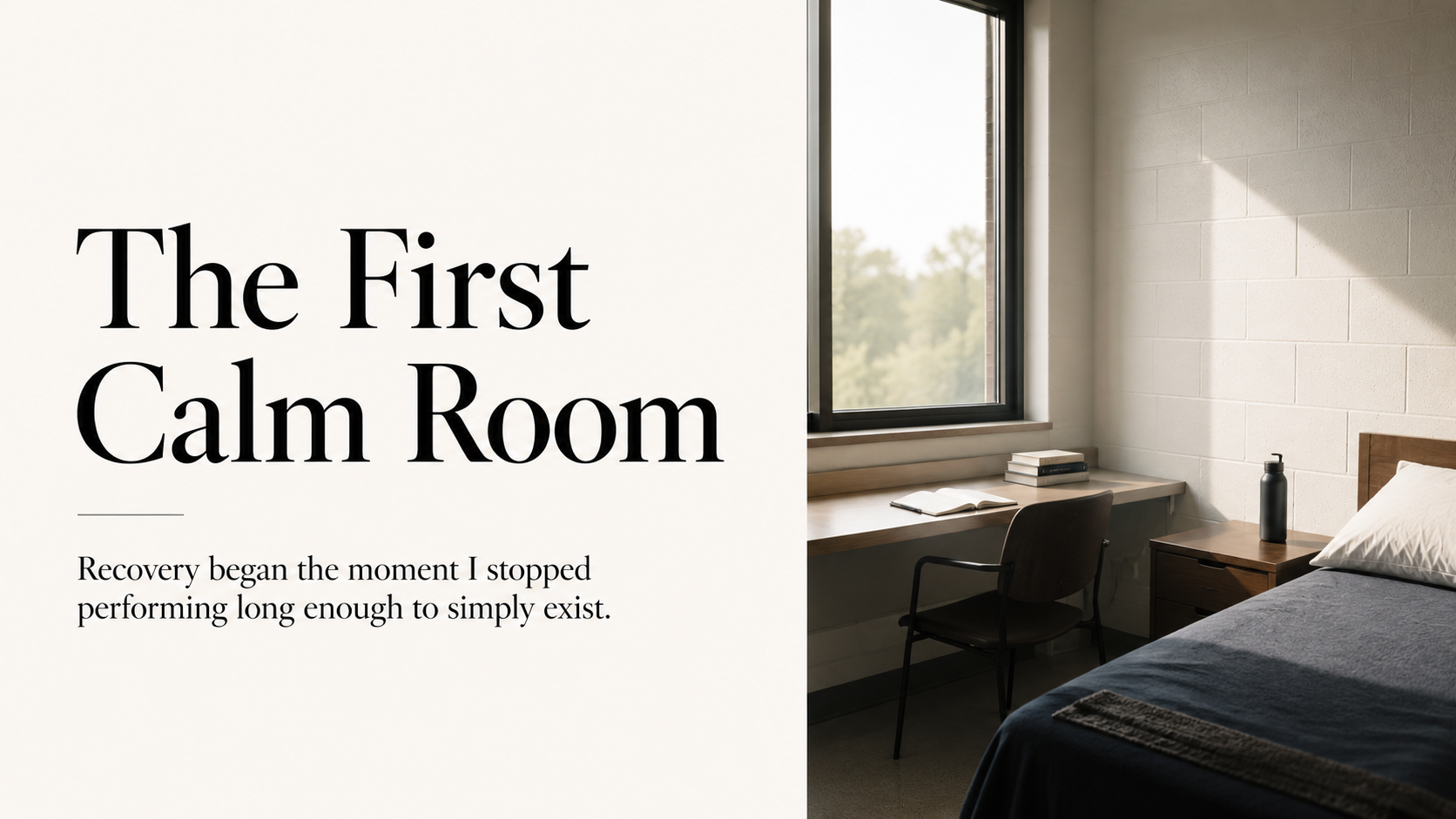
The First Calm Room
Recovery began the moment I stopped performing long enough to simply exist.
One of the strangest moments in recovery was realizing how much energy I had spent performing being okay.
Not just professionally. Socially too.
What I wore. How I sounded. Whether I seemed intelligent enough, successful enough, stable enough, interesting enough, together enough. Even during collapse, part of my mind was still trying to manage perception.
Then I arrived at Muriel Wright.
We are fortunate there. Everyone gets a private room.
At first, I thought the room itself was the luxury.
Eventually I realized it was something else.
For ninety days, the outside world largely stopped demanding interpretation from me.
I did not need to think about clothes very much because most of us barely had anything. I did not need to maintain an image. I did not need to project momentum. I did not need to perform competence while privately falling apart.
The room reduced life down to something almost unfamiliar.
Sleep. Reading. Writing. Meetings. Silence.
Just being human.
That simplicity felt disorienting at first.
My nervous system kept waiting for interruption. It kept trying to restart old patterns of performance and self-management even though there was no real audience left to manage.
Sometimes I could feel my mind beginning to drift toward performance again, trying to construct a version of myself that sounded sharper, more polished, more in control than I actually felt.
Whenever that happened, I would stop.
Take a breath.
Then consciously return to being myself.
That may have been one of the most important skills recovery gave me.
Not performance. Not reinvention.
Interruption.
The ability to notice when I was drifting away from myself and gently step back before the drift became identity again.
The room itself was small, but cognitively it felt enormous.
For the first time in a very long while, my attention was not fragmented across survival, presentation, instability, fear, desire, shame, and exhaustion all at once. The environment remained stable long enough for my mind to finally settle.
That was where writing returned.
Not because inspiration suddenly appeared, but because there was finally enough internal quiet to hear my own thoughts again.
People often imagine recovery as dramatic transformation. My experience was quieter than that.
Recovery began the moment I stopped trying to construct a person worth saving and allowed myself to simply be one.

Subscribe to Amid the Noise
Amid the Noise is an ongoing body of work on signal, systems, governance, AI, and the structures that shape human judgment under pressure.
Subscribe to receive new essays as they are published.