The Day the End Began for AOL
When protecting the present killed the future
I miss Netscape. To this day, almost three decades after it began, I still miss working for Netscape. I left after the acquisition but returned for another two years in 2002 to the AOL/Netscape combo. It was during that time period that I recall the following.
Netscape was my first tech job in Silicon Valley, and it set the course for my entire career. I could not have chosen a better place to start. We were not just building products—we were defining how the web itself would work. I had the privilege of working alongside giants like Larry Tesler and Erin Malone, and some of the principles we refined together persist to this day as the very bedrock of human interface guidelines and best practices. That is one of the reasons I have always held Marc Andreessen in such high regard: he had the vision to push boundaries at a time when the internet was still uncharted territory.
Which is why I remember with such clarity the moment when everything shifted.
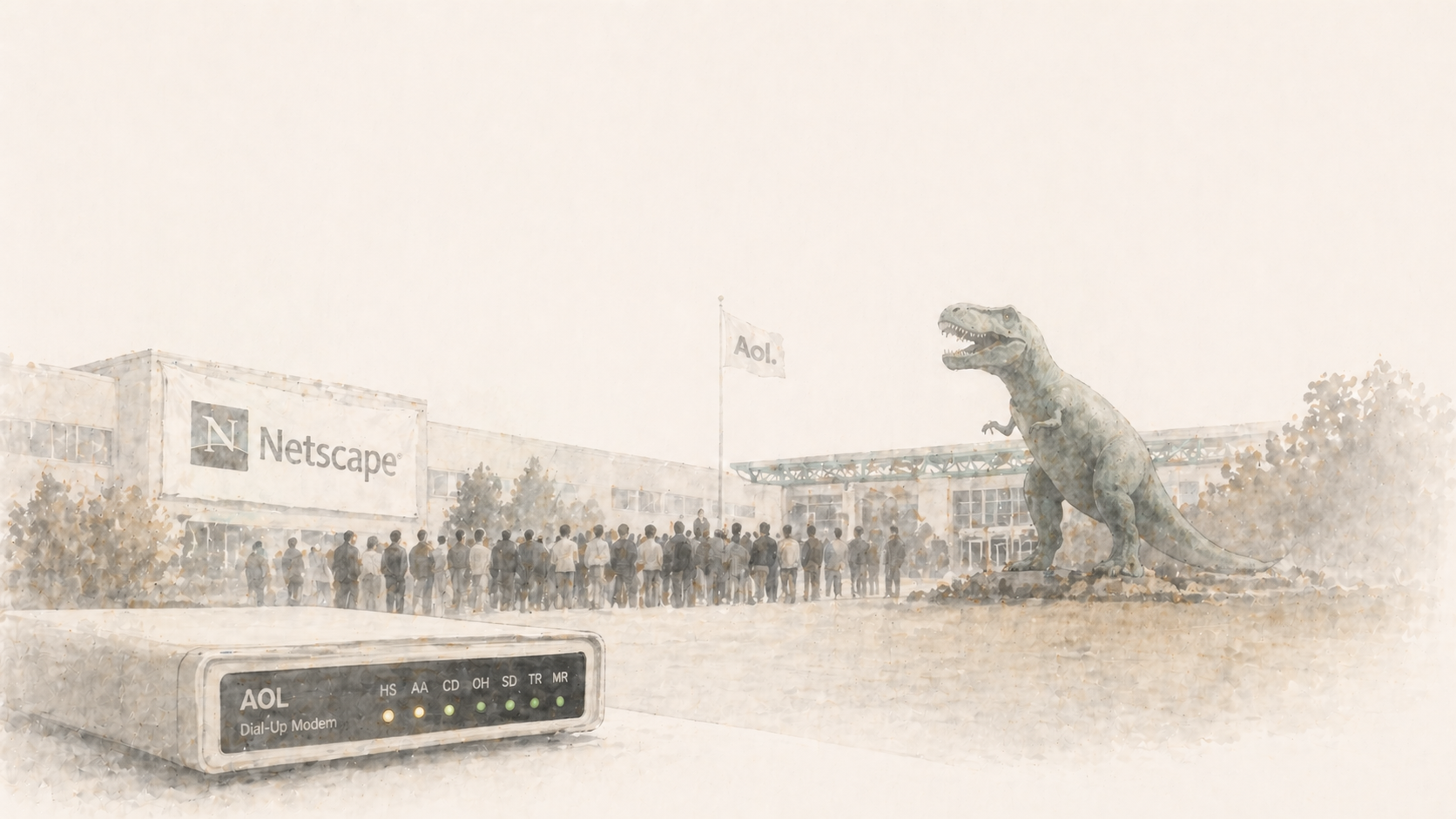
It was an all-hands meeting on the Mountain View campus, held in the building that houses the gym and cafeteria. We gathered outside on the lawn, where the huge green fiberglass Mozilla dinosaurs loomed like relics from another era.
AOL leadership stood before us and made a declaration that still echoes in my mind:
“Americans will never pay for high-speed Internet. The cost is just too high.”
On that bet, they doubled down on dial-up—pushing more investment into a business model already eroding under its own weight. The reasoning was simple, yet profoundly shortsighted: protect the margins, squeeze a little more profit out of the status quo, and hope that broadband was a fad.
Of course, broadband was not a fad. Speed itself became the product. Consumers proved more than willing to pay for faster connections. The competitors who recognized this truth—cable providers, telcos, and later the tech giants—built the world we live in now.
Looking back, it was not only a failure of strategy. It was a failure of imagination. Leadership could not see that the future was not about preserving dial-up but about embracing what was next, even if it meant cannibalizing their most profitable line of business.
The lesson endures: companies do not die from a lack of money—they die from a lack of courage to invest in the future.
Today, as AOL’s dial-up era officially closes, I think back to that lawn in Mountain View. To the dinosaurs standing watch. To the leaders who told us what Americans would never do.
This morning, NPR played the sound of a dial-up modem connecting—those beeps, hisses, and static pulses that once carried us into a new world. I closed my eyes and remembered how it felt. That sound was the beginning of everything, and for AOL, it was also the beginning of the end.

Subscribe to Amid the Noise
Amid the Noise is an ongoing body of work on signal, systems, governance, AI, and the structures that shape human judgment under pressure.
Subscribe to receive new essays as they are published.