The Civic Threshold
Signals of strain, paths to repair
Civilizations rarely fail with spectacle. They fray in plain sight, softened by familiarity and numbed by routine. The danger never begins with catastrophe. It begins with people assuming someone else will handle the hard parts.
What follows traces a pattern visible across nations, industries, and institutions. It begins with physical systems under strain, moves through the incentives that shape behavior, and arrives at a simple conclusion: decline is rarely sudden, and repair is rarely impossible.
I. Russia’s North Star
Russia’s Soyuz launches have long served as the country’s most reliable narrative, a quiet proof that some systems still hold even when the politics around them do not. That reputation faltered on 27 November. The rocket rose cleanly into the Kazakh sky. The crew arrived at the Station without incident. Yet a drone circling Site 31/6 captured something the ascent could not overshadow: Baikonur’s mobile maintenance cabin flipped upside down in the flame trench, inert and embarrassed.
The launch succeeded. The ground beneath it failed.
Baikonur carries the weight of an entire era. Its concrete remembers Gagarin. Its flame trenches have witnessed triumph, tragedy, and decades of indifference. Site 31/6 is not a ceremonial relic. It is a workhorse pad that kept missions flying while Gagarin’s Start underwent renovation. Its equipment is sturdy, familiar, and older than most of the astronauts it supports.
When a structure like that collapses, even in a way that harms no one, it signals something deeper: a slow starvation of upkeep, attention, and institutional memory.
The war in Ukraine has forced Russia to make choices it can no longer disguise. Sustained conflict drains the same resources needed to maintain precision aerospace systems. Budgets tilt toward artillery. Maintenance becomes a deferred promise. Engineers retire or emigrate. Sanctions tighten supply chains.
A system can withstand one of these pressures. It cannot withstand all of them indefinitely.
Soyuz remains robust. Russian spaceflight remains competent. The failures now appear not in the rocket, but around it. Infrastructure fails first at the seams.
The Soyuz climbed flawlessly.
The pad beneath it whispered a different story.
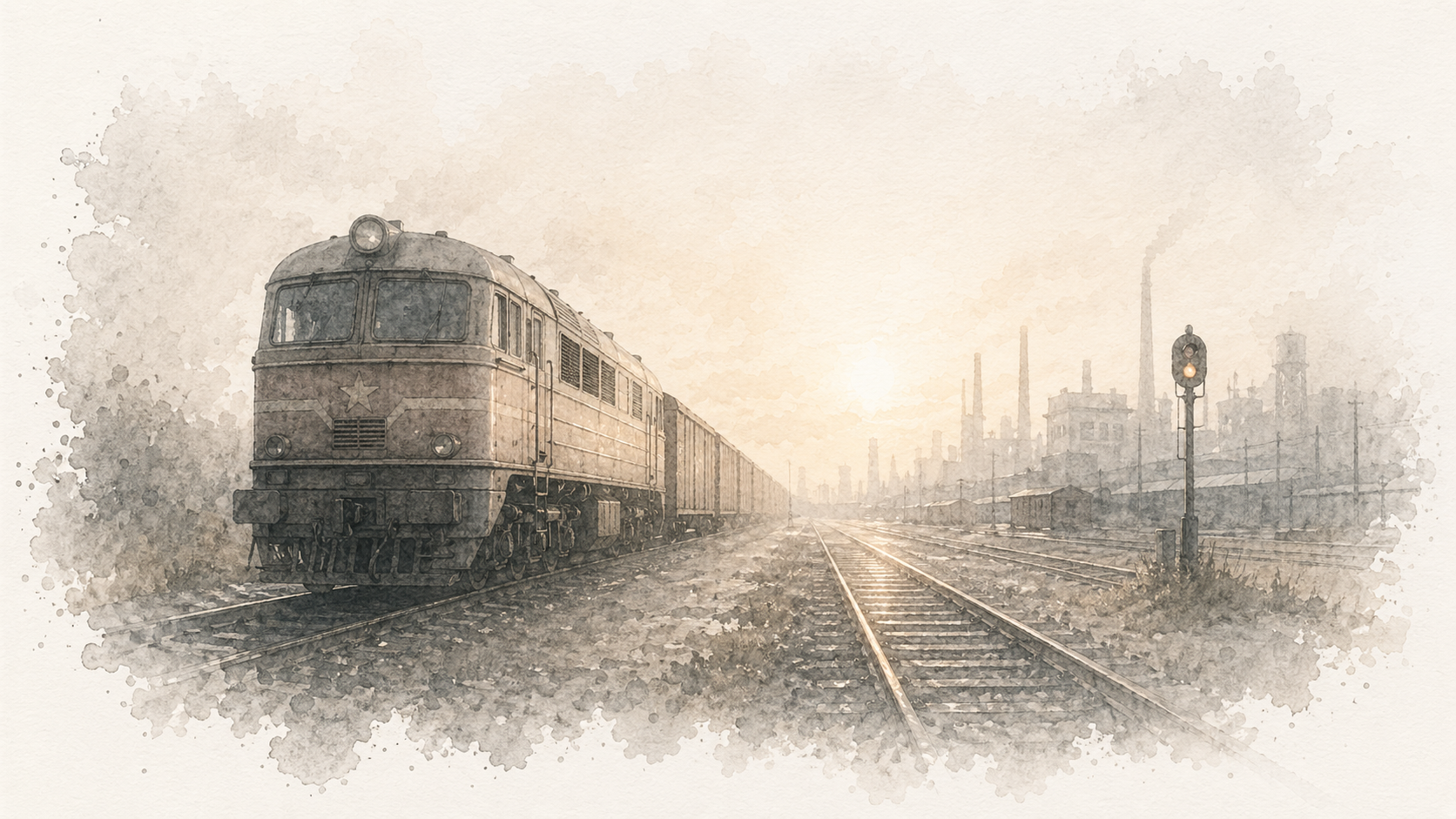
II. Russia’s Vanishing Backbone
Russia’s railways once felt inevitable. They crossed forests, steppes, and industrial corridors with authority. That confidence is harder to find now.
The system was built for mass, not adaptation. It moves volume well when conditions are stable. War has removed that stability.
Military freight now dominates key corridors. Civilian goods wait. Transit times slip. Bottlenecks that once cleared now dictate the rhythm of the entire network.
Sanctions have exposed structural weakness. Rail systems depend on precision parts that are no longer reliably available. Maintenance slips. Locomotives sit idle for lack of a single component. Older stock returns to service beyond safe thresholds.
Officials speak of resilience. The rails speak of fatigue.
Russia’s geography leaves little room for failure. When one corridor falters, the impact travels thousands of kilometers. A delayed shipment becomes a stalled industry.
The system has not collapsed. It has begun to bend.
III. Russia’s Diminishing Core
Russia presents industrial strength as continuity. The reality is closer to depletion.
Factories continue producing, yet much of their machinery predates the Soviet collapse. Tools age. Calibration drifts. Replacement parts are scarce. Output persists because the system has memory, not because it has renewal.
Labor has thinned through mobilization, emigration, and demographic decline. Skilled workers are not easily replaced. Knowledge fragments. Workarounds become standard practice.
Production increases mask erosion. Refurbishment is counted as output. Stockpiles are stripped for parts. The system is not expanding capacity. It is consuming it.
Supply chains no longer behave predictably. Substitutions fill gaps where possible. Delays compound where they do not. The system shifts from strategic to reactive.
The most important measure of an industrial base is not what it produces today. It is what it can promise tomorrow.
Russia can no longer make that promise.
IV. The Political Economy of Decay
Industrial strain becomes systemic when political incentives accelerate it.
Russia’s political economy extracts rather than regenerates. Resources are consumed to maintain output. Institutions are pushed to perform strength rather than build it.
Incentives reward short-term production over long-term stability. Managers meet quotas at the expense of machinery. Maintenance is deferred. Improvisation becomes the operating model.
Information collapses in vertical systems. Bad news is filtered. Accuracy becomes risk. Leadership receives signals shaped by survival rather than truth.
Talent leaves. The most capable workers exit systems that cannot guarantee a future. The pipeline empties. Knowledge disappears.
The state fills gaps through command. This sustains output briefly. Over time, it becomes an obstacle to recovery.
A system that cannot acknowledge reality cannot correct course.
V. The American Mirror
It is easy to treat these dynamics as foreign.
It is harder to recognize their echoes.
America’s decline, where it exists, does not arrive through coercion. It arrives through tolerance.
The country assumes scale will absorb strain. Agencies stretch. Workers compensate. Systems continue functioning long after they should have been repaired.
Friction becomes normal. Procurement delays extend for years. Infrastructure ages quietly. Digital systems lag behind need.
Political volatility introduces a different form of instability. When commitments shift with leadership cycles, long-term planning stalls. Capacity exists, yet it remains underused because institutions cannot rely on continuity.
Institutional memory erodes. Experienced workers retire. New workers cycle quickly. Systems lose the knowledge that once sustained them.
America excels at response. It struggles with maintenance.
The danger is not collapse.
The danger is drift.
VI. The Broken Incentive Loop
Institutions fail when incentives misalign with purpose.
People respond rationally to the structures around them. Over time, those responses reshape the system itself.
In Russia, incentives reward survival and appearance. In America, they reward visibility and urgency. Both distort behavior.
Workers stabilize what is breaking rather than repair what is worn. Leaders perform action rather than invest in prevention. Truth becomes conditional.
None of this requires bad actors. It requires only consistent pressure applied in the wrong direction.
Misaligned incentives flatten expertise, suppress honesty, and reward short-term outcomes at long-term cost.
Decline becomes the aggregate result of reasonable decisions made within a flawed structure.
VII. The Repairable Future
Most decline is reversible.
Repair begins with recognition. Systems recover when people name what is real rather than protect what is comfortable.
Maintenance must return to the center. It is not glamorous, yet it is foundational. Stability is built through continuous, quiet correction.
Institutional memory must be treated as infrastructure. Knowledge must be preserved, not allowed to dissipate through neglect.
Incentives must align with purpose. Systems recover when they reward truth, stewardship, and long-term contribution.
Transparency lowers friction. When people trust institutions, they participate in them. When they do not, they withdraw.
Repair does not arrive through crisis.
It arrives through accumulation. Small corrections, repeated at scale, reverse drift.
VIII. The Civic Threshold
A threshold is a place of recognition.
It is the moment when people understand that institutions are not distant machinery. They are the sum of individual choices, reinforced daily through action or inaction.
The United States stands at such a threshold.
Not at the edge of collapse, but at the edge of choice.
The systems examined here do not fail because they lack resources. They fail when the people within them stop believing their participation matters.
A repairable future requires more than policy. It requires a civic imagination strong enough to see institutions as shared work.
Renewal begins in ordinary places. It happens when people decide that maintenance is not someone else’s responsibility. It happens when truth is spoken without calculation. It happens when participation replaces observation.
A nation moves in the direction its people are willing to carry it.
The civic threshold is not ahead of us.
It is beneath our feet.
The future will follow us, not precede us.
The only decision left is whether we step forward with intention.

Subscribe to Amid the Noise
Amid the Noise is an ongoing body of work on signal, systems, governance, AI, and the structures that shape human judgment under pressure.
Subscribe to receive new essays as they are published.