The Bunker and the Lighthouse
On archives, hope, and the signals we leave behind
People occasionally notice that Amid the Noise is scheduled far into the future.
At the time of writing, there are essays queued more than a year ahead. Some readers find this unusual. Most personal websites struggle to maintain a publication schedule a few weeks into the future. Mine occasionally resembles a municipal reservoir, quietly collecting enough material to sustain itself through a drought that may never arrive.
For a long time, I explained this as discipline.
The explanation was convenient because it was partially true. Maintaining a publication schedule requires planning, consistency, and more than a little stubbornness. If a post is going to appear on a particular Thursday in July of next year, someone has to write it first.
Lately, however, I have begun to suspect that discipline is only the surface explanation.
The deeper explanation is harder to admit.
I think I have been building a bunker.
That realization arrived unexpectedly while working on another essay. The piece began with a missing package and eventually became a reflection on margin, infrastructure, and the way seemingly small problems grow larger when the resources available to absorb them begin to shrink. Somewhere in the middle of that process, I found myself looking at the publication calendar and recognizing a familiar impulse.
People build reserves for a reason.
Cities construct reservoirs because droughts exist. Ships carry extra provisions because storms exist. Communities build infrastructure because failures eventually occur. Perhaps a publication queue stretching deep into the future is not so different.
The last several years have provided more than enough evidence that life can change rapidly. Jobs disappear. Housing becomes uncertain. Health becomes fragile. Relationships evolve. Entire chapters of a life can collapse far more quickly than they were built.
When viewed through that lens, the archive begins to look less like a creative project and more like preparedness.
A bunker is not an expression of optimism. It is an acknowledgment that weather exists.
The strange thing is that the bunker theory explains only half of what Amid the Noise has become.
If protection were the only goal, there would be no reason to publish any of it.
The essays could remain private. The archive could live on a hard drive. The observations could remain safely stored and largely unseen.
Yet that is not what happened.
The work was published.
The domain was renewed.
The archive was organized.
The signal was sent.
That is where the lighthouse enters the story.
For most of my life, I have been fascinated by lighthouses. Like many people, I was initially drawn to the visible elements: the tower, the beam, the lonely silhouette standing against a violent sea. The older I have become, the more interested I find myself in the less romantic parts of the system.
The fuel.
The maintenance.
The logistics.
The Fresnel lens.
Especially the Fresnel lens.
A Fresnel lens is remarkable because it does not create light. It does not generate energy. It does not make the lamp brighter. What it does is take a finite amount of light and project it much farther than it could travel on its own.
That distinction matters.
Amid the Noise has never really been about creating signal.
The signal already exists.
A conversation with a friend. A vote cast at a library. A bowl of dumplings. A man standing across the street. A missing package. A child coloring on a floor.
Most of these moments appear insignificant when viewed in isolation. They arrive quietly and disappear just as quickly. The work of writing has never been to invent meaning where none existed. It has been to linger long enough to discover the meaning already present and then amplify it until it becomes visible from a greater distance.
That realization changed the metaphor entirely.
I had spent years thinking about archives, portfolios, essays, and publication schedules. Suddenly I found myself thinking about lenses.
The purpose of a lighthouse is not to create land. The coastline already exists. The rocks already exist. The fog already exists. The lighthouse simply makes navigation possible.
That idea felt uncomfortably familiar.
When Amid the Noise first appeared, it was largely practical. I had spent decades building products, leading teams, conducting research, and helping organizations understand people. Much of that work existed behind corporate walls. I needed a place to demonstrate how I thought. The site was, in many ways, a portfolio replacement.
The problem with portfolios is that they assume someone is already looking.
Writing operates differently.
A portfolio demonstrates capability.
Writing demonstrates perspective.
Over time, the purpose shifted. The archive became less concerned with proving what I had done and more interested in exploring what I had learned. The essays became a way of making sense of experiences that would otherwise disappear into memory.
Somewhere along the way, another function emerged.
Hope.
If the archive vanished tomorrow, I would not mourn the analytics. I would not miss the social media shares. I would not lose sleep over search rankings or engagement metrics.
What I would lose is something far more difficult to replace.
I would lose evidence.
Evidence that I was here.
Evidence that I paid attention.
Evidence that even during years defined by uncertainty, recovery, reinvention, and loss, there remained a coherent thread connecting one day to the next.
That thread matters more than I realized.
When I published my first book of poetry, the experience felt less like publication and more like release. The poems were not being preserved. They were being burned. I often described the process as writing painful thoughts onto flash paper and setting them alight. The purpose was not memory. It was liberation.
Amid the Noise serves a different function.
The archive preserves what the poetry released.
One lets go.
The other remembers.
For a long time, I thought these impulses contradicted one another. Now I suspect they are part of the same process. Some things need to be carried away by the wind. Others need to survive the storm.
Which brings me back to the lighthouse keeper.
Modern navigation has largely automated the role. Computers, satellites, radar, and the Coast Guard perform much of the work once entrusted to solitary individuals stationed on remote stretches of rock and coastline. Yet the image of the keeper persists because it represents something deeper than maritime logistics.
Stewardship.
The keeper maintains the light regardless of whether a ship appears that evening.
The work continues during storms.
The work continues during fog.
The work continues even when there is no visible evidence that anyone is watching.
There is something profoundly lonely about that image. Not because the keeper is isolated from people, but because the keeper is isolated from certainty. The light is maintained without knowing who sees it, whether it helped, or whether anyone passed safely through the darkness because it remained lit.
There is also something profoundly hopeful about it.
The keeper cannot see every ship.
The ship can see the light.
Perhaps that is enough.
For years I have tried to determine whether Amid the Noise is a bunker or a lighthouse. The question has never produced a satisfying answer because it assumes the two structures are separate.
They are not.
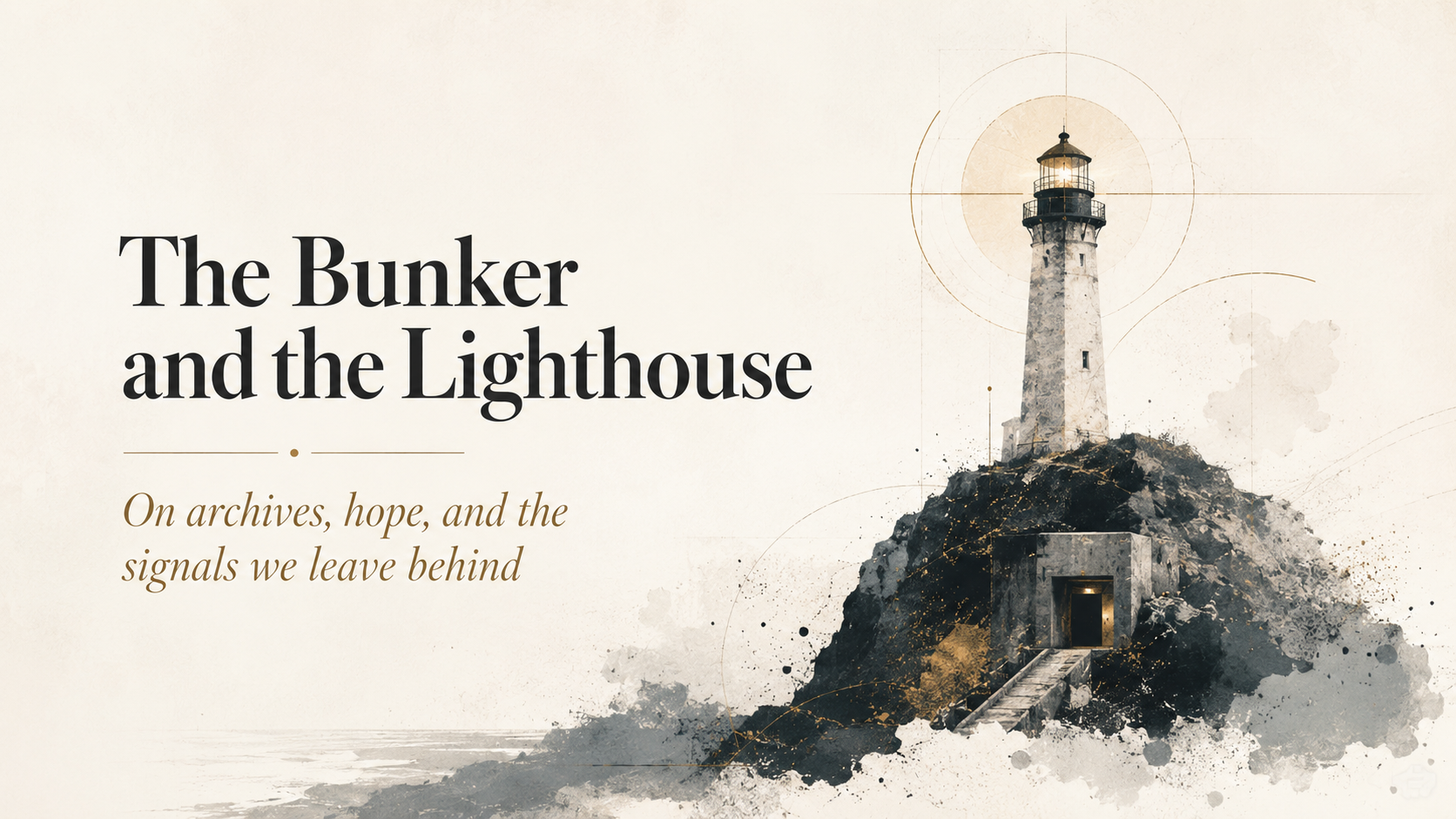
The longer I sit with the metaphor, the more I imagine a lighthouse standing on a lonely island with a bunker hidden beneath it. Above ground, a signal reaches outward into darkness. Below ground, fuel, supplies, records, and reserves ensure that the signal survives another night.
For a long time, I assumed the light was for whoever might eventually find it. The longer I maintain it, the more I suspect it serves another purpose as well. On difficult nights, it reminds the keeper that the shoreline still exists.
One protects the light.
The other shares it.
The distinction matters less than I once believed.
What matters is that the light remains visible.
Especially in the fog.

Subscribe to Amid the Noise
Amid the Noise is an ongoing body of work on signal, systems, governance, AI, and the structures that shape human judgment under pressure.
Subscribe to receive new essays as they are published.