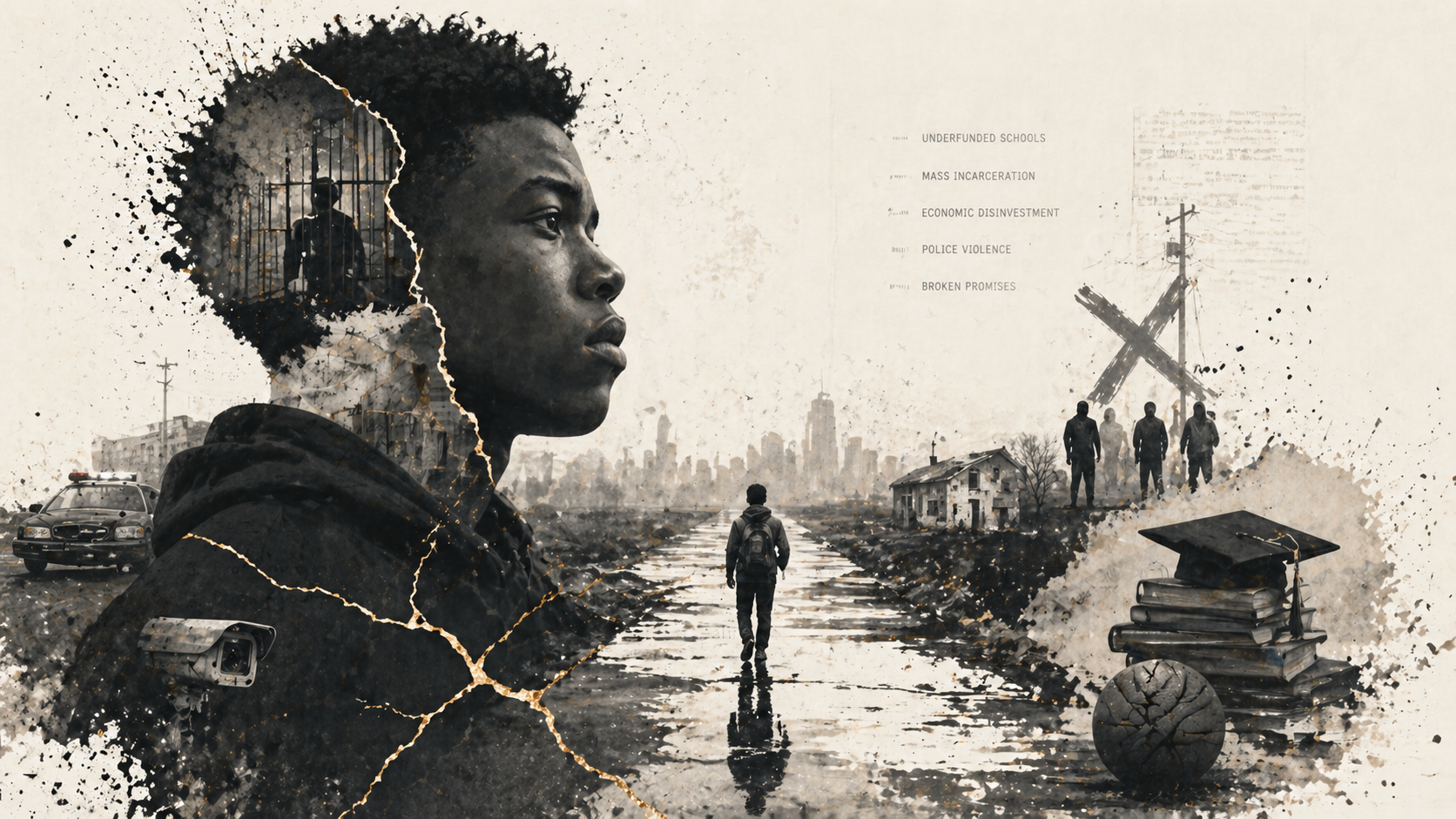
Stay Dangerous
When adaptation replaces protection
“Stay dangerous.”
It reads like a threat if you hear it from the outside.
From the inside, it’s instruction.
Not ideology. Not bravado. A survival protocol.
What sounds like aggression is often adaptation. When systems stop protecting, behavior reorganizes around risk.
This is not a glorification.
It’s a data point.
When Safety Is No Longer Available
In stable systems, safety is assumed.
In failing systems, it becomes conditional. Then it disappears.
When that happens, the social contract fractures. Trust in institutions degrades. Protection is no longer external. It becomes personal.
You don’t stay safe.
You stay prepared.
That shift is not philosophical. It’s environmental.
The Missing State
In communities where incarceration is constant, it stops reading as exception.
It becomes background.
A normal interruption. A predictable outcome.
That normalization signals something deeper. It marks the point where the system has stopped functioning as designed and started operating as a loop.
Entry. Removal. Return.
No repair.
When the State Loses Legitimacy
In healthy systems, the state mediates conflict.
In failing systems, it escalates it.
When people run from the state instead of toward it, legitimacy has already collapsed. Authority still exists, but trust does not.
In that vacuum, individuals create their own enforcement models.
Not because they want to.
Because there is no alternative.
Grief Without Infrastructure
What happens when grief has nowhere to go?
No therapy. No community support. No structure to process loss.
It doesn’t disappear.
It converts.
Into action. Into retaliation. Into something that looks like aggression from the outside, but reads as continuity from within.
Grief becomes motion.
Informal Economies Fill Formal Gaps
When legitimate pathways to mobility close, others open.
Not by design, but by necessity.
The underground economy is often framed as moral failure.
More often, it’s structural response.
When the system offers no viable path forward, people build one anyway.
Conflict Without Resolution
Where conflict resolution is not taught, it is improvised.
Where mediation does not exist, escalation becomes the default.
Violence, in this context, is not chaos.
It is a system.
Fast. Immediate. Enforced.
A replacement for something that never showed up.
What This Reveals
This isn’t a song about danger.
It’s a map of absence.
It documents what happens when safety is privatized, healing is unavailable, and trust collapses.
It shows what people build when systems fail to meet them.
The mistake is treating this as culture alone.
It’s signal.
For designers, policymakers, technologists, this is not something to critique from distance. It is something to study.
These are lived experiences shaped by system behavior.
These are outcomes produced by design decisions, funding choices, policy gaps.
These are wireframes of lives operating under constraint.
The Real Question
The question is not why people adapt this way.
The question is why they have to.
“Stay dangerous” is not the answer.
It’s the symptom.
The work is not to judge the behavior.
The work is to redesign the conditions that made it necessary.
So people don’t have to choose between safety and survival.
So safety becomes real again.

Subscribe to Amid the Noise
Amid the Noise is an ongoing body of work on signal, systems, governance, AI, and the structures that shape human judgment under pressure.
Subscribe to receive new essays as they are published.