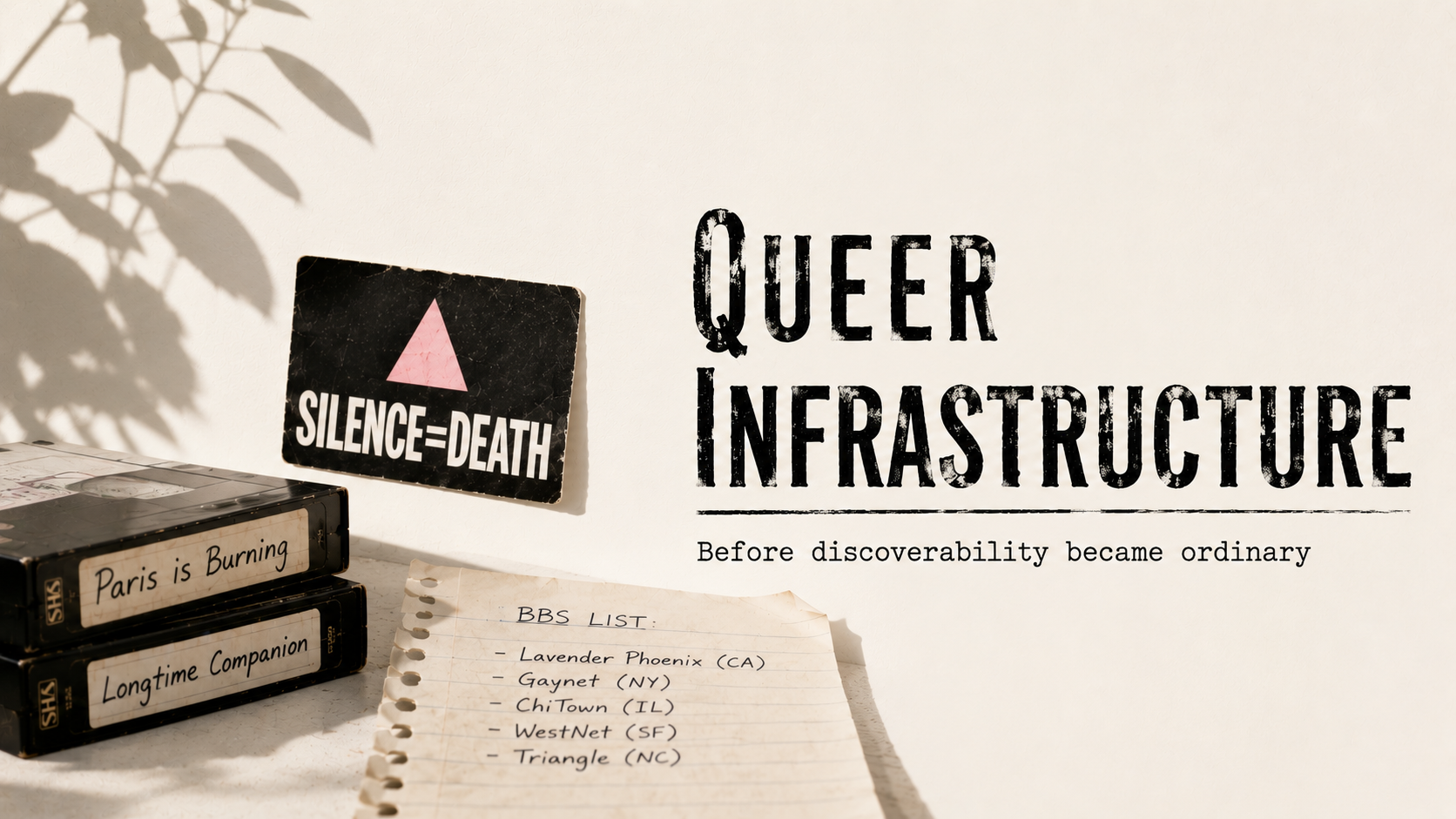
Queer Infrastructure
Before discoverability became ordinary
Coming out in 1992 meant entering a parallel civilization that operated partly in public and partly through signal.
You learned to read symbols because symbols carried information about safety.
A rainbow freedom ring. A pink triangle sticker. A photocopied flyer on a café bulletin board. A bookstore with a small LGBT section tucked somewhere near the back. A VHS copy of Paris Is Burning left in plain sight almost like an invitation.
That was infrastructure.
There was no ambient internet yet. No discoverability layer. No algorithm quietly feeding you people like yourself. Connection required effort, geography, and luck.
For many of us, the first digital bridges were bulletin board systems.
You dialed in manually. Modems screamed into the darkness while text crawled line by line across glowing monitors. Handles replaced names. Sysops moderated tiny communities running on spare bedrooms, second phone lines, and trust.
I ran up several thousand dollars in long-distance charges connecting to BBS systems around the country. In retrospect, I could have purchased a modest used car with the money.
At the time, that did not matter.
The possibility of finding someone like me felt more important.
Those systems carried more than flirtation or curiosity. They carried reconnaissance. AIDS information. Rumors about safe bars. Emotional weather reports from cities you had never seen. Proof that other lives were possible.
Sometimes the goal was nothing more complicated than confirming another person like you existed within fifty miles.
The physical world required its own operational literacy.
Closeted people became experts at self-editing. Pronouns were rehearsed before conversations. Stories were monitored in real time. Body language became situational. Entire social interactions could hinge on whether a room felt safe enough for one unguarded sentence.
Then there was AIDS, hanging over everything like weather.
People disappeared. Memorials accumulated. Hospital rooms could suddenly change status once biological family arrived. Partners became “friends” in the eyes of institutions that refused to recognize the lives they had built together.
Chosen family became practical infrastructure, not symbolic language.
That pressure created unusual forms of intimacy.
Bookstores, diners, bars, coffeehouses, apartments, and Pride events often functioned less like venues and more like continuity systems. They restored recognition where the outside world often withdrew it.
Even camp carried different weight then.
People sometimes remember early 1990s queer culture as theatrical or exaggerated. Some of it was. Some of it was resilience technology. Humor softened terror. Visibility reclaimed dignity before visibility felt safe. Glitter and grief occupied the same room with startling regularity.
Longtime Companion and Torch Song Trilogy were not stories about normalized gay adulthood so much as stories about endurance, loss, and legitimacy. There were few examples of ordinary queer life because ordinary queer life had barely entered mainstream storytelling yet.
What I remember most clearly now is how much significance ordinary visibility carried.
A teacher casually mentioning a same-sex partner.
Two men holding hands in daylight.
A lesbian couple eating dinner without lowering their voices.
Tiny moments by modern standards. Life-altering ones at the time.
Before the internet became ambient, queer people built a parallel infrastructure out of phone lines, bookstores, bars, flyers, VHS tapes, and bulletin board systems.
The systems were fragile, improvised, and expensive.
They carried us anyway.

Subscribe to Amid the Noise
Amid the Noise is an ongoing body of work on signal, systems, governance, AI, and the structures that shape human judgment under pressure.
Subscribe to receive new essays as they are published.