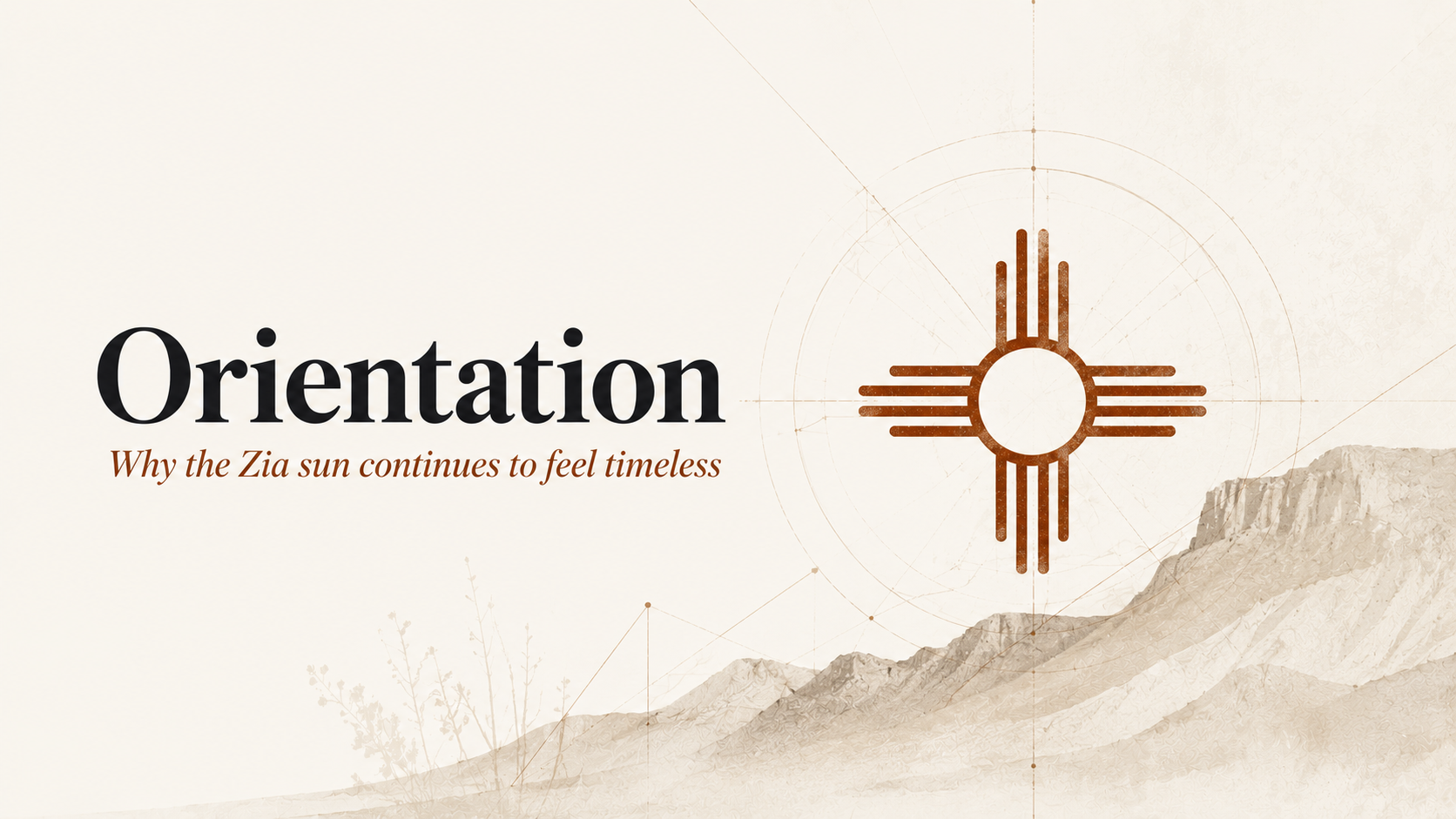
Orientation
Why the Zia sun continues to feel timeless
Some symbols feel designed.
Others feel divine.
The Zia sun symbol has always belonged in the second category for me.
I have seen it painted onto adobe walls in New Mexico, burned into leather, hanging from rearview mirrors, printed onto weathered signs, worked quietly into modern branding systems, and flying from the state flag against impossible blue desert skies. Every time, it feels both ancient and strangely contemporary at the same moment.
That tension fascinates me.
The symbol itself is remarkably simple. A circle at the center. Four groups of radiating lines extending outward. Symmetrical enough to feel stable. Imperfect enough to still feel human.
There is almost nothing there.
Which is probably why it carries so much weight.
The older I get, the more I think humans are naturally drawn toward symbols that compress complexity into recognizable form. The most enduring symbols in history rarely explain themselves. They orient instead.
A compass. A cross. A spiral. A star. A sun.
They create psychological stability before they create intellectual understanding.
The Zia symbol traditionally centers around the sacred significance of four:
- four directions
- four seasons
- four stages of life
- four periods of the day
Even without knowing any of that history, though, the symbol still communicates balance almost immediately. You can feel the geometry working before you consciously interpret it.
That may be part of why the symbol escaped its original context so completely and became absorbed into the broader visual identity of New Mexico itself. The state flag is now inseparable from it. So are entire aesthetics associated with the Southwest:
- adobe architecture
- desert modernism
- turquoise and rust palettes
- open sky geometry
- sunlight as atmosphere
Like many enduring cultural symbols, the Zia sun now exists inside multiple overlapping realities simultaneously: sacred symbol, regional identity, design language, commercial motif, personal resonance.
That complexity deserves respect.
At the same time, reducing the symbol entirely to debates over appropriation misses part of the story too. Symbols survive because human beings keep finding meaning inside them. Civilizations continuously absorb, reinterpret, preserve, commercialize, dilute, and rediscover the symbols that continue to orient them emotionally.
The process is rarely clean.
Still, certain forms endure anyway.
What draws me to the Zia symbol has less to do with New Mexico branding than the feeling the geometry creates. It feels stable. Calm. Balanced without becoming sterile. The same reason certain architectural proportions continue to work century after century.
Good design often operates this way.
Minimal structure. Maximum meaning.
That is much harder to achieve than complexity.
Anyone can create visual noise. It takes restraint to create something simple enough that people carry it with them for generations.
I think that is why the symbol continues to appear in my own design thinking from time to time. Not as decoration exactly, but as orientation. A reminder that the strongest systems are often the ones capable of communicating the most with the least amount of force.
The Southwest understands this instinctively.
Desert landscapes strip away excess. Light becomes sharper there. Distance becomes more legible. Geometry stands exposed against open space in ways wetter landscapes often conceal. Maybe that is why symbols from the region feel so elemental. There is nowhere for visual clutter to hide.
You start noticing how much human beings crave orientation systems once you look for them long enough.
Maps. Flags. Constellations. Religious iconography. Transit diagrams. Corporate logos. Navigation beacons. Even the glowing blue dot that tells you where you are standing right now.
Civilizations continuously reinvent ways to answer the same underlying question:
Where am I in relation to everything else?
The symbols that survive are usually the ones that answer without speaking too loudly.
The Zia sun has always felt like one of those symbols to me.

Subscribe to Amid the Noise
Amid the Noise is an ongoing body of work on signal, systems, governance, AI, and the structures that shape human judgment under pressure.
Subscribe to receive new essays as they are published.