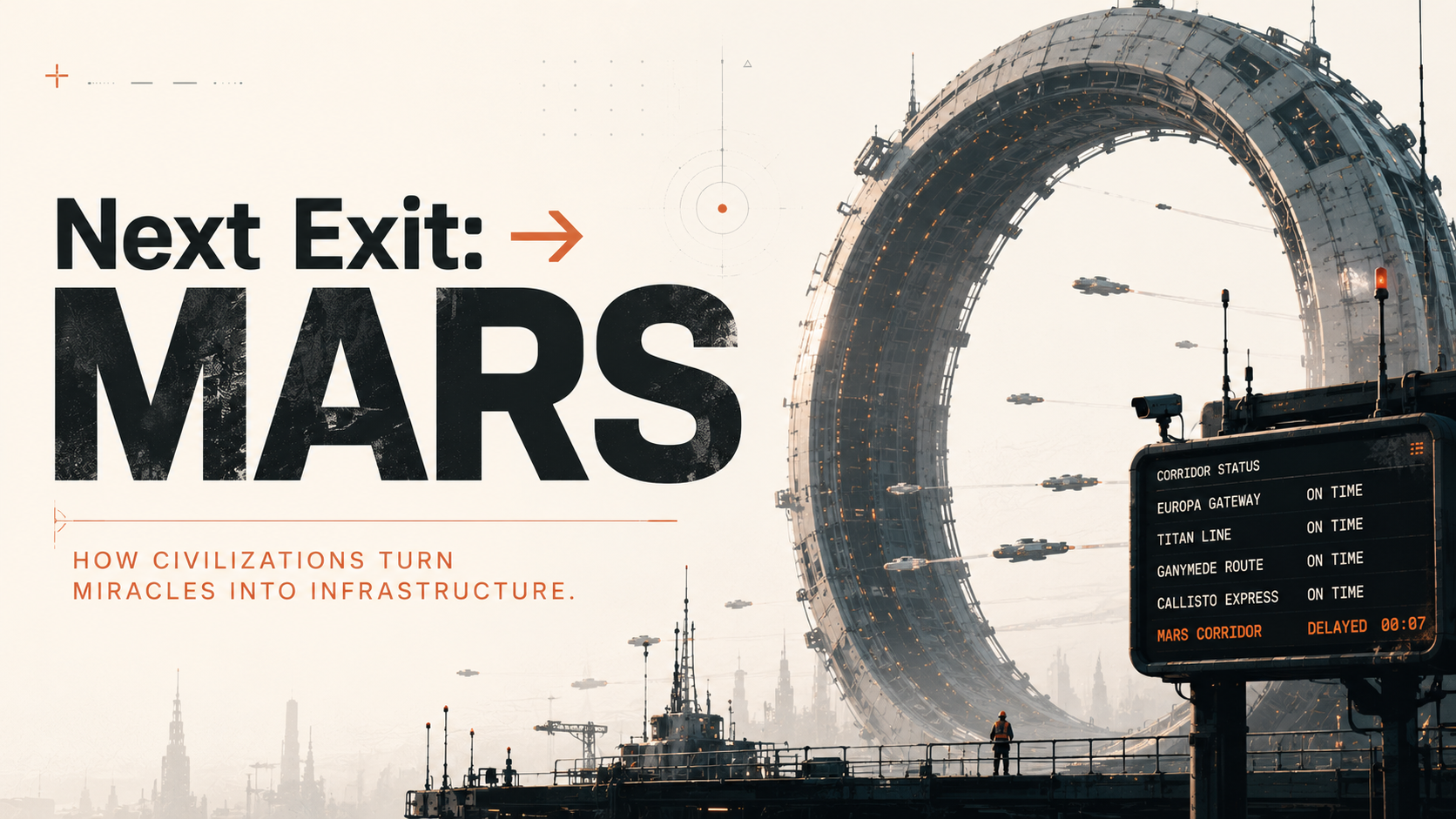
Next Exit: Mars
How civilizations turn miracles into infrastructure.
Most science fiction asks the wrong question.
How does faster-than-light travel work?
The question is understandable. If humanity ever reaches another star system, the technology involved would almost certainly represent one of the greatest breakthroughs in history.
Yet breakthroughs are rarely the most interesting part of the story.
The Golden Spike was a ceremony. The story was the standardized time zones that followed.
The interstate highway system was not the story. The story was that a shipment could leave California and arrive in New York on a predictable schedule.
The internet was not the story. The story was what happened after everyone assumed it would always be there.
The story was what happened next.
Once a technology becomes useful, society begins the slow process of operationalizing it.
Schedules appear.
Regulations appear.
Fees appear.
Maintenance crews appear.
Someone has to pay for all of it.
That thought occurred to me while thinking about the hyperspace gates in Cowboy Bebop.
Most fictional depictions of faster-than-light travel resemble magic. A captain gives an order. The engines engage. The ship disappears into the stars.
Cowboy Bebop took a different approach.
Its gates had toll booths.
Its gates had inspections.
Its gates had traffic.
The miracle had already become infrastructure.
That detail is easy to miss, but it may be the most realistic part of the entire setting.
Human beings have a remarkable tendency to transform extraordinary inventions into ordinary systems.
The first railroad was a marvel.
Eventually it became a timetable.
The first automobile was a curiosity.
Eventually it became a traffic signal.
The first airplane was a miracle.
Eventually it became a boarding group.
Progress often arrives through invention.
Civilization arrives through administration.
If humanity ever discovers a way to travel faster than light, I doubt the first challenge will be the physics.
Who builds the network, who owns it, who regulates it, who receives priority access, who pays the maintenance costs, what happens when the route is congested, and what happens when it fails? The history of infrastructure suggests that these questions matter more than the breakthrough itself.
A transportation planner would not look at a hyperspace gate and see a scientific achievement.
They would see throughput.
An economist would see pricing.
An insurer would see liability.
A politician would see leverage.
A bureaucrat would see permits.
The miracle remains the same.
The story changes depending on who is looking at it.
That pattern appears everywhere.
We often imagine the future as a sequence of discoveries.
History suggests something different.
The discoveries are the opening act.
The real work begins when a civilization decides that the miracle must function on Tuesday at 09:00.
Every transformative technology eventually becomes infrastructure.
Every infrastructure develops rules.
Every rule creates incentives.
Every incentive shapes behavior.
Long before humanity builds a starship capable of reaching another solar system, we will almost certainly build something far more familiar.
A schedule.
Somewhere in the distant future, a freight captain will be frustrated that the Mars corridor is running seven minutes behind.
A transit authority will be conducting inspections.
A maintenance crew will be replacing worn equipment.
A traveler will complain about tolls.
A politician will promise to reduce them.
The technology may be unimaginable.
The experience will feel strangely familiar.
The ultimate success of a miracle is not that it amazes us.
It is that we stop noticing it.
Electricity became an outage.
Air travel became a delay.
The internet became buffering.
The day humanity invents faster-than-light travel will be historic.
The day someone complains that the Mars corridor is running seven minutes behind schedule will be the day it becomes civilization.

Subscribe to Amid the Noise
Amid the Noise is an ongoing body of work on signal, systems, governance, AI, and the structures that shape human judgment under pressure.
Subscribe to receive new essays as they are published.