Most Software Was Never Designed to Decide
When systems cross into responsibility
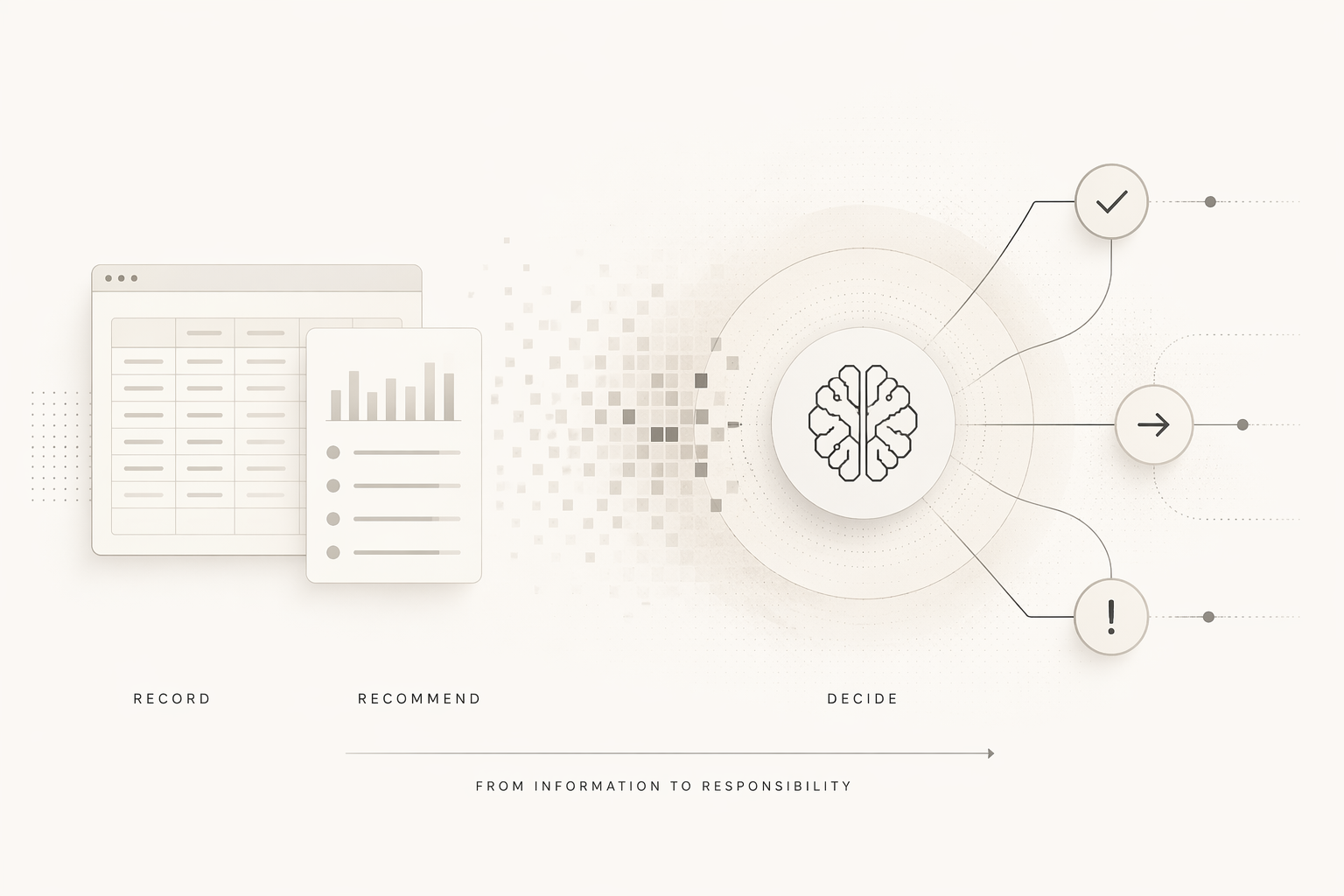
Software was built to record, capturing inputs, organizing them, and producing outputs that a human could interpret. The boundary was clear: the system handled structure, and the human handled judgment. That model worked because responsibility never moved.
Over time, software became more helpful. It began to recommend, surfacing patterns, flagging anomalies, and offering suggestions alongside the data. Even as the surface became more intelligent, the system remained assistive and the human remained the decision-maker. The boundary held.
That boundary is now starting to break.
AI systems no longer just present information. They shape it, prioritize it, and in some cases act on it. What begins as suggestion starts to carry the weight of a decision, even when the system has not taken on the responsibility that implies. The role changes, even if the interface does not.
This shift is easy to miss because it arrives incrementally. A suggested category, a flagged transaction, or an automated workflow that runs unless it is stopped can each feel reasonable in isolation, but taken together they move the system from assistance into action. Most products were never designed for that transition.
The constraint is not capability. It is responsibility.
A recommendation can be wrong without consequence because it still depends on human judgment to complete the loop. A decision system carries a different burden because it must account for what happens when its output is accepted, ignored, or misunderstood. Most software does not have a model for that.
You can already see the strain in real systems. Financial platforms suggest actions without defining when those actions should be trusted. Underwriting tools surface approvals without clear thresholds. Trust and safety systems flag content without establishing how those flags translate into enforcement. Each one operates with the tone of a decision-maker while retaining the structure of a tool.
The problem becomes visible when an error starts to propagate.
A fraud system lowers a transaction’s trust score because a customer logs in from a new device while traveling. The account is frozen automatically. Payroll hits that night. Rent bounces the next morning. No human being ever decided the customer was fraudulent, but the system behaved as though someone had.
That tension holds until it fails.
Once it does, the question is no longer whether the system was helpful.
The question becomes who was responsible for the outcome.
A system designed to decide would answer that question upfront. It would make confidence visible and tie it to behavior, distinguish recommendation from execution, define when to act, when to defer, and when to escalate, and preserve a clear record of how a decision was formed and who ultimately owned it.
These are not features. They are structural commitments.
Most software does not have them because it was never built to need them. It was designed to inform decisions, not participate in them, and that distinction is starting to matter.
As systems take on more of the decision surface, the absence of structure becomes harder to ignore. Outputs begin to carry consequences that the underlying model was never designed to support, creating a growing gap between what systems appear to do and what they are actually accountable for.
Closing that gap will require pressure from every layer of the system. Vendors will need to make systems more legible. Deploying organizations will need governance models that define accountability before deployment rather than after failure. Regulators will eventually need to establish minimum standards for systems that increasingly shape access, enforcement, finance, and identity.
The deeper challenge is designing systems that can carry responsibility under uncertainty without obscuring who remains accountable when something goes wrong.
The interface may still look like software.
Everyone downstream experiences it as a decision.

Subscribe to Amid the Noise
Amid the Noise is an ongoing body of work on signal, systems, governance, AI, and the structures that shape human judgment under pressure.
Subscribe to receive new essays as they are published.