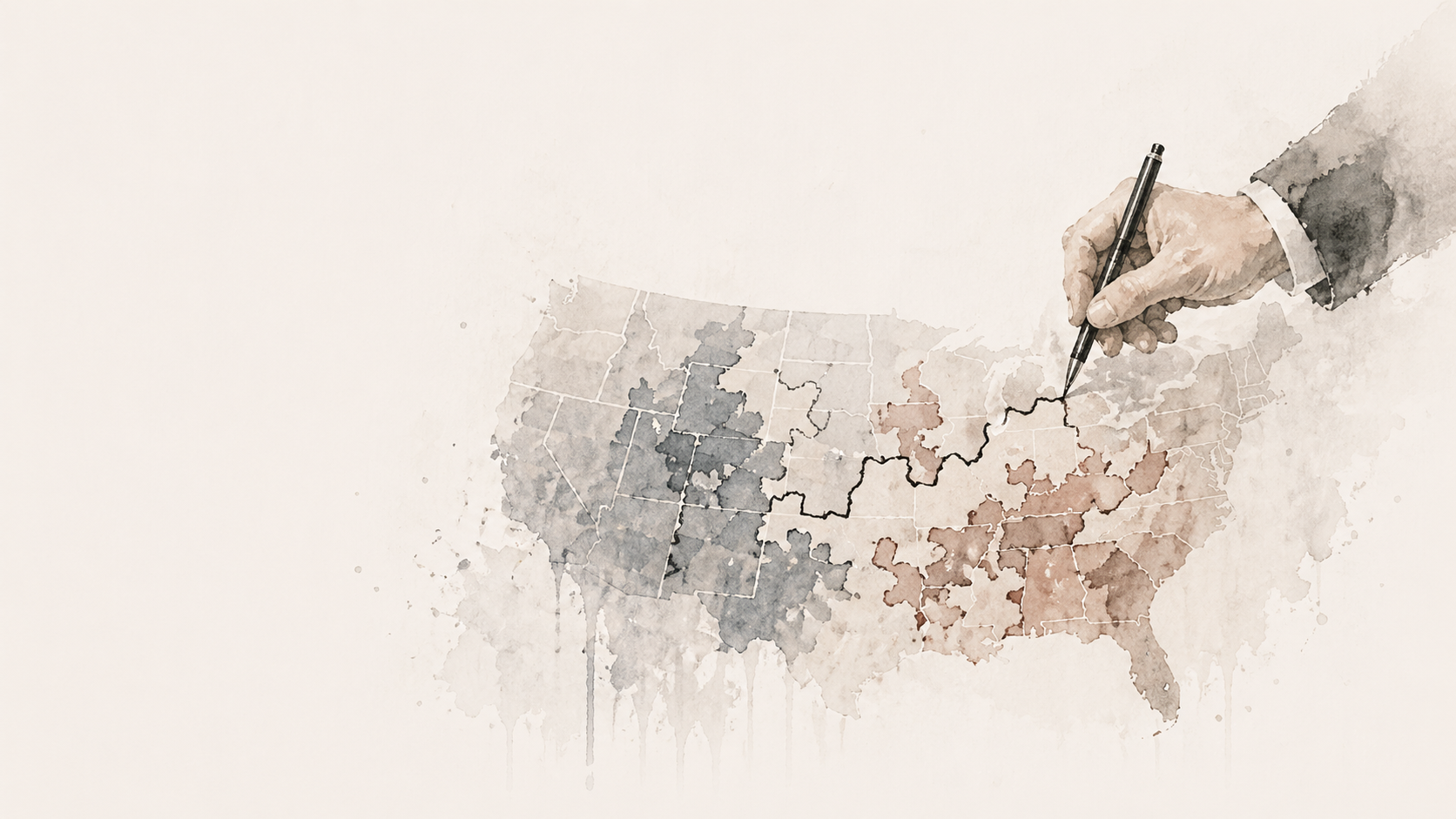
Majority Rule Isn’t Democracy
When gerrymandering becomes bipartisan betrayal
There is a dangerous illusion spreading through American politics—the belief that as long as our side wins, the process does not matter.
In Texas, Republicans redrew congressional maps to solidify power for another decade, splitting communities apart and precisely targeting opposition voters. In California, Proposition 50 proposes a “temporary fix” that would allow Democrats to do the same, this time claiming to promote balance and parity.
Different states. Different justifications. The same betrayal.
The Math of Manipulation
Gerrymandering is not proper governance. It is math masked as democracy, a way to replace genuine consent with calculation. Politicians choose which voters to listen to and which to ignore. The aim is not an accurate representation. It is protection from accountability.
When parties redraw maps to ensure their own victories, they are not building consensus; they are pre-selecting applause. It is a form of electoral stagecraft where the audience has already been selected and the outcome predetermined.
The tragedy is not partisan. It is structural.
A district engineered to guarantee one outcome denies every other voice its chance to matter. Whether those lines are drawn by a Republican legislature in Texas or a Democratic one in California, the effect is identical: half the population wakes up politically homeless.
That is not democracy. That is a monopoly with patriotic signage.
The Texas Blueprint
In 2025, Texas lawmakers undertook a mid-decade redistricting blitz that many analysts described as the most aggressive gerrymander in a generation. Five new congressional seats were effectively locked for the GOP. Civil rights groups immediately filed suit, arguing that the map diluted minority votes. State officials countered that it was “purely partisan,” and therefore legal.
That defense should trouble every citizen. A map that undermines representation is considered lawful so long as it is done for political, not racial, reasons. The moral absurdity of that distinction speaks for itself.
Enter California: The Mirror Image
Proposition 50 is being sold as a temporary countermeasure—a way to offset Republican redistricting elsewhere and “defend democracy” by recalibrating representation in Congress.
The problem lies in its premise. Proposition 50 dismantles California’s independent redistricting commission, the safeguard voters created to prevent partisan abuse in the first place.
It is poetic in a bleak way: the state once hailed as a model for fairness now proposes to suspend its own fairness to fight unfairness. Democrats claim they are protecting balance. Republicans call it a power grab. Both descriptions are accurate.
Majoritarianism in Disguise
Majority rule is not the same as democracy. True democracy requires tension—the friction of ideas, the discomfort of compromise. When those in power can redraw their borders at will, that friction disappears. The opposition is not defeated at the ballot box; it is erased from the map.
This is how self-governance erodes quietly: not through coups, but through the manipulation of cartography.
Every time a state manipulates district lines to lock in an advantage, it tells half its citizens that their voices are ornamental. It converts pluralism into choreography—the illusion of choice rehearsed by the majority.
It is not representation when politicians pick their voters.
It is a hostage negotiation with better branding.
What We Lose
When maps are drawn for power, the damage extends beyond fairness. What erodes is civic trust—the belief that participation matters. Once people stop believing the system can hear them, they stop speaking into it.
That silence is democracy’s real death knell.
Gerrymandering breeds cynicism. It teaches voters that elections are predetermined and that their voices are background noise in someone else’s performance. In that vacuum, extremism thrives because only the loudest remain.
A Call for Consistency
To restore credibility to democracy, our principles must be consistent and transparent. It cannot be wrong only when the other side does it.
The right thing must remain right even when it costs us power.
A fair system cannot depend on who holds the pen. The process must stand apart from the outcome; otherwise, the outcome is already compromised.
Closing Reflection
Every democracy eventually faces this question:
Will we defend fairness only when it favors us, or will we protect it when it does not?
The measure of a free society is not how it treats the majority; rather, it is how it treats the minority. It is how it honors the minority’s right to matter still.
When power redraws the map to silence half its people, it may win the election, yet it forfeits the republic.
A Civic Call to Action
The solution is not outrage; it is participation. Gerrymandering thrives when citizens disengage and cede control to professionals who treat democracy like a chessboard.
Ask your representatives—state, federal, or local—where they stand on independent redistricting. Support organizations that monitor election fairness and expose manipulation in both parties. Demand transparency when maps are drawn. Attend hearings, even when the outcome seems predetermined, because the presence of witnesses can influence the behavior of those involved.
Reform does not arrive by decree; it comes by attendance.
Each of us has a responsibility to preserve the principle that government should reflect the people, not manipulate them. Civic engagement is not charity. It is self-preservation.
The next time a state proposes a “temporary measure” to protect democracy by weakening it, we must respond with a unified demand: fair maps, or no maps at all.

Subscribe to Amid the Noise
Amid the Noise is an ongoing body of work on signal, systems, governance, AI, and the structures that shape human judgment under pressure.
Subscribe to receive new essays as they are published.