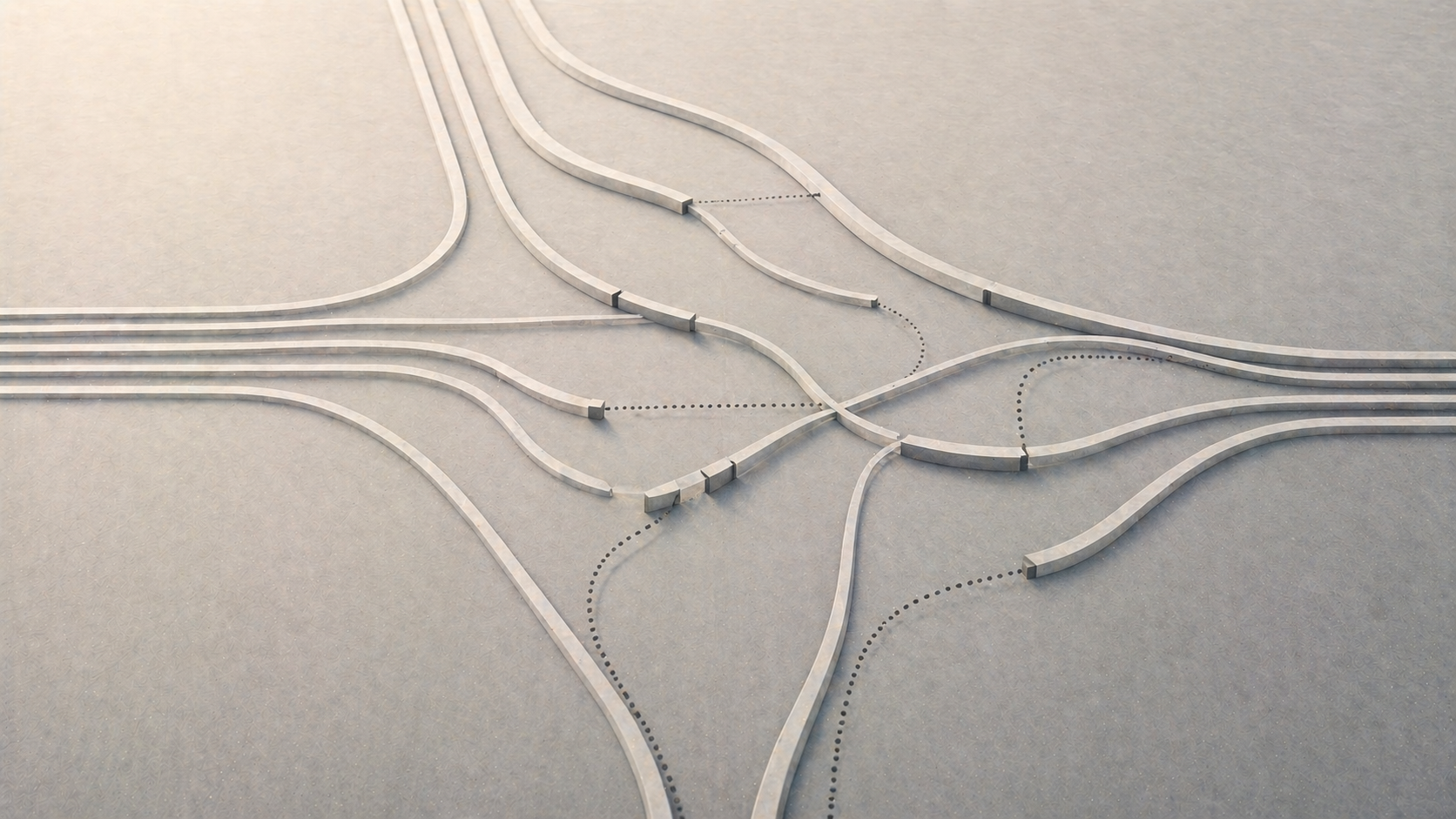
From Signal to Decision
Carrying uncertainty to the point of action
Most systems do not fail when they are wrong.
They fail when they are too certain.
Wrongness is visible. It creates friction, triggers escalation, and invites scrutiny. Certainty, especially when it feels earned, does the opposite. It smooths the path from input to action, removes hesitation, and closes off alternative interpretations before they are fully considered.
That is where risk enters.
By the time a decision is made, much of the decision has already been shaped.
Inputs have been filtered. Signals have been ranked. Context has been compressed into summaries that feel complete but are often only sufficient. What remains is presented as a coherent output, and coherence becomes a proxy for truth.
The system has done its work.
The user inherits the result.
If the goal is to design systems that support better decisions, the work cannot stop at producing accurate outputs.
It has to extend into how uncertainty is carried forward.
Where systems break
Most failures follow a similar pattern.
The system converges too early. It selects a dominant interpretation and suppresses competing ones, not because they are invalid, but because they introduce friction. Confidence is presented without provenance, leaving no clear path to understand how it was formed or where it might be weak.
Summaries overwrite underlying signal. Detail is removed in the name of usability, and with it, the context required to challenge the conclusion. By the time the user engages, the space for interpretation has already narrowed.
There is no clear escalation path. Ambiguity is resolved instead of surfaced, and the system moves forward as if clarity has been achieved.
From the outside, everything appears to be working.
From the inside, optionality has already been lost.
Designing for uncertainty
The alternative is not to remove structure. It is to design systems that know when not to finalize it.
That begins with separating confidence from completeness. A system should be able to express that it is highly confident within a limited frame, while still acknowledging that the frame itself may be incomplete.
Uncertainty should be visible. Not buried in logs or secondary views, but present at the point of decision, where it can influence how the output is interpreted and whether it should be acted on at all.
Alternative interpretations should remain accessible. Not as edge cases, but as parallel possibilities that can be explored when the stakes require it. The goal is not to overwhelm the user, but to preserve enough of the underlying structure that the decision remains open to challenge.
In some cases, the system should slow the user down. Not arbitrarily, but deliberately, when ambiguity crosses a threshold that makes immediate action risky. Friction, used correctly, becomes a form of protection.
What this looks like in practice
A model output is not a single answer. It is a structured response.
It presents a primary interpretation, but it also surfaces where that interpretation is most sensitive to missing or conflicting data. It shows how confidence was derived, not just the final score, and it makes clear what assumptions are carrying the most weight.
When ambiguity increases, the system does not collapse it. It expands the frame.
It offers adjacent interpretations, highlights where they diverge, and signals when human judgment is required to move forward responsibly. Escalation is not treated as failure. It is treated as a designed outcome.
Interfaces reflect this structure.
They do not present a single, polished result as the endpoint. They expose the shape of the decision itself, allowing the user to move through it rather than simply accept it.
The trade
Designing for uncertainty is not free.
Decisions take longer. Interfaces become more complex. Users must carry more cognitive load, and the sense of clarity that makes systems feel intuitive is reduced.
In low-stakes environments, that trade may not be worth it.
In high-stakes environments, it is essential.
The cost of premature certainty is not just error. It is misplaced confidence in decisions that should have been questioned.
The goal is not to eliminate uncertainty.
It is to design systems that know when not to hide it.
When that happens, decisions change.
They become slower, more deliberate, and more accountable to the conditions that produced them.
The system still shapes the path.
But it no longer decides it alone.

Subscribe to Amid the Noise
Amid the Noise is an ongoing body of work on signal, systems, governance, AI, and the structures that shape human judgment under pressure.
Subscribe to receive new essays as they are published.