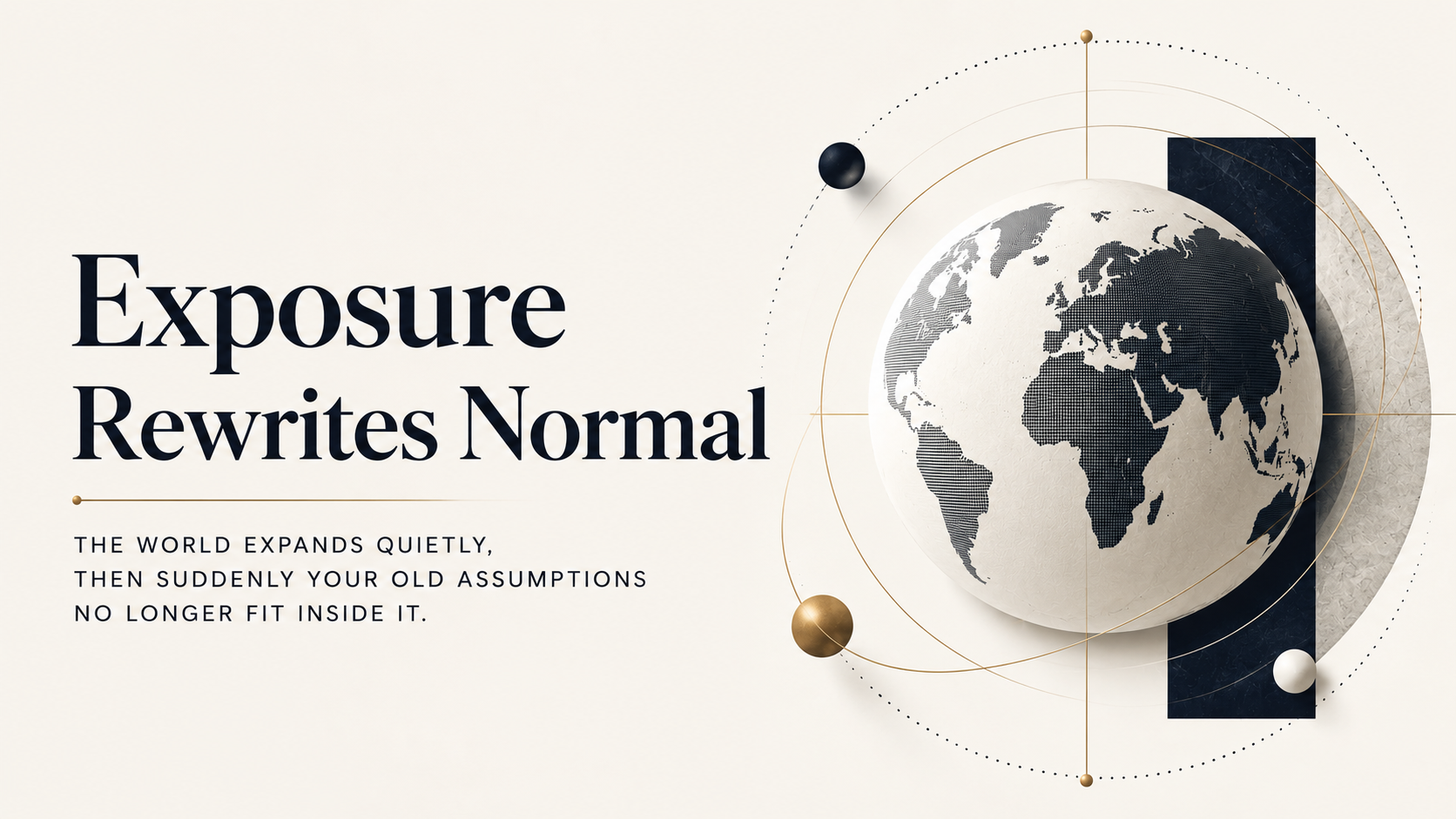
Exposure Rewrites Normal
The world expands quietly, then suddenly your old assumptions no longer fit inside it.
Someone online was mocking military time recently.
Not criticizing it operationally. Mocking it as unnecessary. Pretentious, even.
The joke itself was harmless. What caught my attention was the confidence behind it. The assumption that a format used by most of the world somehow existed outside “normal” life.
That kind of certainty fascinates me.
Not because the person was wrong, but because exposure changes what the brain stops noticing.
I grew up in rural Oklahoma. Certain things felt universal simply because they were everywhere around me. The pace of life. The cadence of speech. Friday night football. American flags on porches. Twelve-hour clocks. Entire assumptions about who sophisticated people were supposed to be.
Then life got bigger.
I started traveling for work. Airports. Tokyo train stations. International engineering teams. Meetings where five countries were represented at the same table. Hotel televisions carrying broadcasts in languages I could not understand. Schedules written in 24-hour time because most of the planet considers it ordinary.
At some point, military time stopped feeling like “military” time.
It just became time.
That shift matters more than it sounds.
Exposure does something subtle to a person. It separates familiarity from universality. You begin realizing many of the things you once treated as objective reality were simply local defaults repeated often enough to feel permanent.
The same thing happens with wealth.
People who perform wealth loudly are often performing an idea of wealth rather than proximity to it. Real exposure tends to have the opposite effect. Things become less exotic as they become more familiar. International travel stops feeling cinematic. Fine dining becomes dinner instead of theater. Luxury becomes quieter. Competence becomes quieter too.
The world expands, and performance starts looking exhausting.
I think that is one reason exposure matters so much.
Not because it makes people superior. Because it makes certainty harder to maintain.
You start encountering too many ways to live. Too many systems that function differently. Too many intelligent people whose defaults contradict your own without making them wrong.
That realization can either threaten a person or deepen them.
The healthiest version turns into curiosity.
You stop asking: “Why would anyone do it that way?”
You start asking: “What conditions made that way make sense?”
That question changes everything.
It changes design. It changes policy. It changes empathy. It changes relationships. It changes how you move through the world.
Most importantly, it changes how tightly you grip the idea that your experience represents the center of reality.
Exposure rewrites normal.
Quietly at first.
Then all at once.
Subscribe to Amid the Noise
Amid the Noise is an ongoing body of work on signal, systems, governance, AI, and the structures that shape human judgment under pressure.
Subscribe to receive new essays as they are published.