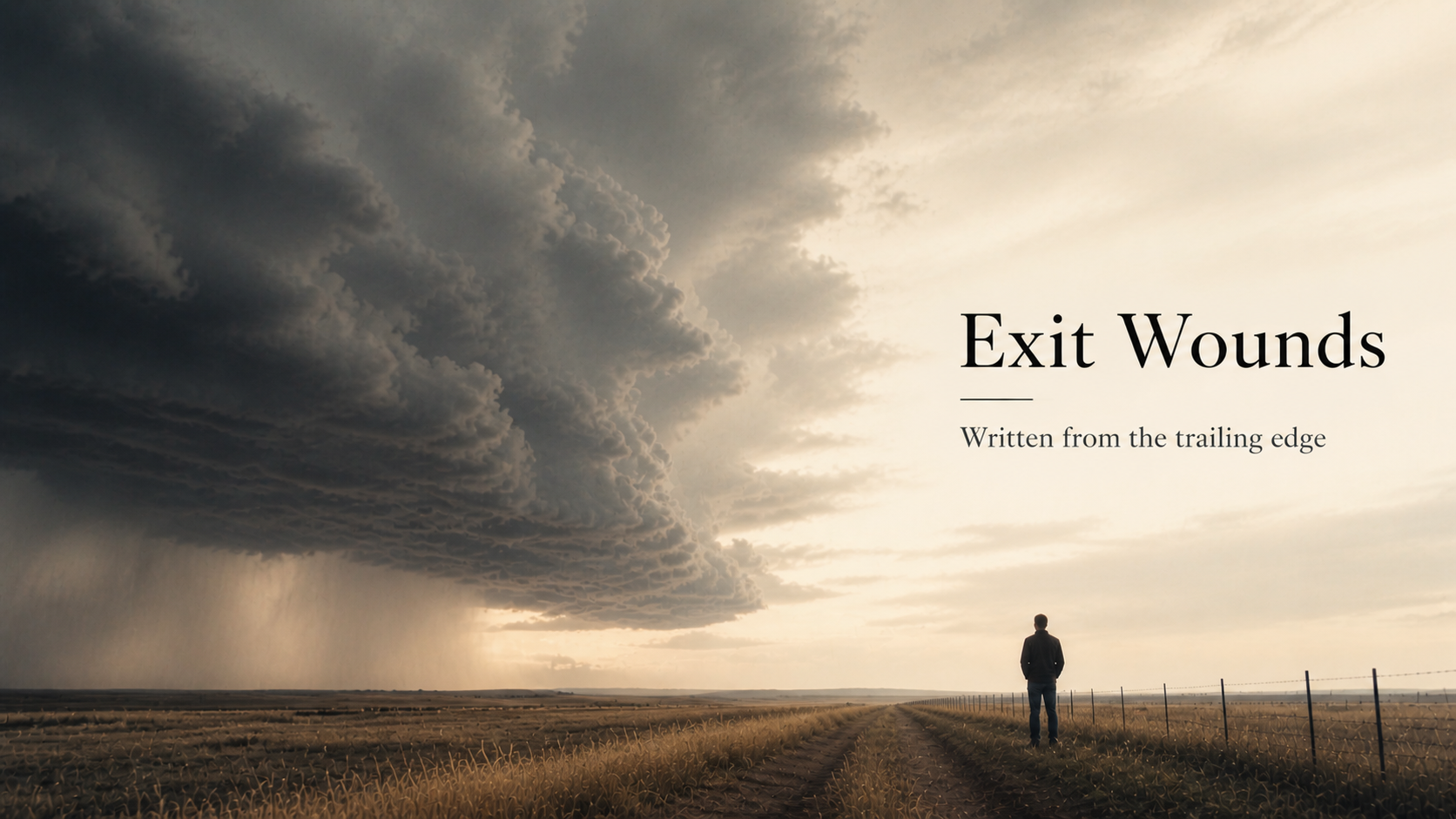
Exit Wounds
Written from the trailing edge
I did not write Exit Wounds after the storm.
I wrote it from the trailing edge of it.
That distinction matters. The noise had not fully cleared. The systems that broke me were still close enough to feel. Recovery had started, but it was new, structured, almost artificial in its stability. I was in rehab. I had a bed, a schedule, a place to sit long enough to think.
Outside of that, my life had not caught up yet.
Housing was still uncertain. The ground shifted under anything that tried to settle.
The pain had not resolved. It had just surfaced.
My roots are in Oklahoma, a state full of storm chasers in the traditional sense.
At some point, I realized I had been doing the same thing.
Not with weather, but with chaos. Moving toward it. Staying too long. Convincing myself I could read it, handle it, maybe even outlast it.
I grew weary of chasing my own storm.
Not all at once. Just a quiet recognition that whatever I was doing, it was not going to end on its own.
Exit Wounds began somewhere inside that recognition.
There were two things I was trying to leave at the same time.
A person, and a drug.
At first they felt separate. They weren’t.
Both gave me something I thought I needed. Both asked for more than they gave back. Both reshaped what “normal” felt like until I could not tell the difference between intensity and connection, between relief and damage.
You do not see that clearly when you are inside it.
You start to see it when you step just far enough away to notice the pattern repeating.
The book did not start as a book.
It started as somewhere to put what I could not carry anymore.
Early recovery brings feeling back before it brings language. You know something is wrong long before you can explain it, even to yourself.
Writing gave it shape.
And then something shifted.
In rehab, I was able to clear my mind in a way I had not in years. For the first time in a long time, I was disconnected from every problem waiting for me outside. It was a vacuum, but not an empty one.
That’s where the words showed up.
They didn’t come carefully. They came fast. One poem after another, sometimes before I fully understood what I had just written. I would print each one out and tape it to the wall beside my bed.
At first it was a few pages.
Then it was a section of the wall.
Then it was the entire wall.
People would open the door and stop for a moment, trying to take it in. It didn’t look like decoration. It looked like evidence.
That was the moment the book surfaced. Not as a plan, but as something already in motion.
Rehab gave me a boundary, but not distance.
I was not past it. I was contained just enough to look at it without being pulled all the way back in. The conditions that allowed everything to happen were still nearby, still familiar.
You can feel that in the book.
Some passages are clear. Others are still reaching. I left that intact because it was honest to where I was.
Something else happened during that time that I did not expect.
I started reading differently.
Or maybe I started noticing what I had never given any attention to before. Mark Twain showed up in a way that surprised me. Not as a figure I was supposed to admire, but as a voice that cut straight through things. Direct. Unimpressed. Honest without being heavy.
It felt like permission.
Like you could tell the truth without dressing it up. Like you could hold something serious and still leave room for air.
I did not set out to write that way, but I could feel it starting to influence how I put words together.
Exit Wounds is not a clean narrative of that period.
It is a record from inside it.
It holds the overlap. The part where you know something has to end but you are still learning how to end it. The part where clarity shows up in flashes and then disappears again. The part where you start to recognize yourself, lose that thread, and then find it again.
It is not polished because that moment was not polished.
It is not resolved because I was not resolved.
Looking back, the book matters for a different reason than I expected.
It was not proof that I could write.
It was proof that I could take something that was actively destabilizing my life and give it form before it took everything else with it.
Not control. Not closure.
Form.
That was enough to start.
Available in print and digital editions: See books

Subscribe to Amid the Noise
Amid the Noise is an ongoing body of work on signal, systems, governance, AI, and the structures that shape human judgment under pressure.
Subscribe to receive new essays as they are published.