Ellipses and Proof: A Family Method
Truth carried across generations
This is not only the story of my ancestors—Kepler, Carper, McClendon—but also of how exile and patriotism, astronomy and medicine, heresy and survival converged in me. It’s a meditation on what families carry across continents, wars, jealousies, and work, and what remains when everything else drifts: truth and courage.
Family stories rarely follow a straight line. They loop like comets, brightening the night, then slipping into quiet orbits between generations. This one begins with a man who taught the heavens to curve.
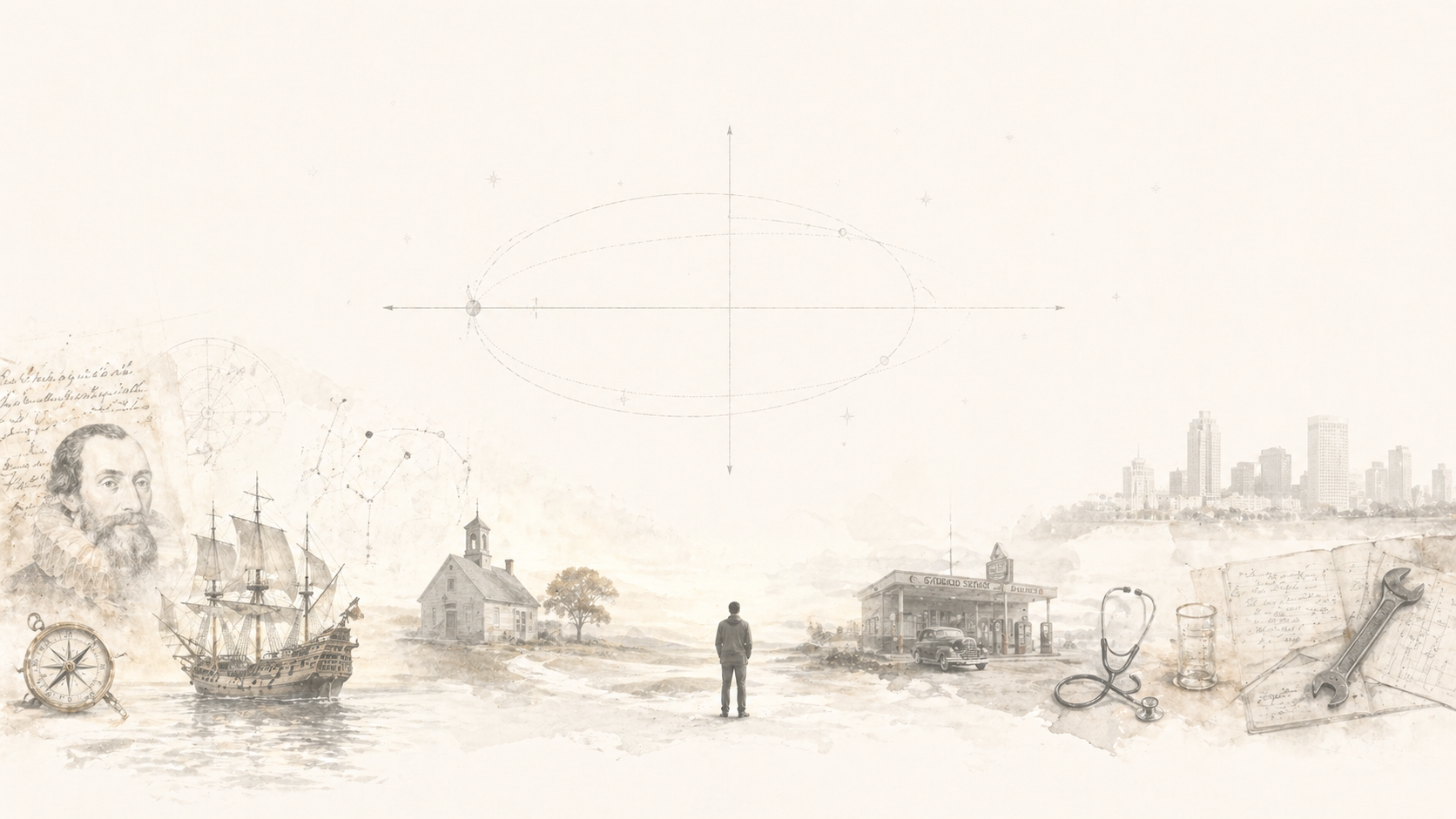
Johannes Kepler measured the sky with stubborn devotion. He drew truth out of error the way a smith draws a blade from raw iron. His ellipses challenged the church’s preferred circles and unsettled courtiers who preferred miracle to mathematics. Whispers followed him through Württemberg: visionary, troublemaker, son of a sorcerer. The gravity of his ideas bent not only the planets but the fates of those who carried his name.
A grandson learned that brilliance can be a kind of exile. Elders lowered their voices when scripture met science at the table. They repeated the story of Kepler’s mother and her trial for witchcraft. Knowledge, in the wrong season, becomes dangerous weather. Villages survive on consensus. Families survive on discretion. A choice emerged: argue with the wind or hoist a different sail.
The family moved through the aftershocks of war and plague, carrying letters that announced distinction while hinting at liability. The surname shifted in registers to ease passage: Kepler, Keppler, Kepper. Names do this when they need to move unseen. Sermons out of England spoke of a colder, cleaner world where a soul could argue directly with God. Puritans sounded less like doctrine and more like a forecast from another coast.
A ship groaned west across the Atlantic. Psalms rose from the hold, roughened by seasickness and conviction. The name changed again at Boston through a clerk’s quill, then again where memory strained across accents. Purity of faith proved easier than purity of spelling. Night skies over New England carried the same lawful order as the skies over Germany, and the old astronomy survived in private. The family built plain meetinghouses, endured brutal winters, and measured life not by rhetoric but by covenant.
Generations dissolved into one another like ink in water. A Josiah Kepper stepped off a cart in the Carolinas with a plank for a sign and a hunger for acreage. A Joseph Carper signed a deed in Virginia where the consonants traded places with a shrug. The sky did not object. The ellipse tolerated the drift so long as gravity remained. The line pushed south and west through Tennessee clay and prairie light, swapping parishes and counties as easily as a telescope can swap eyepieces. Their resilience was a testament to the human spirit’s ability to adapt and thrive in the face of change.
Oklahoma entered the family story as a promise and a dare. Wind taught them to listen with their whole bodies. Dust taught their lungs the vocabulary of scarcity.
The men kept motors alive. Trueman ran gas stations and, later, owned a service station; petroleum replaced plows. Work smelled of fuel, vulcanized rubber, and ink from account books. Astronomy became torque specs and pressure gauges; precision migrated from star tables to timing lights and tire irons. The family’s central intuition survived every retooling: the world reveals itself to those who measure carefully and refuse to flatter error.
Donna Marcia, Trueman’s daughter, carried a quiet vocation toward nursing. Her mother’s jealousy barred the door, yet that curiosity kept circulating in the house like air. She had already chosen William Lee before the draft carried him to Vietnam. The war left its quiet imprint, visible less in medals than in the weight he brought home. When he returned, their bond did not need renewal—it had only been waiting. They married in 1971, joining the two branches of the family in both name and vocation.
A few years later, in late 1973, their son was born. He learned to read by tracing patterns on the ceiling at night. Tiny glow-in-the-dark stars formed their own republic above the bed, and his finger became a sextant. He learned that love is a kind of navigation, that trust is a shoreline, that grief is fog. He carried the family weather into classrooms, boardrooms, and quiet rooms where addiction and healing argue like cousins at a wake. The old ellipse lived in his work long before it lived in his signature.
The McClendons, meanwhile, had their own arc. They came of age under a flag that was still becoming itself. Patriotism showed up in rolls and rosters rather than speeches. A physician’s kit rode in a saddlebag beside a small copper coil wrapped in cloth. Frontier medicine and frontier distilling were not contradictions. One steadied the body, the other steadied a winter.
As the family moved west, those early professions yielded to necessity. Doctors’ tools gave way to migrant hands in fields, distillers’ craft to modest trades, and itinerant work. The name shifted across records, sometimes McLendon, sometimes McClendon, but the ethic held: attention mattered, labor mattered, and moderation was a form of loyalty. Modernization refined the grandeur of ideals while preserving their core. Patriotism became less about declarations and more about showing up, season after season, for both land and neighbor.
The twin inheritances began to rhyme. Ellipses and proof formed one method. Precision at the stars echoed in the pulse at the wrist. A designer’s interview carried the patience of a physician. A hydrometer’s humility spoke again in a product dashboard. A few sentences endured as household law: test before you trust; taste before you boast; record what is there, not what you wish it to be.
Spelling drifted, and jurisdictions argued. Genealogies often do. Kepler became Kepper and then Carper. McClendon kept its shape while its bearers crossed counties and trades. The ellipse forgave the drift; the oath to measured truth did not. Legacy became method, and the method preferred attention over noise, service over swagger, clarity over flattery.
Evening returns the story to its origin. A man stands outdoors and watches the sky settle into a deep cobalt blue. A plane carves a temporary line through the fading light. The Big Dipper performs its ancient duty. A memory arrives of a mathematician defending ellipses before a council that loved circles. Gratitude moves through the body for every ancestor who chose clarity over comfort. The night answers with a silence that feels like a nod of consent.
Morning follows with plain light. Coffee warms the hand that signs another record—sometimes Carper, sometimes McClendon, always committed. A child somewhere asks why the moon follows the car. A designer somewhere else asks why a form field makes people feel small. A policymaker asks how to measure dignity. Each question receives the same reply: measure carefully, state plainly, serve the community, honor the shape truth actually takes.
Kepler is not only an ancestor. Kepler is the practice of looking up and then looking closer. McClendon is not only a surname. McClendon is synonymous with treating attention as a civic duty. Carper is not only a spelling. Carper is the proof that truth keeps its shape across accents, counties, and clerks whose ink runs low. The family story travels its ellipse with two steady foci: truth and courage. Everything else is the path traced between them.

Subscribe to Amid the Noise
Amid the Noise is an ongoing body of work on signal, systems, governance, AI, and the structures that shape human judgment under pressure.
Subscribe to receive new essays as they are published.