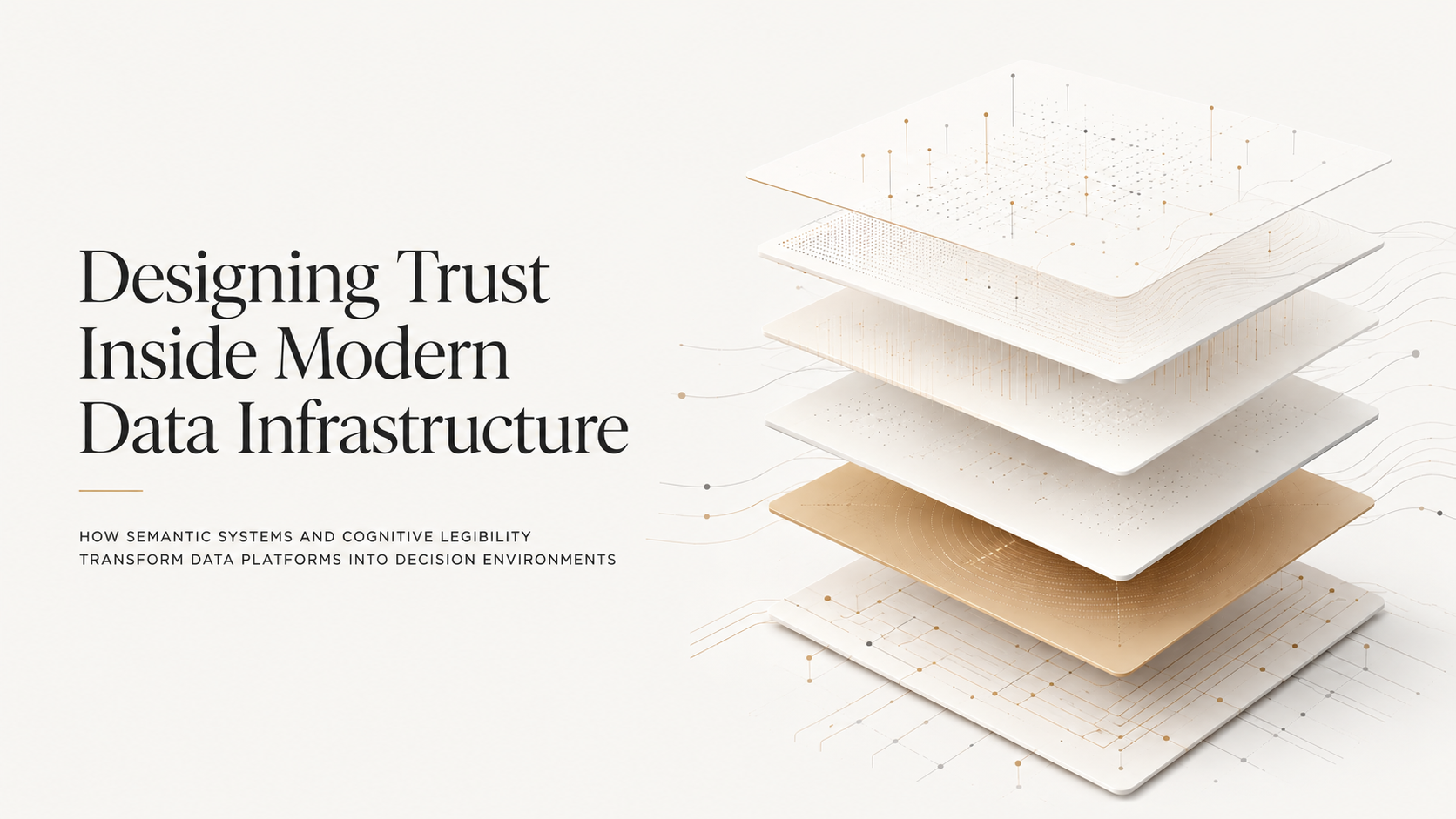
Designing Trust Inside Modern Data Infrastructure
How semantic systems and cognitive legibility transform data platforms into decision environments
Field Study
Designing Trust Inside Modern Data Infrastructure
Modern data infrastructure rarely fails because organizations lack data.
It fails because people cannot confidently interpret what they are seeing.
Across healthcare, financial services, and enterprise infrastructure, I kept encountering the same pattern: technically sophisticated systems paired with cognitively exhausting user experiences. The architecture worked. The storage scaled. Query performance improved.
Yet adoption stalled.
Analysts reverted to spreadsheets. Business users waited on engineering teams. Data scientists built shadow workflows outside official systems because the path to understanding remained too brittle, too opaque, or too difficult to trust under pressure.
The issue was not storage.
The issue was legibility.
Over several engagements spanning enterprise analytics, healthcare informatics, and financial systems, the same insight surfaced repeatedly:
Users do not navigate raw data. They navigate meaning.
That distinction changed everything.
The Problem Beneath the Problem
Modern data environments often assume that accessibility and usability are interchangeable.
They are not.
A dataset can technically be available while remaining psychologically inaccessible.
In practice, many large-scale systems produced the same operational symptoms:
- overwhelming dataset sprawl,
- inconsistent naming conventions,
- unclear lineage,
- fragmented permissions,
- hidden transformations,
- poor discoverability,
- low confidence in outputs,
- excessive dependence on engineering mediation.
Over time, these environments degrade into what teams quietly call “data swamps”: repositories rich in information but poor in navigability.
The systems were optimized for ingestion and computation.
The humans inside them still needed orientation.
FactSet: Speed Without Friction
At FactSet, the challenge centered around high-volume financial datasets distributed across multiple systems. Data scientists needed to move rapidly between exploration, modeling, and validation without sacrificing auditability or trust.
The technical problem was substantial.
The experiential problem mattered just as much.
Several interface decisions proved disproportionately important:
- visible lineage tracing,
- in-line SQL validation,
- semantic organization of datasets,
- workspace flexibility,
- low-friction transitions into Jupyter and BI tooling.
These were not cosmetic improvements.
They reduced the cognitive distance between:
- raw data,
- transformation,
- interpretation,
- and operational confidence.
Performance mattered too. Query times dropped below ten seconds across extremely large datasets. Data preparation overhead decreased significantly.
But the larger outcome was psychological:
Users began trusting the system enough to think inside it.
NetApp: Self-Service Requires Orientation
Petabytes of telemetry data already existed. The infrastructure itself was not the bottleneck. The issue was discoverability and usability across non-expert users.
The organization did not merely need faster queries.
It needed:
- understandable systems,
- reusable abstractions,
- safe exploration,
- and reduced dependency on engineering intervention.
The most effective improvements were surprisingly human:
- semantic tagging,
- virtual data marts,
- SQL previews,
- interactive guidance,
- transparent feedback loops.
Self-service analytics succeeds only when users feel confident enough to explore without fear of destabilizing the environment.
That confidence is designed.
TransUnion: Trust at Scale
At TransUnion, the challenge shifted toward governance, compliance, and organizational trust.
Highly regulated environments create a unique design tension:
Systems must simultaneously:
- restrict access,
- preserve auditability,
- accelerate discovery,
- and remain cognitively manageable.
The solution was not simplification through removal.
It was contextual clarity.
Role-aware interfaces, trust indicators, insight previews, and contextual onboarding reduced ambiguity while preserving institutional safeguards.
One detail proved especially important:
Users needed to understand not only what they were seeing, but whether they should trust it.
That subtle distinction appears repeatedly in modern AI and analytics systems.
Trust is rarely inferred from output alone.
It emerges from:
- visibility,
- provenance,
- continuity,
- and explainability.
Designing for Depth
The pattern became clearest during work involving large-scale healthcare data systems.
The architecture itself was technically sound:
- distributed storage,
- scalable compute,
- unified ingestion,
- schema-on-read flexibility.
Still, adoption remained weak outside engineering teams.
The system was functionally rich but experientially impoverished.
The intervention shifted from infrastructure-first thinking toward cognitive design:
- semantic overlays,
- trust scoring,
- lineage visualization,
- task-oriented metadata,
- role-aware abstraction layers,
- faceted exploration,
- contextual storytelling.
The result was not merely higher usability metrics.
The system became interpretable.
That distinction matters.
Interpretability is not a visualization layer added after architecture. It is part of the architecture itself.
The Larger Pattern
Across all four environments, the same principle continued to hold:
Modern data systems succeed or fail based on the quality of human interpretation they enable.
Not storage.
Not ingestion.
Not even raw performance.
Interpretation.
As organizations move deeper into AI-mediated decision systems, this becomes even more consequential. Models increasingly shape:
- ranking,
- visibility,
- recommendation,
- prioritization,
- escalation,
- and operational action.
When people cannot confidently interpret the systems around them, trust collapses.
Then behavior fragments:
- shadow workflows emerge,
- manual workarounds proliferate,
- governance weakens,
- and institutional confidence erodes.
The future of enterprise infrastructure will not belong solely to organizations with the largest datasets or fastest compute layers.
It will belong to organizations capable of making complexity cognitively legible without destroying nuance.
That is a design problem.
Not an engineering afterthought.

Subscribe to Amid the Noise
Amid the Noise is an ongoing body of work on signal, systems, governance, AI, and the structures that shape human judgment under pressure.
Subscribe to receive new essays as they are published.