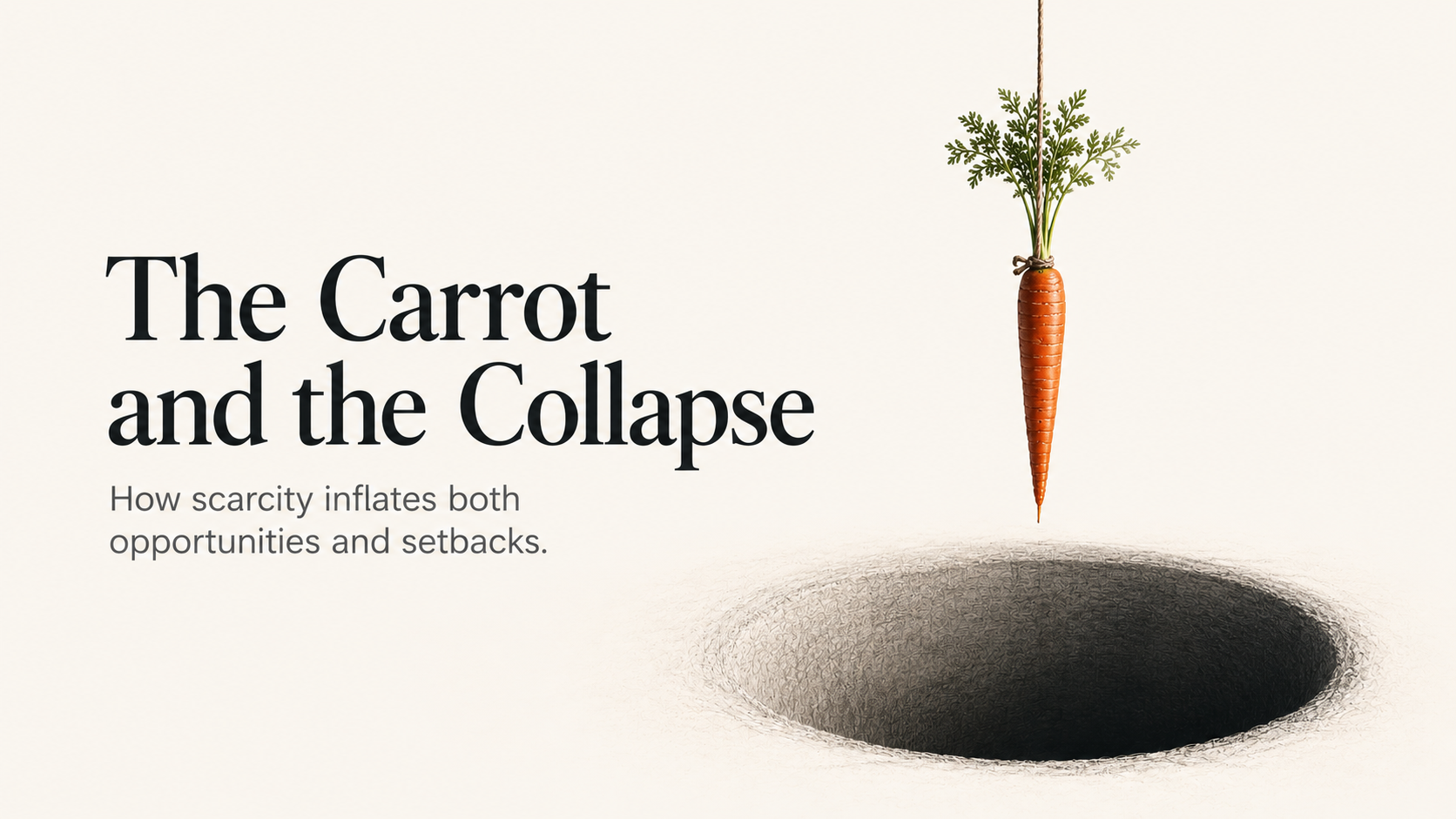
The Carrot and the Collapse
How scarcity inflates both opportunities and setbacks.
Imagine standing in a grocery store and learning that an additional two hundred dollars in food assistance has been approved.
Nothing about the shelves changes.
Milk costs what it cost ten minutes ago.
Bread costs what it cost ten minutes ago.
The cart contains the same items.
Yet the world suddenly feels larger.
There is room to breathe.
A little less arithmetic.
A little less compromise.
A little more certainty that the month can be navigated without running out of runway.
A few days later, imagine learning the increase will not happen after all.
The shelves remain unchanged.
The prices remain unchanged.
The cart remains unchanged.
Yet the world feels smaller.
The difference is only two hundred dollars.
The emotional impact is much larger.
Why?
Most discussions about scarcity focus on resources.
Scarcity certainly affects resources.
It determines what we can buy, where we can live, how quickly we can recover from setbacks, and how many options remain available when something goes wrong.
What receives less attention is the way scarcity changes perception.
Under abundance, opportunities are evaluated on their merits.
Under scarcity, they are amplified.
They begin carrying responsibility for problems they were never designed to solve.
A contract job is no longer simply a contract job.
It becomes transportation.
Savings.
Security.
Relief.
A prescription is no longer a prescription.
It becomes progress.
A benefit increase is no longer a benefit increase.
It becomes breathing room.
Each opportunity begins carrying far more weight than the opportunity itself.
I have started thinking of this dynamic as the carrot and the collapse.
The carrot is the opportunity that promises to solve everything.
The collapse is the setback that appears capable of destroying everything.
Neither is usually true.
Scarcity simply makes both feel true.
The carrot gleams brighter than reality.
The collapse appears larger than reality.
Both are distortions created by pressure.
Consider a job interview.
Under ordinary circumstances, an interview is a conversation.
One opportunity among many.
One possible path forward.
Under scarcity, the same interview can quietly accumulate responsibility for a dozen unrelated problems.
It becomes the car.
The savings account.
The overdue purchase.
The emergency fund.
The medical bill.
The future itself.
The opportunity has not changed.
Its symbolic weight has.
The same process occurs in reverse.
A rejection is no longer a rejection.
It becomes evidence.
Evidence that progress has stalled.
Evidence that nothing is changing.
Evidence that the future is narrowing.
Again, the event has not changed.
Only its meaning has.
This distortion is not irrational.
It is structural.
Scarcity removes more than resources.
It removes buffers.
Savings, available credit, insurance, transportation, social support, and time all act as forms of redundancy.
They absorb shocks before those shocks reach the center of a life.
When those buffers disappear, ordinary setbacks travel further than they otherwise would.
A delayed paycheck becomes a crisis.
A flat tire becomes a transportation problem.
A denied prescription becomes a financial decision.
The event may be the same.
Its consequences are not.
When resources are plentiful, setbacks are absorbed by reserves.
An unexpected expense is frustrating.
A denied opportunity is disappointing.
A temporary problem remains temporary.
When resources are scarce, the same events strike closer to the bone.
A flat tire is no longer a flat tire.
A prescription is no longer a prescription.
A job interview is no longer a job interview.
Every event begins carrying consequences far beyond its actual size.
This is why scarcity is so exhausting.
It is not merely the absence of resources.
It is the constant inflation of significance.
Recognizing the distortion does not diminish the need.
The need is real.
An additional two hundred dollars helps.
A good job can change the trajectory of a year.
Access to medication matters.
The point is not that scarcity is imaginary.
The point is that scarcity alters scale.
It turns ordinary developments into symbols.
Opportunities become lifelines.
Setbacks become verdicts.
Neither description is entirely accurate.
Yet both can feel completely true in the moment.
The job is not salvation.
The denial is not destiny.
Both deserve to be seen clearly.
Scarcity makes that difficult.
It paints halos around opportunities and shadows around setbacks.
The work is learning to recognize the paint.
Because reality usually lives somewhere between the carrot and the collapse.

Subscribe to Amid the Noise
Amid the Noise is an ongoing body of work on signal, systems, governance, AI, and the structures that shape human judgment under pressure.
Subscribe to receive new essays as they are published.