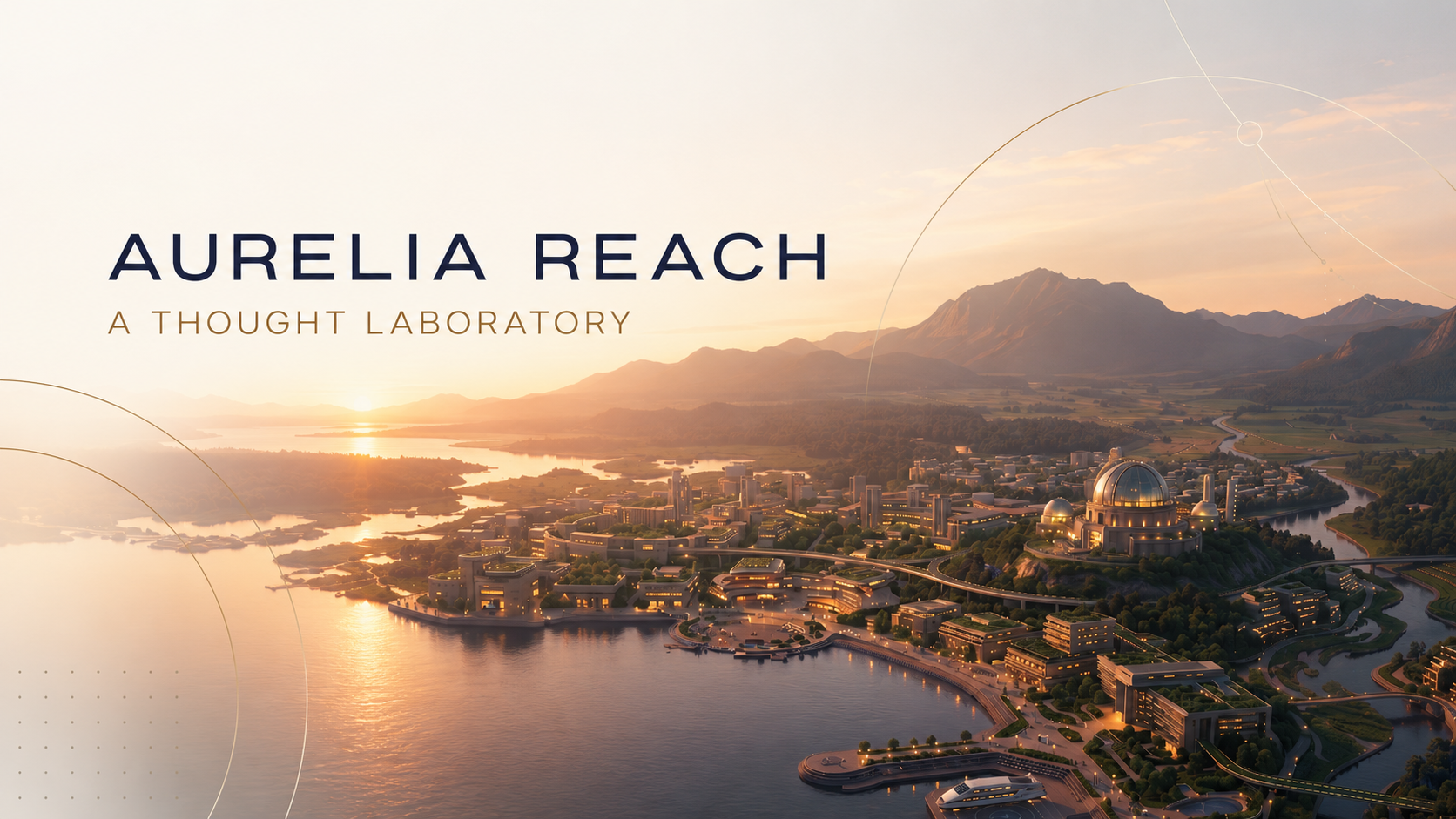
Building a Thought Laboratory
Why Aurelia Reach exists.
Aurelia Reach was never supposed to become a city.
It began as a collection of questions about infrastructure, belonging, significance, trust, and what remains when scarcity is no longer the primary organizing force of society.
The city came later.
So did the stories, maps, transit systems, institutions, neighborhoods, and histories.
Those are artifacts.
The questions came first.
Aurelia Reach is often described as a Federation member world in the Aurelia System. Meridian, its capital city, serves as a center of government, education, commerce, and interstellar affairs. While that description is accurate, it has always felt incomplete to me. The city, the infrastructure, and the stories are products of the project rather than the project itself.
Aurelia Reach began as a collection of questions.
Over time those questions started interacting with one another.
The result was not a world so much as a thought laboratory, a place where assumptions could be subjected to pressure and their consequences observed.
The city emerged because the questions needed somewhere to live.
The setting serves another purpose as well. Difficult conversations often arrive carrying political, cultural, and historical baggage. Aurelia Reach provides enough distance to examine the underlying questions without immediately becoming trapped in contemporary arguments. By moving the discussion into a fictional setting, the goal is not to escape reality. The goal is to see it more clearly.
What happens when energy becomes abundant?
What happens when transportation becomes nearly frictionless?
What happens when survival is no longer the primary organizing force of daily life?
What remains scarce when material scarcity recedes?
How do people find significance?
How do institutions earn trust?
How does a society communicate belonging?
The interesting part is not the individual questions.
The interesting part is what happens when they collide.
Abundant energy changes transportation.
Transportation changes urban form.
Urban form changes community.
Community changes belonging.
Belonging changes governance.
Governance changes trust.
Pull one thread and the others move.
One of the more surprising aspects of the project has been discovering which ideas fail.
What surprised me was how quickly the world began resisting easy answers. Every change created second- and third-order consequences. Solving transportation altered settlement patterns. Altering settlement patterns changed community. Changing community changed governance. The world became less an act of creation than an act of discovery.
Early versions of Aurelia Reach included large floating cargo vessels moving between coastal settlements. The imagery was compelling, but the idea became increasingly difficult to justify. If energy is abundant, logistics are heavily automated, and transporter technology has fundamentally altered freight movement, what role are these ships serving?
The ships were eventually removed, not because they were unrealistic, but because they no longer made sense within the assumptions of the world.
Transporters created a similar challenge.
The easiest answer was that everyone transports everywhere.
The more interesting answer was that not everyone can.
Biological incompatibilities present one example. Trill physiology presents another. Medical limitations, cultural objections, and personal preferences create others. Suddenly regional rail matters again. Walkability matters again. Local transportation matters again.
The technology changes.
Human requirements remain.
That pattern appears repeatedly.
The more assumptions are removed, the more certain questions survive.
Not because the future is simple, but because some concerns appear remarkably durable.
People still seek belonging.
People still seek significance.
People still seek identity.
People still seek community.
People still need institutions they can trust.
Over time, the thought laboratory burns away many things.
These remain.
That realization is why Aurelia Reach is not an attempt to imagine a perfect future.
Perfect futures are boring.
Every problem has been solved.
Every answer has already been found.
There is nothing left to explore.
Aurelia Reach exists because the most interesting questions survive technological progress.
In many cases, they become more visible.
A society may eliminate scarcity.
It may not eliminate loneliness.
A society may solve transportation.
It may not solve purpose.
A society may provide abundance.
It may not provide meaning.
Those are human questions.
They are the same questions that exist today.
The setting simply allows them to be examined from a different angle.
Recently I added a small feature to the Aurelia Reach homepage.
The skyline changes depending on the time of day.
Morning visitors see dawn.
Afternoon visitors see daylight.
Evening visitors see sunset.
Night visitors see a city illuminated against the dark.
Most visitors will never consciously notice.
The site functions perfectly without it.
Yet I like knowing it is there.
Not because it is clever.
Because it reflects the larger purpose of the project.
Good systems anticipate human needs.
Great systems invite participation.
Aurelia Reach is not the destination.
It is the laboratory.
The city, the stories, and the institutions are simply the artifacts left behind after a collection of questions has been subjected to pressure.
I am less interested in the future itself than in discovering what survives when the assumptions of the present are removed. Aurelia Reach simply provides a clean room in which those questions can be explored.
Continue exploring at aureliareach.org.

Subscribe to Amid the Noise
Amid the Noise is an ongoing body of work on signal, systems, governance, AI, and the structures that shape human judgment under pressure.
Subscribe to receive new essays as they are published.