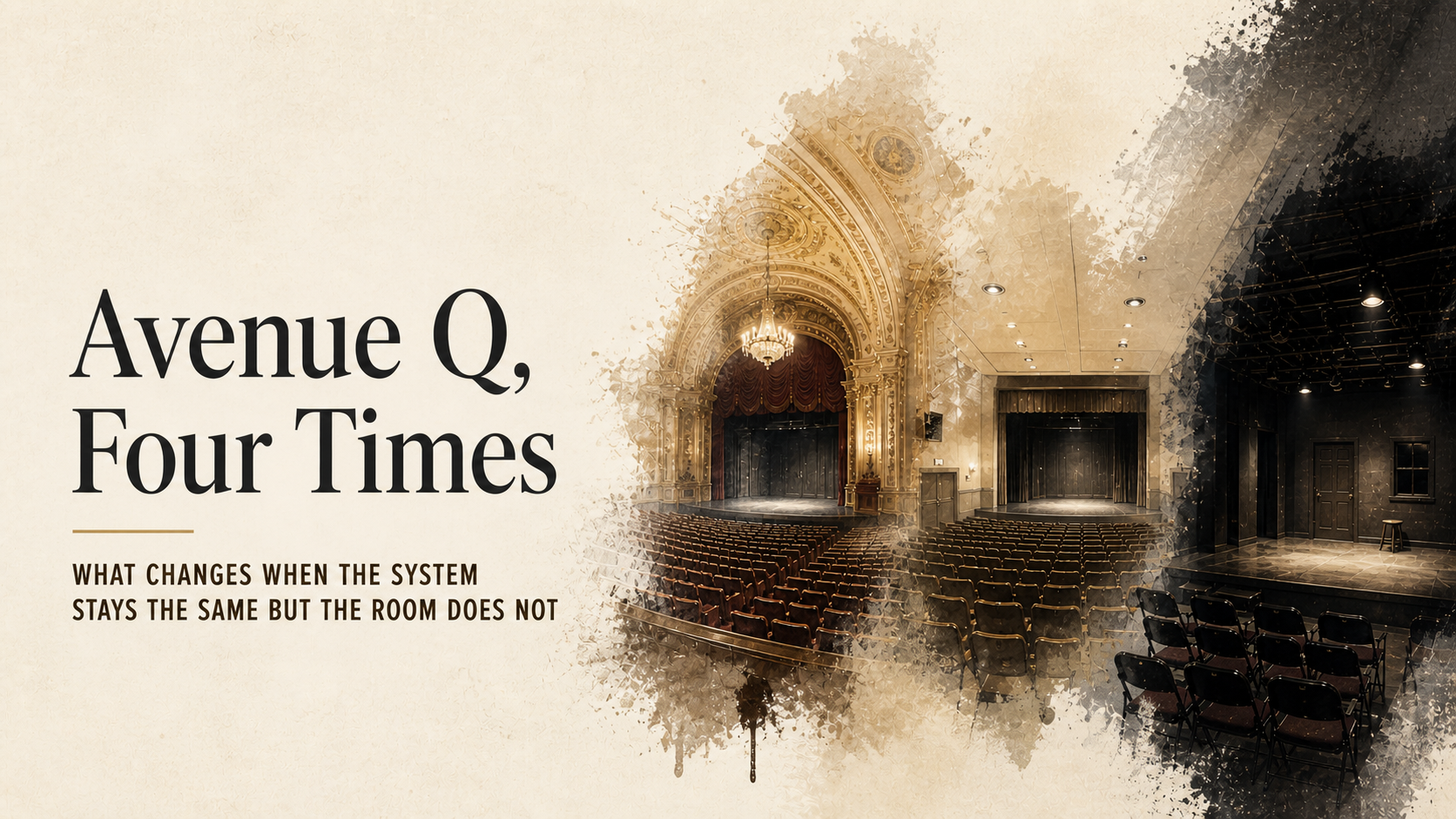
Avenue Q, Four Times
What changes when the system stays the same but the room does not
I saw Avenue Q four times.
Las Vegas.
San Francisco.
San Jose.
New York.
Same script. Same songs. Same structure.
Different outcomes.
The first time, it was spectacle.
The second, distance.
The third, functional.
The fourth, precise.
Nothing about the show changed. The system was stable.
The room was not.
The Traveling Variable
At the Wynn in Las Vegas, everything felt polished. Controlled. The show sat inside a larger machine built for entertainment at scale. It worked. It always works. That is the point.
At the Orpheum in San Francisco, the space introduced distance. The architecture carried weight. You could feel history in the walls. You could also feel the gap between performer and audience widen just enough to matter.
At the San Jose Civic, the experience held together. It did what it needed to do. The room was neutral, almost indifferent. The show survived it.
At New World Stages in New York, something clicked.
The room disappeared.
Not literally. It just stopped interfering.
Every line landed. Every beat resolved. The audience responded in rhythm with the performers. The show did not feel bigger.
It felt clearer.
What Actually Changed
The script did not improve.
The cast did not suddenly become better.
The difference was transmission.
- Acoustic precision
- Sightline intimacy
- Audience density
- Feedback loop between stage and room
Small shifts, compounding.
The closer the environment moved toward human scale, the less distortion entered the system.
The Pattern
We tend to think experience improves with scale.
More seats.
More demand.
Higher price.
That logic works for distribution.
It fails for clarity.
Large systems introduce drag. Sound travels further. Attention fragments. Timing stretches. Signal competes with environment.
Smaller systems collapse that distance. The signal has fewer places to go before it lands.
Nothing gets lost.
The Mismatch
Around the same time, I saw Hamilton in New York.
I had a balcony seat. Perfect view. Eight hundred dollars.
I left at intermission.
It was too loud. The words blurred. The signal never resolved.
That show is optimized for scale. Speed, density, momentum. It assumes clarity will survive amplification.
From where I sat, it didn’t.
The market priced scarcity.
I needed legibility.
What This Reveals
A system can succeed publicly and fail privately.
The show can be flawless.
The demand can be real.
The ticket can be expensive.
None of that guarantees the experience works for the person inside it.
We confuse access with outcome.
We assume proximity equals understanding.
It doesn’t.
The Quiet Conclusion
I kept returning to Avenue Q until the environment matched the intent.
Not consciously. Just instinct.
Most people chase novelty.
I was chasing fidelity.
The version that worked was not the biggest one.
It was the one that let the signal through.
That is the only version that matters.

Subscribe to Amid the Noise
Amid the Noise is an ongoing body of work on signal, systems, governance, AI, and the structures that shape human judgment under pressure.
Subscribe to receive new essays as they are published.