AI Is a Stack
Most conversations start at the surface
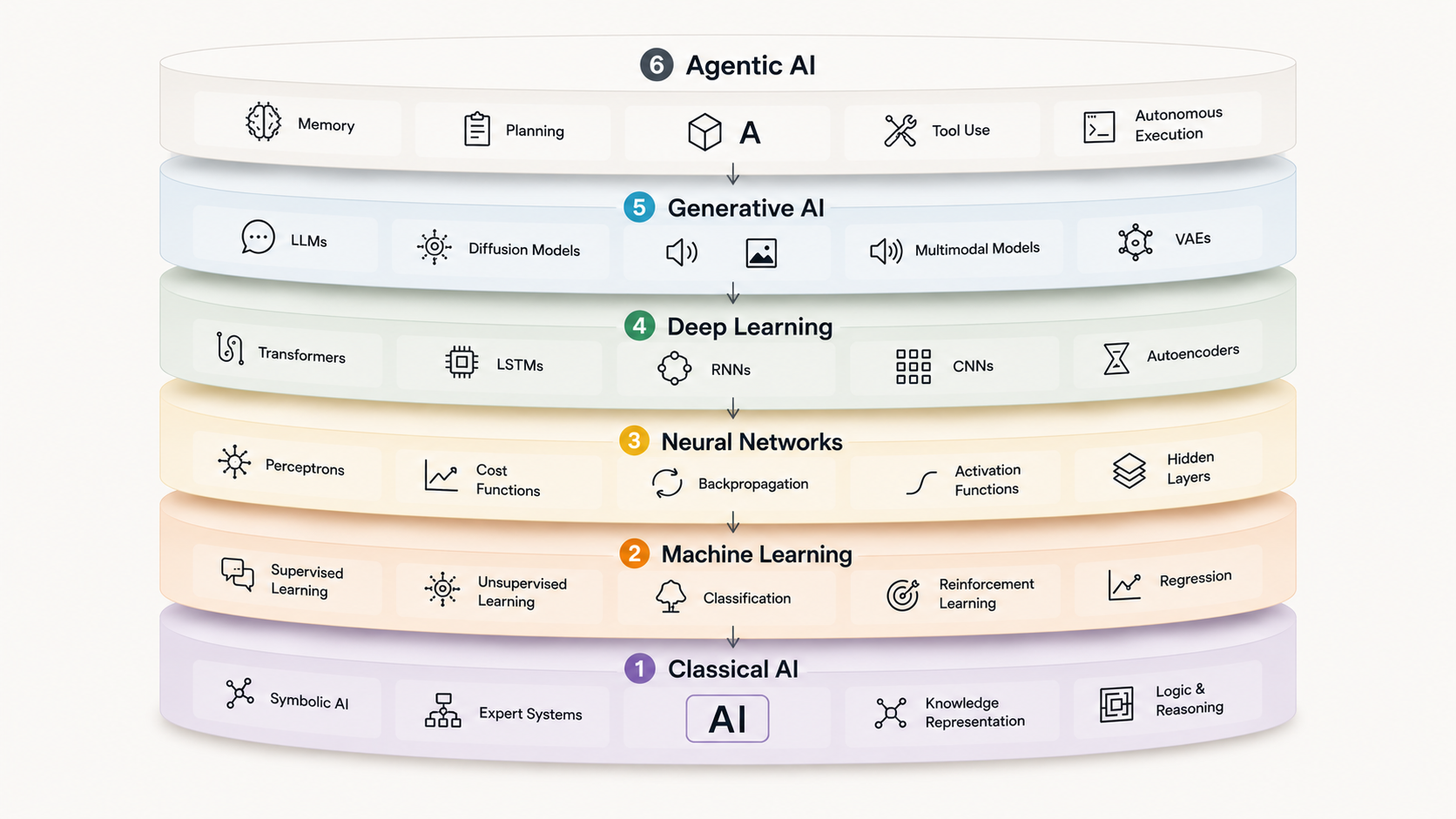
AI isn’t a single breakthrough. It’s a stack.
Most people encounter the top layer and assume that’s the system. In reality, it’s just the interface. What sits underneath is decades of iteration, each layer compensating for the limits of the one before it.
Here’s the stack, bottom to top:
1. Classical AI
We began with certainty: rules, logic, explicit instruction. Systems worked as long as the world behaved predictably, which it rarely does.
2. Machine Learning
We shifted from telling systems what to do to letting them infer patterns from data. Prediction replaced instruction. Accuracy improved, but understanding remained implicit and often opaque.
3. Neural Networks
As data grew more chaotic, systems needed ways to model relationships that rigid logic could not capture. Layered networks made ambiguity tractable, though at the cost of explainability.
4. Deep Learning
Scale changed the equation. Larger models trained on massive datasets began producing capabilities that were difficult to predict in advance and difficult to fully trace after deployment. Performance improved faster than interpretability.
5. Generative AI
Systems began producing language, images, and code, outputs coherent enough to resemble reasoning. This is where most public conversations about AI begin, even though it sits near the top of the stack.
6. Agentic AI
Now systems act. They retain memory, plan, use tools, and execute tasks across steps. At this layer, the shift is no longer about generation. It is about delegated behavior.
Understanding the stack changes the decision you’re actually making.
You’re not evaluating a tool in isolation. You’re deciding where a system is allowed to act without direct oversight, and how much uncertainty you’re willing to absorb as a result.
Most conversations stay focused on what the system says.
The more important question is what happens when the stack begins acting on its own.

Subscribe to Amid the Noise
Amid the Noise is an ongoing body of work on signal, systems, governance, AI, and the structures that shape human judgment under pressure.
Subscribe to receive new essays as they are published.